The grandson of Africanus
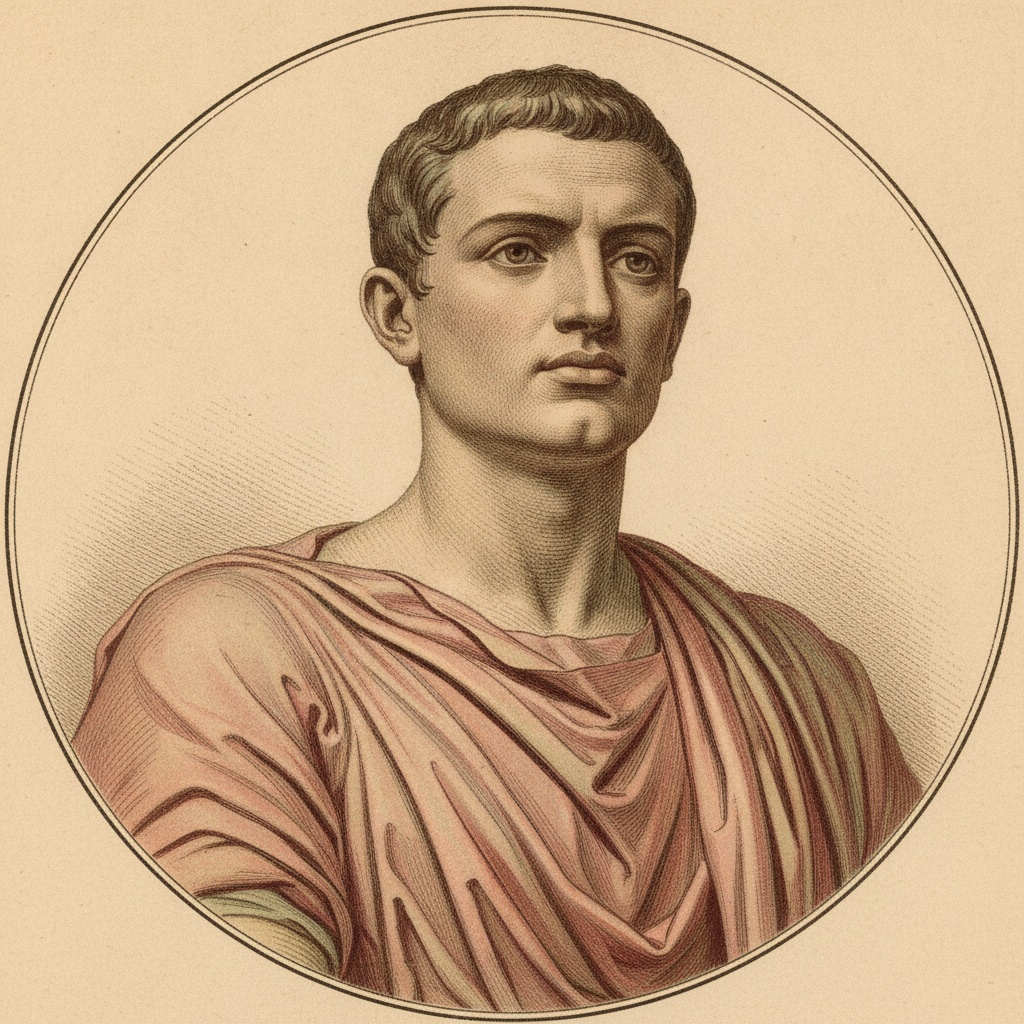
Tiberius Sempronius Gracchus could hardly have come from more inside the Roman establishment. His father, of the same name, was twice consul and once censor. He had governed Nearer Spain on terms the Spanish tribes still honoured a generation later. His mother, Cornelia, was the daughter of Scipio Africanus, who had beaten Hannibal. His sister married Scipio Aemilianus, who destroyed Carthage. Tiberius served under Aemilianus there as a young man. Plutarch, citing the historian Fannius, who says he climbed beside him, has Tiberius the first man onto the enemy wall.
So the man who opened Rome's century of civil war did not come from outside the governing class. He was one of its most promising sons, raised among Greek philosophers and Roman aristocrats who agreed that something had gone wrong in Italy. The question was who would dare to act on it.
A grievance probably helped. In 137 B.C., as quaestor with the consul Mancinus at Numantia in Spain, Tiberius negotiated the surrender that saved a trapped Roman army. The Senate repudiated the treaty and handed Mancinus over to the enemy, naked and bound. Modern historians have made this humiliation central: a young noble whose credit had been publicly destroyed by his peers, and who went looking for another route to standing. Others read the whole reform as the programme of a faction — the circle around Tiberius's father-in-law, Appius Claudius, set against the circle of Scipio Aemilianus. Plutarch knew the motive was disputed even in antiquity. Some blamed Tiberius's Greek teachers, some his mother's ambition, some his rivalry with another young orator. One story went back to his brother:
“when Tiberius went through Tuscany to Numantia, and found the country almost depopulated, there being hardly any free husbandmen or shepherds, but for the most part only barbarian, imported slaves, he then first conceived the course of policy which in the sequel proved so fatal to his family.”
Plutarch, Tiberius Gracchus — trans. J. Dryden, rev. A. H. Clough (public domain)
Gaius wrote that after his brother was dead, and it made the best possible case for him. It may still be true. The rest of this section is largely about whether it was.
What the conquests had done to the land
Every Roman war in Italy had ended with land taken from the defeated. Some of it was settled with colonies. Much of it stayed state property, the ager publicus, and was left open to anyone who would work it in return for a share of the crop. In practice that meant anyone with the capital to stock it. The land was loosely administered; occupation hardened into something like ownership simply because no one in Rome checked. Appian's account of what followed is the one every later history starts from:
“the rich, getting possession of the greater part of the undistributed lands, and being emboldened by the lapse of time to believe that they would never be dispossessed, absorbing any adjacent strips and their poor neighbours' allotments, partly by purchase under persuasion and partly by force, came to cultivate vast tracts instead of single estates, using slaves as labourers and herdsmen, lest free labourers should be drawn from agriculture into the army.”
Appian, Civil Wars 1.7 — trans. Horace White (Loeb, 1913; public domain)
The last clause is the key to the whole affair. A Roman legionary had to own property. The small farmer who lost his land lost his place in the ranks as well. An old law, which Appian and Plutarch both describe, had capped the public land any one man could hold at 500 iugera, about 125 hectares. Nobody enforced it. Meanwhile the slave war in Sicily, not yet over in 133, showed what an economy run on imported captives might cost.
The sources disagree here, and this is the biggest argument in the section. For most of the twentieth century, historians accepted Appian's picture and explained it: long service overseas took men off their farms for years, and many never came back to work them; war brought booty and captives, the rich put the booty into land and the captives to work on it, and the peasants they displaced went to Rome, to the colonies or into the army. Since the 1990s that picture has been attacked from two directions. The first is demographic — that Italy's free population was growing in the second century, not shrinking, so that the crisis of 133 was a shortage of land for too many heirs, not an empty countryside. The second is archaeological: field surveys across Italy keep finding small farm sites that survive right through the period when Appian says they vanished. An older voice belongs in this camp too — in 1914 Tenney Frank worked through the record of confiscations and concluded that most of the disputed public land had been taken during and after the war with Hannibal, not in the earlier conquest of Italy.
None of this makes Tiberius's alarm false. It was shared by a sitting consul, the leading jurist of the day and the head of the Senate. But it is worth saying plainly that “the free farmers of Italy had disappeared” is the ancient sources' claim; modern evidence has made it much less certain.
The law
Tiberius took up office as tribune of the plebs on 10 December 134 B.C. The tribunes were ten annual officers, first created to protect ordinary citizens from magistrates. By this date each of them could propose laws directly to the assembly of the tribes, and each could veto the acts of any other official — including a fellow tribune.
His bill was not radical in its terms. It revived the old 500-iugera limit, with an allowance for sons. Holders were confirmed in what they kept, and the surplus went back to the state. A standing commission of three men would survey it and hand it out in small plots that could not be sold — a clause meant to stop the rich simply buying the poor out again. Plutarch names the men who helped draft it: the jurist Mucius Scaevola, consul that year; Crassus Mucianus; and Appius Claudius, princeps senatus. Plutarch himself was impressed:
“Never did any law appear more moderate and gentle, especially being enacted against such great oppression and avarice.”
Plutarch, Tiberius Gracchus — trans. Dryden, rev. Clough
Appian names the purpose in a few words. It was a law about the army, not about charity:
“What Gracchus had in his mind in proposing the measure was not money, but men.”
Appian, Civil Wars 1.11 — trans. White
One group is missing from both ancient accounts until the aftermath: the Italian allies. Much of the “Roman” public land was worked by Latin and Italian communities under old arrangements, and the commission's surveys are likely to have fallen hardest on them. If so, the land law began the chain of grievance that ended in the Social War forty years later.
The veto
The holders of public land could not beat the bill in the assembly, so they used the constitution against it. Another tribune, Marcus Octavius, a friend of Tiberius, was persuaded to veto it. He was within his rights. Tiberius escalated one lawful step at a time. He offered to pay Octavius, who held more than the limit himself, for his surplus out of his own pocket. He suspended public business and sealed the treasury. When the voting urns were carried off by force, he agreed to refer the dispute to the Senate, where the landholders sat. The Senate did nothing.
At this point everyone agrees that something broke. Plutarch, who admired Tiberius, still says he was then:
“driven to a course neither legal nor fair, and proposed to deprive Octavius of his tribuneship.”
Plutarch, Tiberius Gracchus — trans. Dryden, rev. Clough
The vote is told almost identically by Appian and Plutarch, which suggests a common source that both trusted. Seventeen of the thirty-five tribes voted to remove Octavius. Tiberius stopped the count and begged him once more, publicly, to give way. Octavius refused. The eighteenth tribe made a majority, and he was dragged from the rostra. The law passed. The three commissioners were Tiberius, his brother Gaius and Appius Claudius. It was a family firm, and the Senate noticed.
How to read that vote is the second great argument, and it is really an argument about what the Roman Republic was. One school takes the assemblies seriously as sovereign: Tiberius was invoking a real popular power the constitution had always contained. Another replies that the voting enclosure could hold only a small fraction of a citizen body counted at over 300,000 men — “the people” who deposed Octavius were whoever could be brought into Rome that week. Nobody in 133, Tiberius included, had a different constitution in mind. Both sides were using the old one against each other.
Pergamum's gold, and a question with no answer
Then fortune dropped a kingdom into the dispute. In 133 Attalus III of Pergamum died and left his realm to the Roman people. Tiberius proposed that the royal treasure be used to stock the new farms, and that the people, not the Senate, decide what to do with the cities of the kingdom. Both finance and foreign affairs belonged to the Senate by custom rather than by law. Now a tribune was proposing to take both.
The response was to call him a would-be king. Plutarch reports that a senator claimed to have seen the Pergamene envoy hand Tiberius a diadem and a purple robe. Then Titus Annius put a single question in public. Suppose Annius appealed to a tribune against Tiberius, and that tribune stepped in —
“would you for that reason fall into a passion, and depose him?”
Plutarch, Tiberius Gracchus — trans. Dryden, rev. Clough
Plutarch says Tiberius had no answer. The veto was the ordinary citizen's shield; Tiberius had shown that a majority could take it away. His defence, as Plutarch gives it, was a real argument: the tribune is sacred because he serves the people, and when he turns against them he forfeits the sanctity —
“He who assails the power of the people, is no longer a tribune at all.”
Plutarch, Tiberius Gracchus — trans. Dryden, rev. Clough
Cicero, two generations later, could not settle the matter either. When he spoke to the people, he praised the Gracchi. In his treatises for fellow senators, he repeated that Tiberius had aimed at kingship.
A second year, and the Capitol
His enemies said openly that he would be prosecuted the day his term ended. Tiberius stood for a second consecutive tribunate to keep his immunity. Appian records the objection that “it was not lawful for the same man to hold the office twice in succession.” Custom was against it, and the law was at least unclear. His farmers were in the fields at harvest, and he had to rely on the city crowd.
The election assembly met on the Capitol in the summer of 133. The first tribes voted for Tiberius. The opposition objected, and the day ended in confusion. Plutarch surrounds the next morning with bad omens — the details that gather around a death once it has happened, and that show how the story was told afterwards. At the Capitol a friendly senator pushed through to warn Tiberius that the Senate's hardliners had armed their slaves and clients. The crowd was too loud for him to be heard, so Tiberius touched his head to show that his life was in danger. His opponents took the gesture to the Senate as a request for a crown.
The consul, Scaevola, refused to kill a citizen without trial. Scipio Nasica, who held more public land than most, did not share his scruples:
“Let those who would save our country follow me.”
Appian, Civil Wars 1.16 — trans. White
Nasica pulled the edge of his toga over his head, and Appian cannot say why. He offers three explanations, the last “in order to conceal himself from the gods on account of what he was about to do.” The senators and their men carried clubs and broke up the benches for more. Tiberius ran, lost his toga to a hand that caught it, and fell. Plutarch gives the toll:
“And of the rest there fell above three hundred, killed by clubs and staves only, none by an iron weapon.”
Plutarch, Tiberius Gracchus — trans. Dryden, rev. Clough
Gaius asked for his brother's body to bury it. He was refused. The dead were thrown into the Tiber.
Verdicts
Appian passed the verdict that has lasted best. Tiberius, he wrote, “lost his life in consequence of a most excellent design too violently pursued.” Velleius Paterculus, writing under the emperor Tiberius, gives a hostile senatorial version in which Tiberius threw everything into confusion and Nasica saved the state. The nineteenth century settled on a version of Appian: Mommsen admired the aim but said Tiberius chose revolution to reach it, and that is still the frame of most textbooks.
The modern arguments leave three live positions, and this edition means to show all three rather than pick one:
- The crisis was real and the reform was right. On this view the Senate's violence is the story — a lawful, moderate bill met with a lynching.
- The crisis is partly a literary creation. The later sources projected the politics of the Gracchan quarrel back onto the countryside; what broke in 133 was aristocratic consensus, not rural Italy. This draws on the demographic and survey work of recent decades.
- 133 was a break, but not yet the end. On this reading there was no single “Roman Republic” but a sequence of them, and the decisive rupture was Sulla's march on Rome in 88, not the murder of Tiberius. Appian's date is a choice of narrative, not a fact.
What changed is not in dispute. The land commission went on working, and its boundary stones survive in southern Italy. The census recorded about 318,000 citizens in 131 B.C. and about 395,000 in 125 — a jump many have read as the commission creating new property owners, and others as a by-product of how the census was taken. The reform, in other words, outlived the reformer. What did not survive was the rule that Roman politics stopped short of killing. Appian, who wrote the whole century as one continuous civil war, dates its beginning to this day:
“The sword was never carried into the assembly, and there was no civil butchery until Tiberius Gracchus, while serving as a tribune and bringing forward new laws, was the first to fall a victim to internal commotion.”
Appian, Civil Wars 1.2 — trans. White
Rome had conquered the Mediterranean with citizen armies. In 133 the Republic found it could neither reform the system that produced those armies nor settle the argument peacefully. Whether it was ever as broken as its critics said is the question the rest of the chapter has to keep open.