From the ashes the Gauls left behind to the defeat of a Greek king who had beaten Rome twice and still lost the war — a century in which citizen armies, unglamorous roads, and a patient system of unequal alliances did more than any single battle to make Rome master of Italy.
390 – 275 B.C. · The Roman Republic · Latium, Samnium, Etruria, Campania & Magna Graecia
Drawn from The Cambridge Ancient History, 2nd ed., Vol. VII Part 2 — The Rise of Rome to 220 B.C.
✦ ❧ ✦
Scroll to begin ↓
I390 – 386 B.C. · A city that chose to rebuild where it stood
After the SackRome refuses to move
The Gauls took their gold and left, and Rome was a burned shell with her law-tables melted in the ash. Later writers said some in the Senate argued for abandoning the ruins altogether and moving the whole community twelve miles north to the captured Etruscan town of Veii, already fitted out with houses and walls that still stood. The proposal did not carry. Rome rebuilt on the same seven hills, in haste and without a plan — later Romans blamed the sack for the city's famously crooked streets — but she rebuilt as herself, not as a refugee population resettled somewhere safer.
The decision mattered because everything Rome did in the following century depended on staying exactly where she was: at the point where the routes north from Campania met the crossing of the Tiber, ringed by peoples who now believed her weak. Etruscan cities to the north, the Aequi and Volsci in the hill country to the south-east, and Rome's own Latin kin to the south all had reason to test a state that had just been humiliated by an unfamiliar enemy from beyond the Alps. That every one of these neighbors eventually ended up conquered, allied, or absorbed rather than triumphant is the subject of this chapter.
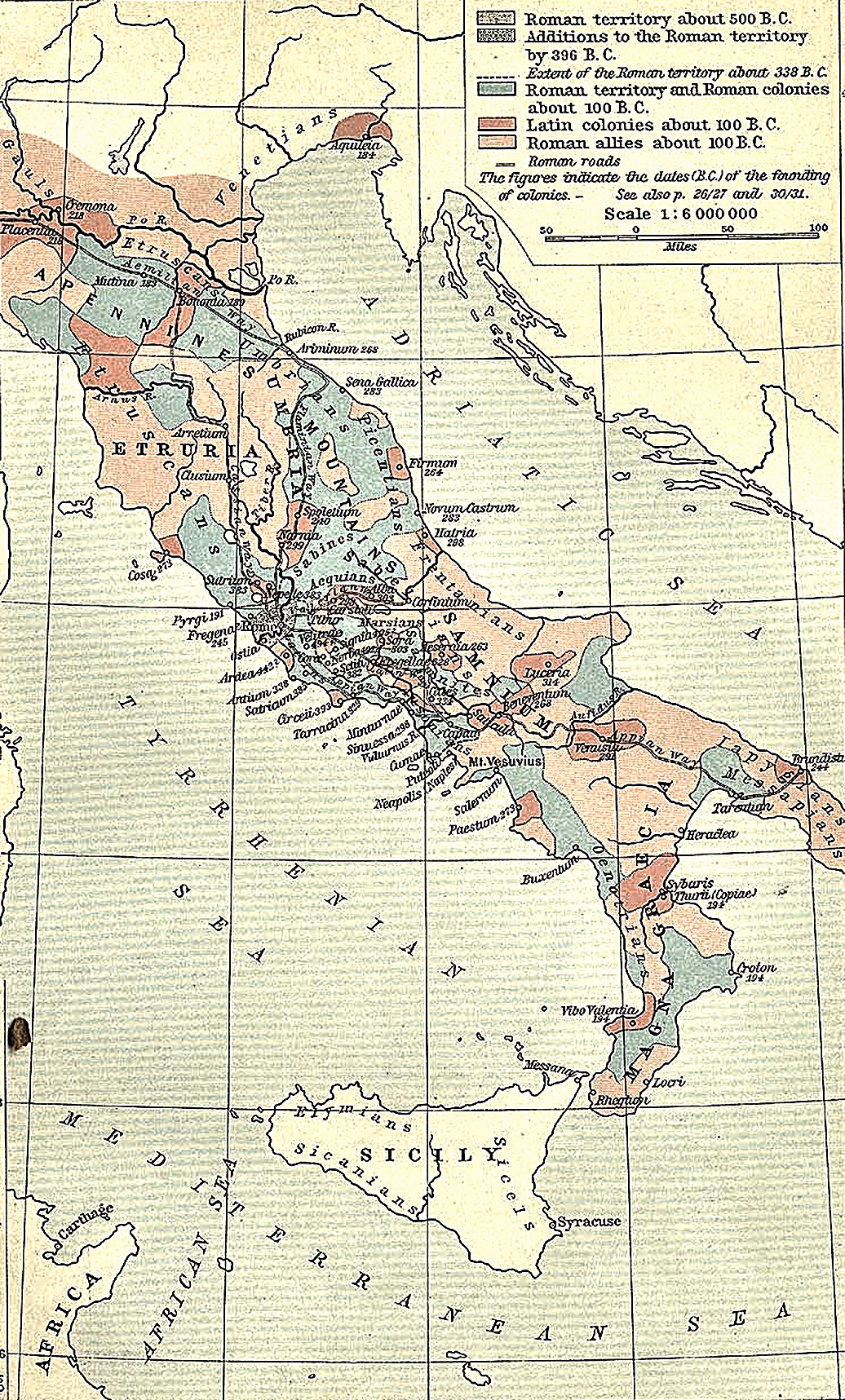
Map · Growth of Roman power in ItalyClick to enlarge
The whole chapter on one sheet. This map layers three centuries of expansion: the small patch of Roman territory in 500 B.C., what the recovery after the Gallic sack had added by 396 B.C., the far larger area under Roman control by 338 B.C. at the end of the Latin War, and the network of colonies and roads — Luceria, Beneventum, Venusia, the Via Appia toward Tarentum — through which Rome held Samnium and the south after this chapter's wars were won.
After Shepherd, Historical Atlas (1911), “Growth of Roman Power in Italy.”
II386 – 367 B.C. · A wall, a dictator, and an old grievance revived
Camillus RebuildsRecovery answers an unfinished argument at home
Tradition credited the recovery to Marcus Furius Camillus, already a famous general before the sack and recalled afterward, by Rome's own later telling, to drive the Gauls out and refuse the ransom gold already on the scales. Whatever really happened at the moment of the Gauls' departure — even ancient writers treated the rescue as suspiciously well-timed to save Roman pride — the practical work that followed was real: a new circuit of stone fortification, the Servian Wall, went up around the city in the decades after 390 B.C., built broad and high enough that no army would take Rome by direct assault again for eight hundred years.
Recovery did not mean the end of internal conflict; it revived it. The plebeian secession that had produced the Twelve Tables a century earlier had settled the question of written law without settling the question of power. Through the 380s and 370s B.C., tribunes pressed again for what the wealthy patrician families still refused: relief from crushing war debt, a fairer distribution of newly conquered public land, and above all the right of a plebeian to be elected consul, the Republic's highest office. Camillus himself, five times dictator by later reckoning, spent much of his last public career resisting exactly this.
The deadlock broke in 367 B.C. with the Licinio-Sextian laws, named for the two tribunes who forced them through after years of blocking all other elections until the Senate gave way: they capped how much public land any one citizen could hold, eased debt, and — the change with the longest consequences — opened the consulship itself to plebeians. A plebeian noble class began to form alongside the old patrician one, competing for the same offices under the same rules rather than contesting the rules themselves. It is this newly stabilized, more broadly based citizen body that the Republic would spend the next century sending out, year after year, to fight the wars that follow.
III340 – 338 B.C. · Rome's oldest allies become her first subjects
The Latin WarAn alliance breaks, and Rome invents a new kind of settlement
Rome's closest kin were the other Latin-speaking towns of Latium, bound to her for generations by a treaty of mutual defense and intermarriage, the Latin League. By the 340s B.C. that partnership had become an irritant to its junior partners: Rome's wars against the Samnite hill peoples to the south-east dragged the League into fighting for Roman objectives, while the Latins themselves had no vote in deciding on them. When several Latin towns rose in 340 B.C. demanding full political union with Rome — one Latin consul and one Latin-majority Senate, an equal partnership rather than a subordinate one — Rome answered with war rather than union, and won it within two years.
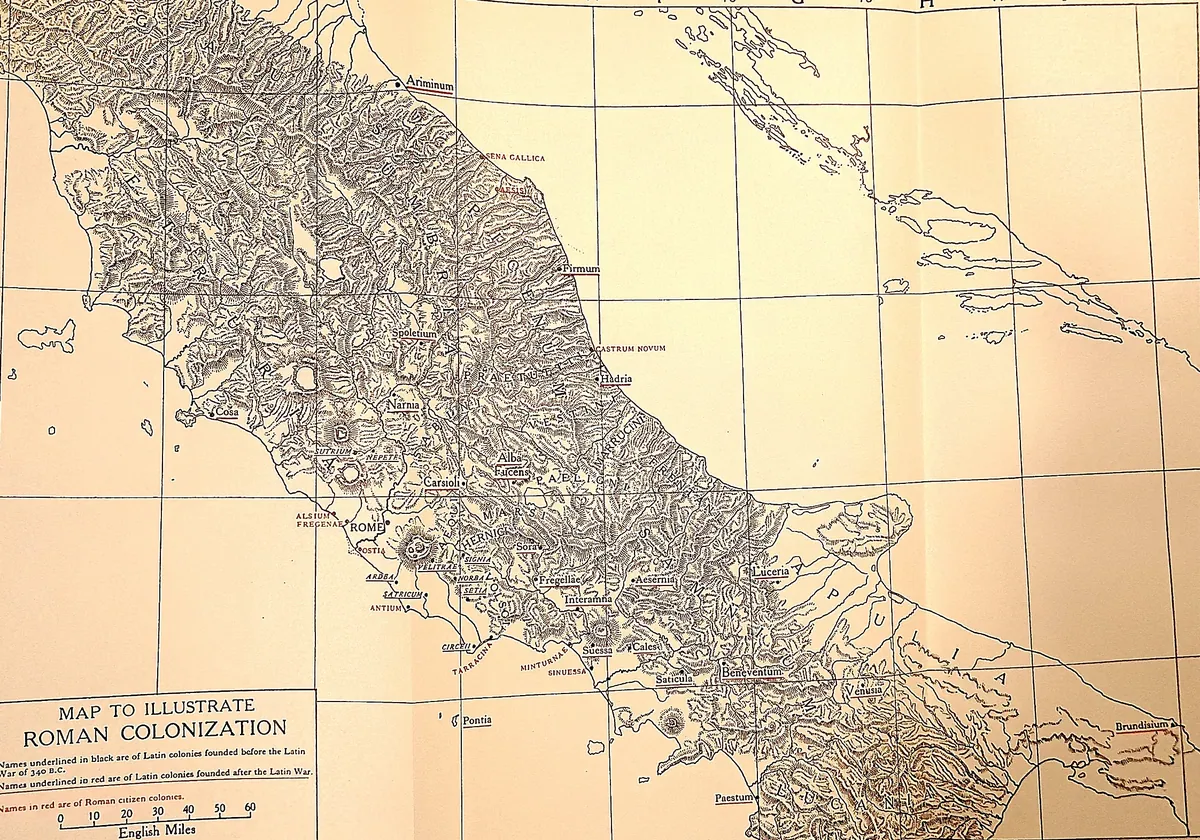
Plate · Colonies, before and after 340 B.C.Click to enlarge
The settlement, drawn. The plate separates the Latin colonies founded before the Latin War from those planted after it, and marks the citizen colonies in a third hand. Read together they are the map of the instrument Rome invented in 338 B.C.: not a conquered province, but a graded ladder of statuses fastened down by roads and garrison towns.
The Cambridge Ancient History (1st ed., Cambridge University Press), map plate “Map to Illustrate Roman Colonization” — photographed from the fold-out sheet and cleaned.
What Rome did with the victory mattered more than the victory itself. Rather than annexing Latium outright or exterminating the defeated towns, the Senate broke the old League into a deliberately uneven patchwork of individual relationships with Rome: some communities received full Roman citizenship outright; others received citizenship without the vote, obliged to Rome's laws and army but not its politics; others kept local self-government as formally allied states, bound by one-sided treaties that fixed their military obligations to Rome without any reciprocal Roman obligation to them. No two Latin towns now shared quite the same relationship to Rome, and — this was the calculated point — no combination of them could easily unite against her again.
IV343 – 321 B.C. · A mountain people Rome could not simply outnumber
The Caudine ForksRome's worst defeat between the Gauls and Hannibal
The Samnites were a confederation of hardy upland communities in the central Apennines, organized in a loose league rather than a single state, without Rome's dense city infrastructure but with excellent light infantry and a country of narrow passes that favored the defender. Rome and the Samnites fought three long, separated wars between 343 and 290 B.C. over who would control the fertile lowlands of Campania where their spheres of interest met — a struggle less like the quick campaigns against the Latins and more like a slow, repeatedly interrupted contest for the whole of central and southern Italy.
The low point came in 321 B.C., during the Second Samnite War. A Roman consular army, marching by a narrow mountain route to relieve an allied town, was lured into the Caudine Forks — a valley enclosed by steep wooded ridges with only two exits, both of which the Samnite commander Gaius Pontius had already blocked. Trapped without room to fight and without supplies to wait, the consuls surrendered the entire army. The Samnites did not massacre their captives; they humiliated them instead, forcing the disarmed legions to pass one by one under a "yoke" of spears — a formal ritual of submission — while the victors watched. The army that limped back to Rome, stripped of its weapons and its standing, marched in a silence later writers found more eloquent than any lament.
Rome's response was not to make peace on the terms extracted at Caudium. The Senate repudiated the treaty its own consuls had sworn — on the argument that men under duress could not bind the state — and handed the officers responsible back to the Samnites as the price of Rome's release from the oath, then resumed the war. It is a pattern that recurs throughout this chapter and the next: a Roman defeat, however severe, changed Roman tactics far more often than it changed Roman aims.
Vc. 340 – 300 B.C. · An army rebuilt for broken ground
The Manipular LegionRome trades the phalanx for flexibility
Somewhere across the Latin and early Samnite Wars — ancient writers disagree on exactly when and credit no single reformer — the Roman army abandoned the rigid Greek-style hoplite phalanx it had used since the early Republic and adopted a more flexible formation built around small, semi-independent units called maniples, each of about 120 men. Arranged in three staggered lines by experience — young hastati in front, seasoned principes behind them, veteran triarii held in reserve — a legion fighting this way could hold together on the broken, hilly ground of Samnium where a single unbroken phalanx line would simply crack apart.
The reform was inseparable from who filled the ranks. Roman and allied citizen-soldiers were not a standing professional force but landowners called up annually, arming themselves according to a property-based census: the wealthiest as fully equipped infantry or cavalry, the poorest contributing only light-armed skirmishers or, later, none at all. This meant Rome's military capacity scaled directly with how many free landholding citizens and obligated allies she could count — which is exactly why the citizenship ladder built after the Latin War mattered militarily as much as politically. Every Latin or Campanian community drawn one rung up that ladder became, in wartime, more legionaries.
Livy and other Roman writers looked back on the manipular legion as the instrument that finally matched Roman numbers to Samnite terrain, and modern historians broadly agree that some such tactical shift happened in this period, even if the neat single-moment "reform" of the ancient tradition simplifies a more gradual adaptation. What is not in dispute is the result: an army that could lose badly, as at the Caudine Forks, and still come back within a single generation stronger than before.
VI312 B.C. · Roads, water, and an old order challenged from within
Appius ClaudiusPublic works as a weapon and an argument
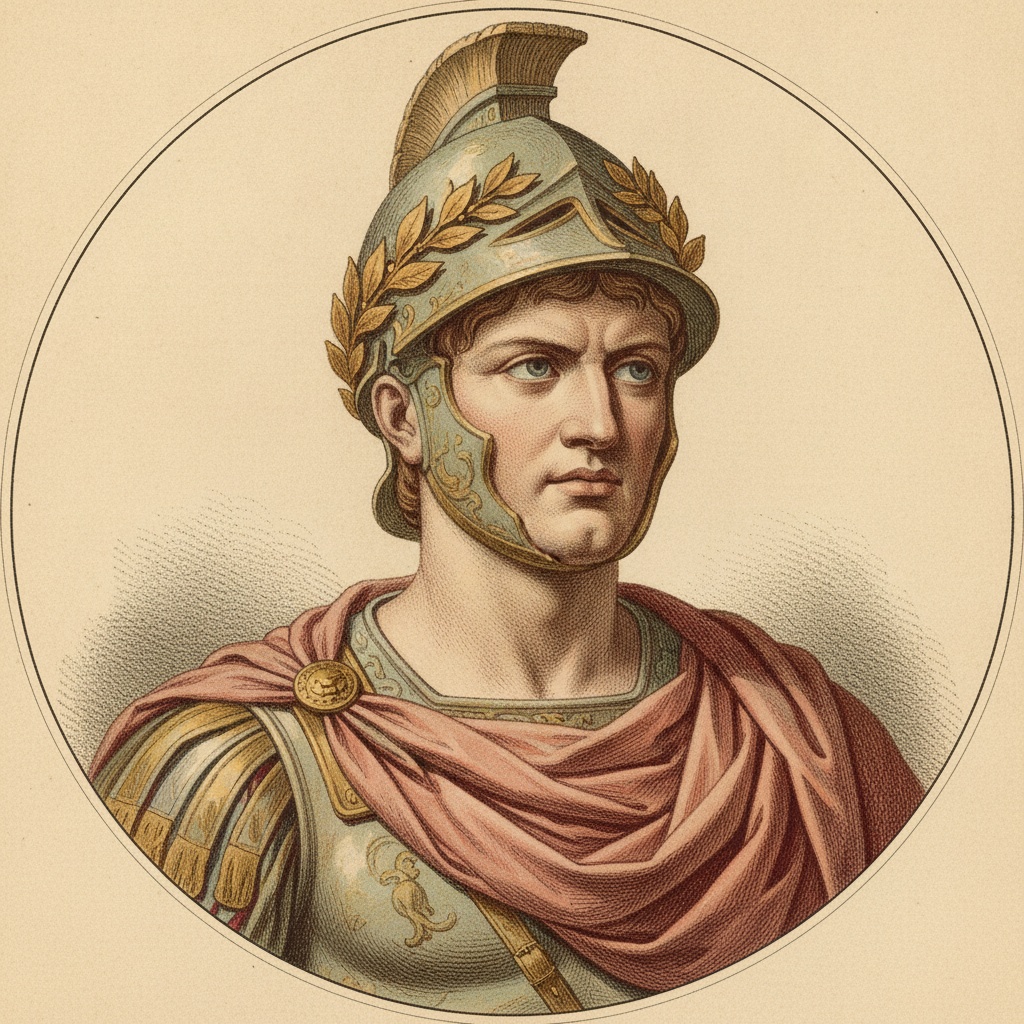
Ap. Claudius CaecusCensor, 312 B.C.No ancient likeness survives
Appius Claudius Caecus — "the Blind," though ancient sources disagree on whether he lost his sight early or only in old age — held the censorship in 312 B.C. and used it to reshape Rome in ways that outlasted every battle fought in this chapter. He began construction of the Via Appia, Rome's first great paved military road, driven south-east from Rome toward Capua and eventually Beneventum along a route engineered with a straightness that startled later travelers; he also began Rome's first aqueduct, the Aqua Appia, bringing water into the growing city by underground channel. Both projects served the war against the Samnites directly — a road moved legions and supplies faster than any army had moved before — and both served Rome for centuries after the war that funded them was forgotten.
Appius Claudius was as disruptive in the Senate as in engineering. He is credited with admitting the sons of freedmen to the Senate and distributing landless citizens across the voting tribes in a way that increased their political weight, provoking fierce resistance from the established nobility before much of it was later rolled back. Roman tradition also preserved him, decades on, as an old blind man carried into the Senate to make the speech that stopped Rome from accepting Pyrrhus's peace terms — a story that belongs later in this chapter, but that Romans remembered as of a piece with the man who had already shown he would spend Roman resources on infrastructure the aristocracy had never bothered to build.
VII298 – 290 B.C. · A coalition Rome had to beat all at once
SentinumThe Samnites' last, largest throw
By the Third Samnite War the stakes had grown far beyond Samnium itself. Facing a Rome now strong enough to threaten their independence outright, the Samnites assembled the broadest anti-Roman coalition Italy had yet seen — allying with Etruscans, Umbrians, and Gauls from the north in a deliberate attempt to force Rome to fight on several fronts simultaneously. The combined armies met a Roman force at Sentinum in 295 B.C., in what ancient and modern historians alike treat as the decisive battle of the whole Samnite conflict: had the coalition won, the piecemeal Roman conquest of central Italy might have unraveled at a stroke.
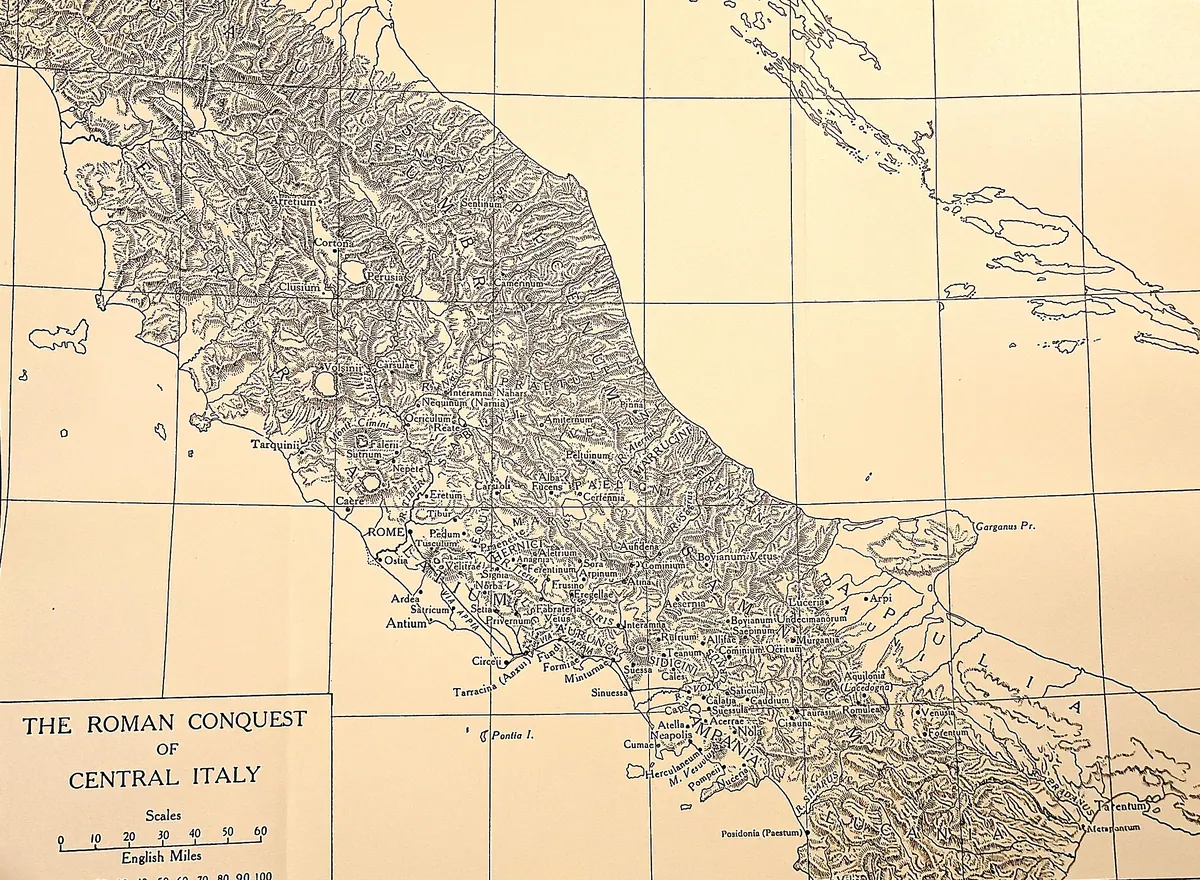
Plate · The conquest of central ItalyClick to enlarge
Fifty years of war on one sheet. Etruria at the top, the Samnite highlands through the middle, Campania and Apulia at the foot: the whole theatre of the Samnite wars, with the Caudine Forks, Luceria, Sentinum and the colonies that pinned each gain in place.
The Cambridge Ancient History (1st ed., Cambridge University Press), map plate “The Roman Conquest of Central Italy” — photographed from the fold-out sheet and cleaned.
It did not win. Roman command split its consular armies to face the different national contingents separately rather than let the coalition fight as one body, and after heavy losses on both sides broke the Samnite and Gallic center. One of the consuls, Publius Decius Mus, was said to have ritually dedicated his own life to the gods of the underworld in exchange for a Roman victory and then ridden deliberately into the enemy line to die — a story from the same family that told an identical tale of an earlier Decius at an earlier battle, which should make a reader treat the repetition itself as a sign of legend rather than plain reportage, even where the battle it decorates is real.
Samnite resistance continued in diminishing form for another five years, but Sentinum had broken the possibility of a combined Italian front against Rome. When the Third Samnite War finally ended in 290 B.C., Samnium itself was absorbed into Rome's alliance system on the same graduated, unequal terms already used on the Latins — allied, obligated, disarmed of independent foreign policy, but not annexed outright or depopulated. Rome now controlled, directly or through alliance, virtually the whole of central Italy from the Tiber to the Adriatic and south toward the Greek cities of the coast.
VIII282 – 279 B.C. · A Hellenistic king answers a Greek city's call
Pyrrhus LandsItaly's Greek cities look east for a champion
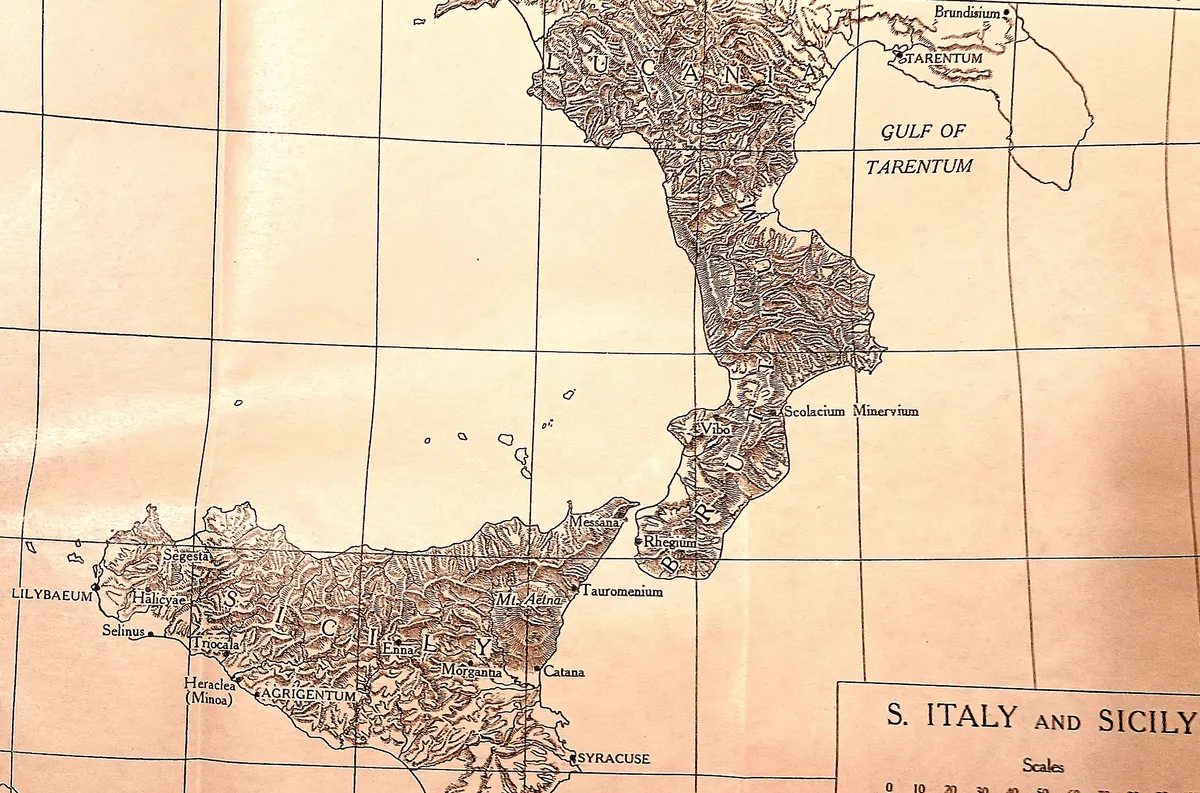
Rome's expansion south finally brought her into conflict with Tarentum, the wealthiest and most powerful of the Greek cities of southern Italy, over a naval treaty Tarentum accused Rome of violating. Rather than fight Rome alone, Tarentum did what several Greek cities under pressure from Italian neighbors had done before: it invited a professional Hellenistic king to fight on its behalf. Pyrrhus, king of Epirus in north-western Greece and a cousin of Alexander the Great by marriage, was among the most admired soldiers of his generation, restless for a Western kingdom to match his ambitions and glad of the pretext.
Plate · Magna Graecia and SicilyClick to enlarge
The Greek south, in relief. Tarentum at the top of the gulf, the mountain spine running down to Rhegium, and across the strait the Sicily of Syracuse and Agrigentum. Pyrrhus’ war ran the length of this plate and then crossed it; the Romans who followed him would cross it again in 264 B.C.
The Cambridge Ancient History (1st ed., Cambridge University Press), map plate “S. Italy and Sicily” — photographed from the fold-out sheet and cleaned.
He landed in Italy in 280 B.C. with a Hellenistic-style army entirely unlike anything Rome had fought before: a pike phalanx, Thessalian cavalry, and — decisively, in the first engagements — war elephants, animals no Roman soldier had ever seen used in battle. At Heraclea in 280 B.C. and again at Asculum in 279 B.C., Pyrrhus's professionals beat the Roman legions in the field. But both victories cost him irreplaceable officers and veterans he had no way to replace so far from home, while Rome's allied system kept feeding fresh legions into the war exactly as it was designed to.
"It is said, Pyrrhus replied to one that gave him joy of his victory that one other such would utterly undo him. For he had lost a great part of the forces he brought with him, and almost all his particular friends and principal commanders."
Plutarch, Life of Pyrrhus — trans. J. Dryden, rev. A. H. Clough (public domain)
The remark is the origin of the phrase "Pyrrhic victory," and later writers may have sharpened its wording for effect — but the arithmetic behind it was real. A mercenary and allied army fighting far from its own recruiting grounds could not sustain the casualty rate that a citizen-and-allied system rooted in the very soil being fought over could absorb and replace.
Early Republic · The Struggle for Italy
Pyrrhus: The Restless Warlord, 280–275 B.C.
Scroll to follow the campaigns of King Pyrrhus of Epirus from Tarentum and Heraclea to Asculum, Sicily, and the final standoff at Beneventum.
280 B.C.
The Cry from Tarentum & The Hellenistic Champion
Rome’s expansion south brings her into collision with Tarentum, the richest Greek metropolis of Magna Graecia. Threatened by Roman legions, the Tarentines invoke the old Greek custom of hiring an overseas royal protector. They send envoys across the Ionian Sea to Pyrrhus, King of Epirus — cousin to Alexander the Great, seasoned veteran of the Successor wars, and widely regarded as the most gifted tactical general alive. Resting on his capital at Ambracia, Pyrrhus dreams of founding a western Mediterranean empire to rival Alexander’s in the east.
280 B.C.
The Shock of Elephants at Heraclea
Pyrrhus crosses the Ionian Sea with an armada carrying 20,000 veteran phalangites, 3,000 Thessalian cavalry, and twenty armored war elephants — beasts no Roman soldier has ever seen in combat. Consular commander Publius Valerius Laevinus meets Pyrrhus on the banks of the Siris near Heraclea. The Macedonian pike phalanx clashes head-on with Roman maniples across seven furious assaults. When Pyrrhus unleashes his elephant corps, the terrified Roman cavalry horses bolt, trampling their own infantry lines. Seven thousand legionaries fall; Pyrrhus loses 4,000 elite veterans, but gains the alliance of the Lucanians, Bruttians, and Greeks.
280 B.C.
The March on Rome & The Blind Statesman
Exploiting his victory, Pyrrhus executes a lightning advance up the Latin Way, bypassing fortified Roman colonies and reaching Praeneste — just twenty-five miles from the walls of Rome. Hoping to divide the Republic, he dispatches his silver-tongued diplomat Cineas with gifts and generous peace terms. The Senate wavers until the aged, blind statesman Appius Claudius Caecus is carried into the Curia, thundering that Rome never negotiates while an invader stands on Italian soil. Rebuffed by Roman tenacity and finding Rome’s Latin allies refusing to defect, Pyrrhus withdraws south to winter in Capua.
279 B.C.
Asculum: The Pyrrhic Victory
In the spring of 279 B.C., both sides field forty thousand men on the wooded, uneven terrain of Asculum in Apulia. The Romans deploy specialized anti-elephant ox-wagons armed with scythes and fire-pots, fighting Pyrrhus to a standstill on day one. On the second day, Pyrrhus maneuvers the legions onto flat ground where his phalanx and elephants deliver a crushing charge. Rome loses 6,000 men, but Pyrrhus loses over 3,500 irreplaceable officers and veteran comrades. When congratulated on his victory, Pyrrhus famously replies: “One more such victory over the Romans, and we are utterly undone.”
278 B.C.
The Sicilian Diversion: Sweeping Carthage
Unable to break Roman resolve and receiving urgent appeals from Syracuse, Pyrrhus leaves garrisons in Tarentum and sails for Sicily to champion the Greeks against Carthage. He sweeps the island in a whirlwind campaign: Panormus falls, and at Eryx Pyrrhus is first over the ramparts. The Carthaginians are driven back to their solitary fortress at Lilybaeum. But when Lilybaeum withstands his siege and Pyrrhus demands ruthless conscription and taxes to build an invasion fleet for Africa, his Sicilian allies turn against him, defecting to Carthage and forcing his evacuation.
275 B.C.
Beneventum & Rome Masters Italy
Returning to Italy through a Carthaginian naval ambush, Pyrrhus plunders the temple treasury of Persephone at Locri to pay his mutinous troops. At Beneventum (then Maleventum), consul Manius Curius Dentatus exploits dense woodlands and rains flaming javelins upon the Epirote elephants, turning the panicked beasts back through Pyrrhus’s own phalanx. Exhausted and without reinforcements, Pyrrhus sails home to Epirus, remarking: “What a wrestling ground we leave behind for Carthage and Rome!” In 272 B.C., Tarentum falls to Roman siege. Rome is now undisputed mistress of peninsular Italy.
Sites: Pleiades. Land, lakes and rivers: Natural Earth (public domain). Routes are schematic — reconstructed after Plutarch, Life of Pyrrhus, and the Cambridge Ancient History (Vol. VII, Part 2). Realm boundaries are labels only.
Rome's Italy, year by year
Rome takes Italy, 509–264 B.C.
From a city-state on the lower Tiber to the head of an Italian confederacy, south of the Arno and the Rubicon.
509 B.C.
A city on the Tiber
By the traditional date the last king, Tarquin the Proud, is driven out and two consuls are elected each year. Rome's land runs a few miles from the Tiber, perhaps 800 square kilometres. Around it lie the Latin towns, the Etruscan cities and the hill peoples, Sabines, Aequi and Volsci. A treaty with Carthage, which Polybius read on bronze, already names the Latin coast as Rome's.
493 B.C.
The Latin treaty
The Latins fight Rome at Lake Regillus, in 496 by Livy's reckoning, and lose. In 493 Spurius Cassius makes a treaty with them: peace, a joint army, and an equal share of the spoils. A like treaty with the Hernici follows in 486. For a century the allies hold off the Aequi and Volsci, who press down from the hills on Latium.
396 B.C.
Veii
Veii, the great Etruscan city a dozen miles north of Rome, falls to Marcus Furius Camillus after a siege the tradition makes last ten years, like Troy's. Its land is annexed and shared among Roman citizens, and Rome's territory nearly doubles. During the siege the soldiers are paid for the first time, a sign of campaigns that now keep men from their farms through the year.
390 B.C.
The Gauls
A Gallic war band from the Po valley routs the Roman army at the river Allia and sacks the city; only the Capitol holds, and the Gauls leave with gold. Polybius dates the sack to 387, the later Roman reckoning to 390. Rome recovers quickly: it builds a wall of stone, plants Latin colonies at Sutrium, Nepet, Satricum and Setia, and fights the Volsci for their plain.
338 B.C.
The Latin War
Called in by Capua against the Samnites in 343, Rome finds its Latin allies in arms behind it. It wins the Latin War (340–338) and dissolves their league. Some towns become Roman, while Tibur and Praeneste stay allies, each bound to Rome alone. Capua and the Campanian towns receive citizenship without the vote. The beaks of Antium's warships are set up on the speakers' platform in the Forum.
304 B.C.
The Samnite wars
The Samnites, a league of highland peoples, contest Campania and the south. In 321 they trap a consular army in the Caudine Forks and send it under the yoke. Rome answers with roads and colonies: Luceria in Apulia (314), the Via Appia to Capua (312), Alba Fucens among the Aequi (303). Peace comes in 304; the Aequi are crushed, and the Marsi, Paeligni and their neighbours make treaties.
290 B.C.
Sentinum
In 295 Samnites and Gauls, allied with Etruscans and Umbrians, meet two consular armies at Sentinum, the largest battle yet fought in Italy; the consul Decius Mus, Livy says, devoted himself to death to win it. Samnium is beaten again at Aquilonia (293) and makes peace in 290. That year Manius Curius overruns the Sabines, who receive citizenship without the vote.
280 B.C.
Pyrrhus
Rome drives the Senones from the Adriatic coast (284–283) and plants Sena Gallica on their land; the Etruscan cities, beaten again, accept treaties. Then Tarentum calls in Pyrrhus, king of Epirus, with a professional army and elephants. He beats the Romans at Heraclea (280) and Ausculum (279), at a cost Plutarch made proverbial, and Samnites, Lucanians and Bruttians rise to join him.
264 B.C.
Master of Italy
Pyrrhus campaigns in Sicily, returns, is checked at Beneventum (275) and sails home. Tarentum surrenders in 272. Picenum is conquered (269–268) and Ariminum founded on the Adriatic; Volsinii in Etruria is stormed and destroyed in 264. Italy south of the Arno and the Rubicon is Rome's, as citizen land or as allies bound to send soldiers. That year the Mamertines of Messana appeal to Rome.
509 B.C.
Roman territoryAllies bound by treatyAt war with RomeAllies in arms against Romechanged this step
Territories are editorial outlines after Shepherd’s Historical Atlas (1911), plate 29, cut from the Ancient World Mapping Center’s c. 60 BC outline of Italy (ODbL); the borders between the peoples of Italy are approximate, and a people is coloured whole from the date its main towns came to terms. Coastlines and rivers: Natural Earth. Sites: Pleiades.
IX280 – 275 B.C. · Integrity as propaganda, and a war Rome refuses to end early
Master of ItalyFabricius, Beneventum, and what Rome had become
After Heraclea, Pyrrhus tried diplomacy, sending his advisor Cineas to Rome with gifts and a peace offer that would have let Rome keep most of what she held. The Senate wavered — until, Roman tradition held, the aged and now-blind Appius Claudius Caecus had himself carried into the chamber to deliver a speech arguing that Rome did not negotiate with a foreign army still standing on Italian soil. The Senate refused the terms. Whatever the speech's exact wording, later lost, the episode was long remembered as the moment Rome declared that her wars would end only on her ground, by her decision.
The war produced its own moral legend in the consul Gaius Fabricius Luscinus, sent to negotiate over prisoners. Pyrrhus is said to have tried bribery and even a staged elephant to unsettle him; Fabricius, unmoved by either, is credited with a line historians cannot verify but Romans loved to repeat regardless. More securely attested — Plutarch reports the letter itself — is the episode a year or two later, when Pyrrhus's own physician secretly offered the consuls poison to end the war by murder. Fabricius and his colleague refused the offer and warned Pyrrhus of the plot instead.
"Caius Fabricius and Quintus Aemilius, consuls of the Romans, to Pyrrhus the king, health. You seem to have made an ill judgement both of your friends and enemies; you will understand, by reading this letter, that you are at war with honest men, and trust villains and knaves."
The Roman consuls' letter to Pyrrhus, as reported by Plutarch, Life of Pyrrhus — trans. J. Dryden, rev. A. H. Clough (public domain)
Pyrrhus won one further victory too costly to sustain and then, in 275 B.C., was fought to a standstill at Beneventum by a Roman army that had finally learned to counter his elephants. He withdrew from Italy for good, reportedly remarking that he was leaving Rome and Carthage a fine wrestling ground — a line ancient writers may again have polished after the fact, but that correctly foresaw what came next. Tarentum surrendered to Rome in 272 B.C. Rome now controlled the whole Italian peninsula south of the Po valley, through direct rule, half-citizenship, or one-sided alliance — master of Italy in a way no single battle had made her, but through a century of graduated absorption that a foreign king's professional army had ultimately failed to break.
✦
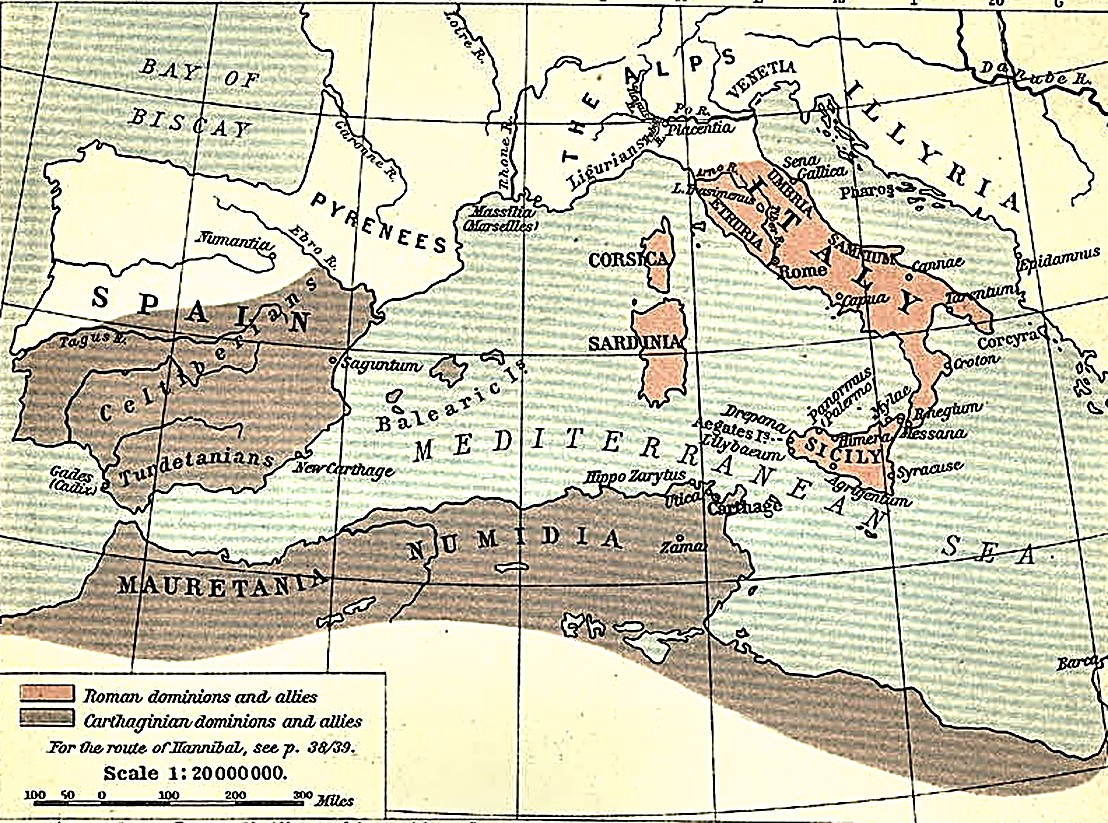
What Rome did not yet control was the sea, or the western Mediterranean beyond it, where a much older and richer power — the Phoenician city of Carthage on the African coast — had watched Pyrrhus's Italian war with an interest that was not entirely friendly. Rome and Carthage had briefly been allies against Pyrrhus. They were about to become the two greatest powers left standing in the western Mediterranean, with only Sicily, half Carthaginian and half Greek, sitting between them.
Map · Rome and Carthage, on the eve of warClick to enlarge
The next board is already set. Every color on this map that is not Roman orange is Carthaginian territory or sphere of influence — Spain, North Africa, and a long-standing hold on western Sicily. Rome, unified master of Italy, and Carthage, mistress of the western sea, now faced each other across a single island.
After Shepherd, Historical Atlas (1911), “Roman and Carthaginian Dominions.”
✦ ❧ ✦
A century after the Gauls burned her, Rome governed Italy not as a single conquered territory but as a graduated ladder of citizens, half-citizens, and allies, defended by a citizen army that could absorb a defeat like the Caudine Forks and still out-produce a professional king's veterans within a decade. That system — not any one general or battle — is what Pyrrhus could not beat, and it is what Rome would now turn against Carthage.