Spring 218 B.C.
Out of Spain
Hannibal leaves New Carthage, his family's capital in Spain, and marches north. Behind him lies Saguntum, the Roman ally whose eight-month siege in 219 had begun the war.
Three wars across a century turned a quarrel over a Sicilian strait into the destruction of a civilization — and left Rome without a rival from Spain to the Aegean.
By 264 B.C. Rome governed the Italian peninsula through a web of alliance and citizenship it had built over the previous chapter's wars. Carthage, an old Phoenician trading city on the North African coast, governed something larger still: a maritime empire of coastal Africa, western Sicily, Sardinia, and southern Spain, held together not by shared citizenship but by tribute, treaty, and a navy the Mediterranean had not seriously challenged in a century. The two powers had coexisted through three earlier treaties of friendship. Neither had ever fought the other.
 Click to enlarge
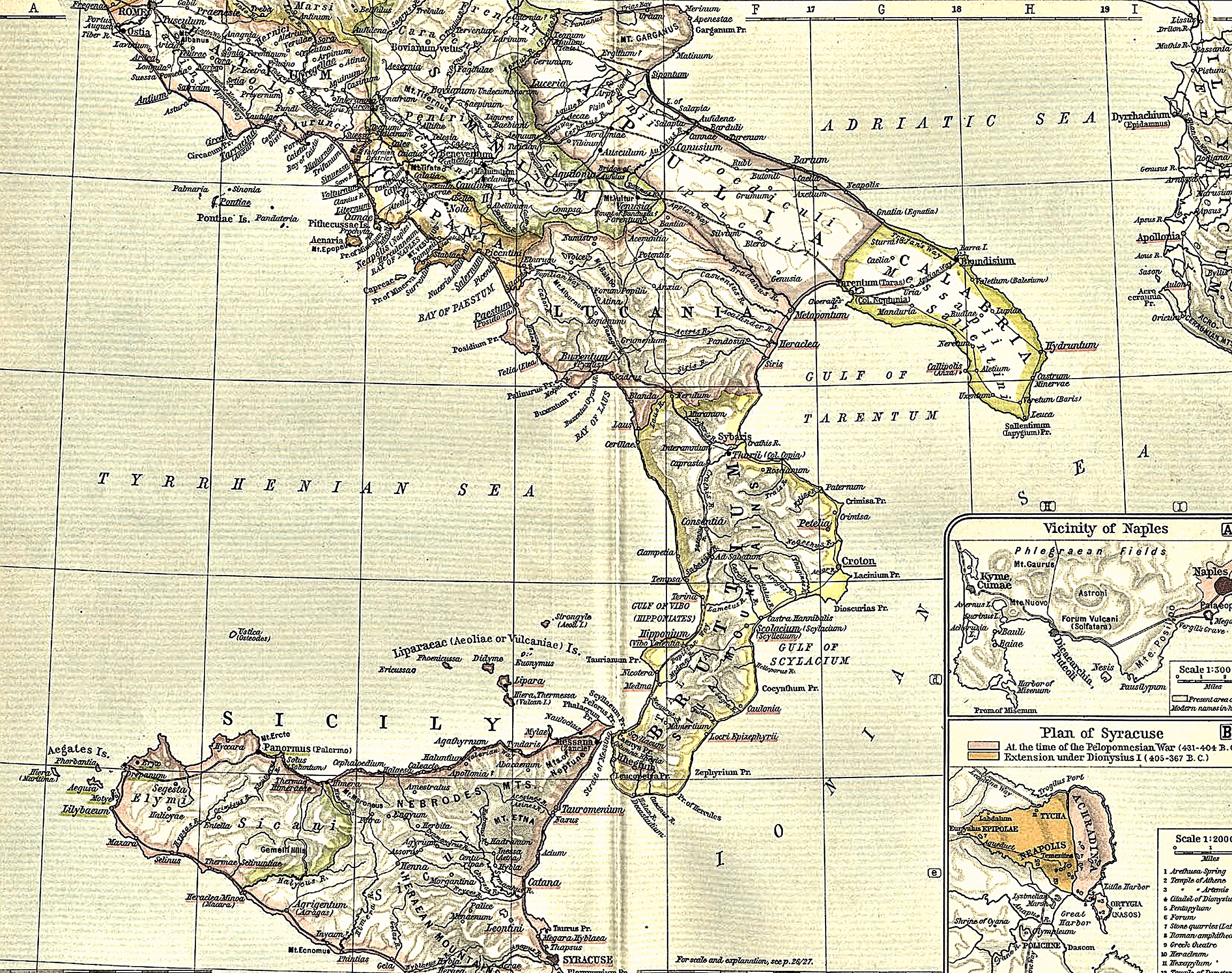
The spark was a gang of Italian mercenaries, the Mamertines, who had seized the Sicilian city of Messana and now faced destruction at the hands of Syracuse's king Hiero II. Besieged, they appealed to both great powers at once. A Carthaginian garrison arrived first and occupied the citadel; then the Mamertines, unhappy with their new protectors, appealed again to Rome. The Roman Senate, by Polybius's account, saw the danger of a Carthaginian foothold at the toe of Italy but balked at defending men who were themselves pirates and city-thieves; it was the popular assembly, weighing plunder and glory against the Senate's caution, that voted to send a consul across the strait. It was the first time a Roman army had ever campaigned outside Italy.
What began as a local rescue became, almost by inertia, a war neither side had planned for on this scale. Carthage would not simply concede Sicily; Rome, having intervened once, found withdrawal more costly than escalation. Within a year both powers were committed to a war that would run for nearly a quarter-century and would be decided, in the end, not on land but at sea — an element in which Rome, a case can be made, had no business competing at all.
 Click to enlarge
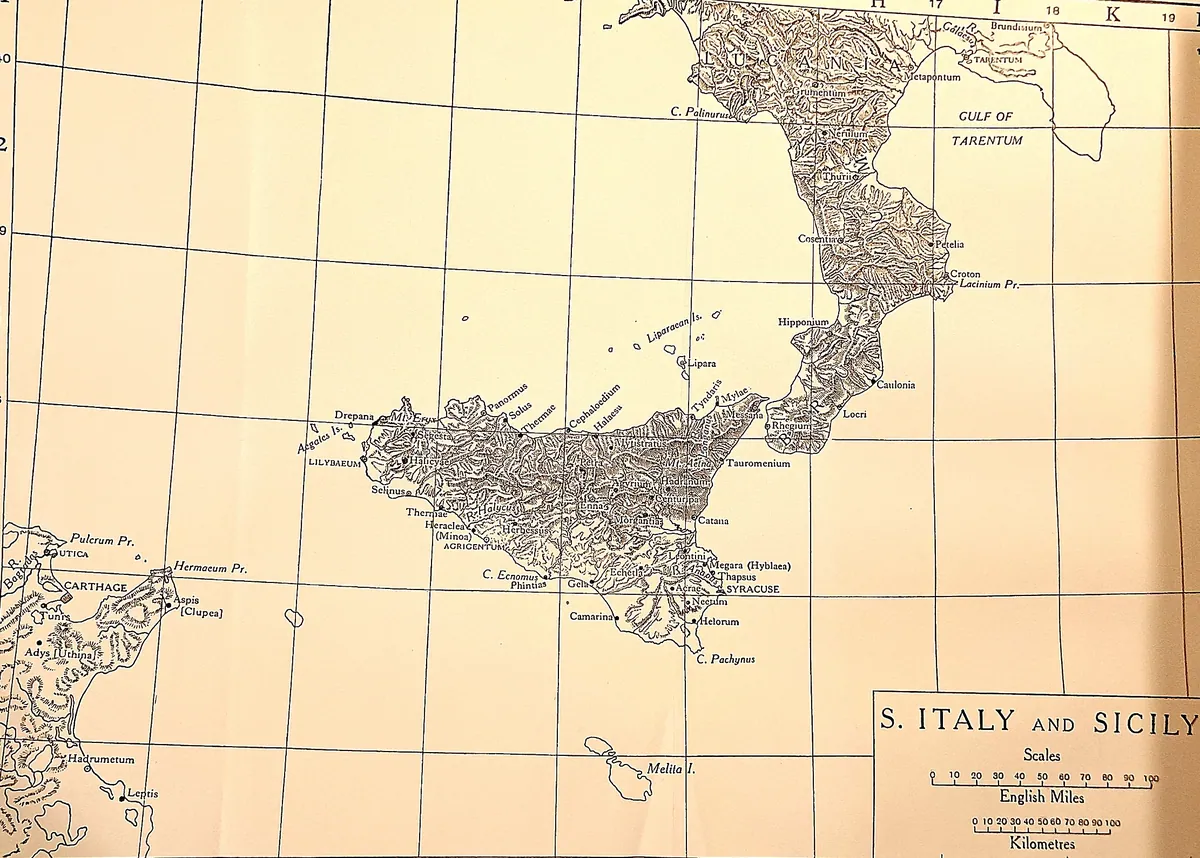
Rome's armies could match Carthage's on Sicilian soil, but Carthage's navy could land troops and cut supply anywhere on the island's long coastline at will. Rome's answer, as the ancient sources tell it, was to copy a wrecked or captured Carthaginian warship timber for timber and build a fleet from nothing — reportedly some hundred vessels in a matter of months, their crews drilled to row on benches set up on dry land before ever putting to sea. To offset Carthaginian skill in naval maneuver, the new fleet carried a hinged boarding ramp, the corvus ("crow"), that let Roman legionaries turn a sea battle into the kind of infantry fight they already knew how to win. It worked: the consul Gaius Duilius won Rome's first naval victory at Mylae in 260 B.C.
 Click to enlarge
The war see-sawed for two more decades — a Roman invasion of Africa under Regulus that began in triumph and ended in his defeat and capture by a Spartan mercenary general, Xanthippus, in 255 B.C.; grinding sieges in Sicily; catastrophic fleet losses to storm as much as to battle on both sides. Later Roman writers built Regulus into a legend of iron word-keeping — sent to Rome on parole to negotiate an exchange of prisoners, he is said to have urged the Senate to refuse it and then honored his oath by returning to Carthage and a martyr's death. The story is moving, and it is almost certainly embroidered well past anything Polybius, writing closest to the events, actually reports; this chapter repeats it as the legend later Romans told about themselves, not as verified fact.
Rome finally forced the issue at sea again, destroying Carthage's last relief fleet off the Aegates Islands in 241 B.C. Carthage, unable to supply Sicily any further, sued for peace: it surrendered Sicily outright and paid a war indemnity over ten years. Sicily became Rome's first possession outside Italy — and, tellingly, was not absorbed as allied territory in the Italian pattern but organized as a provincia, a defined sphere of command governed by an annual Roman magistrate and taxed for Rome's benefit. A second blow followed within a few years: while Carthage was consumed by a savage mutiny of its own unpaid mercenaries — the so-called Truceless War — Rome seized the moment to occupy Corsica and Sardinia as well, on pretexts Polybius himself calls unjust. Carthage, prostrate, could only submit. It was a grievance the Carthaginians did not forget.
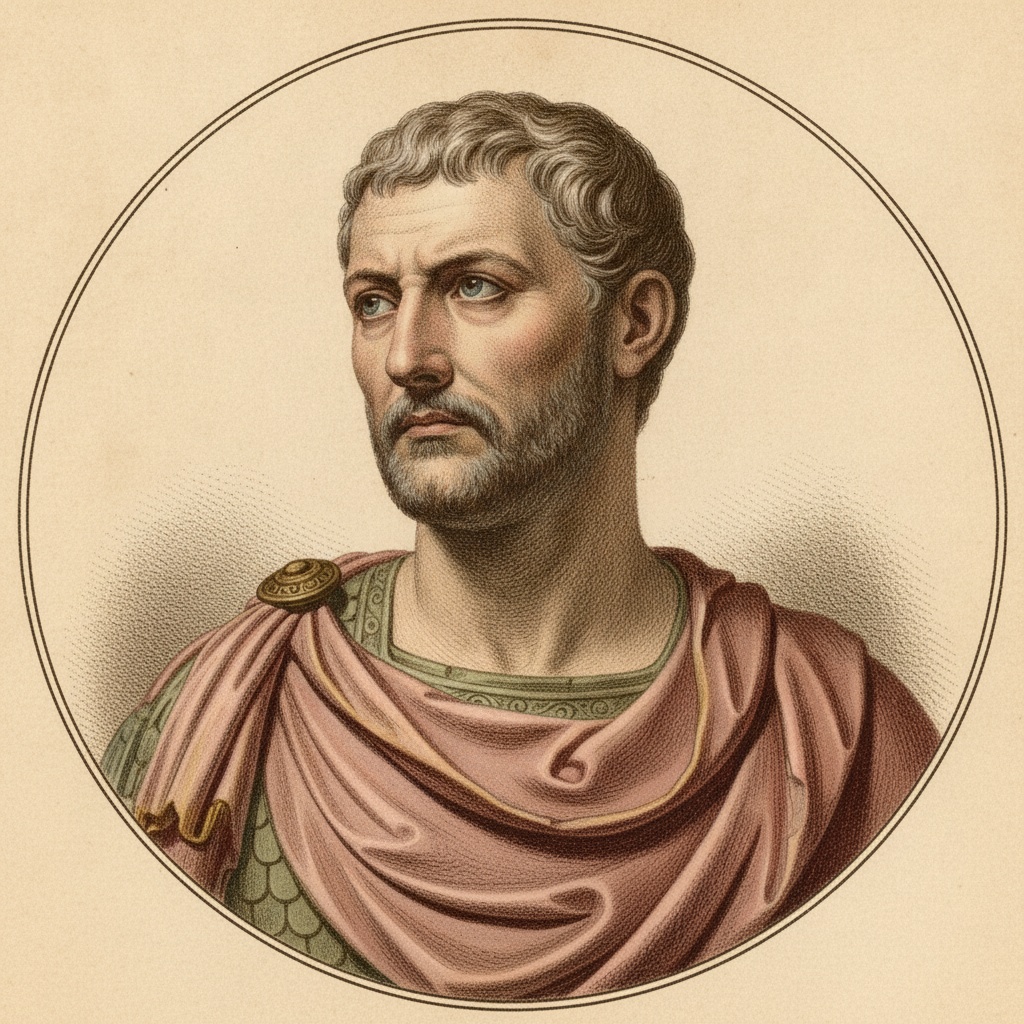
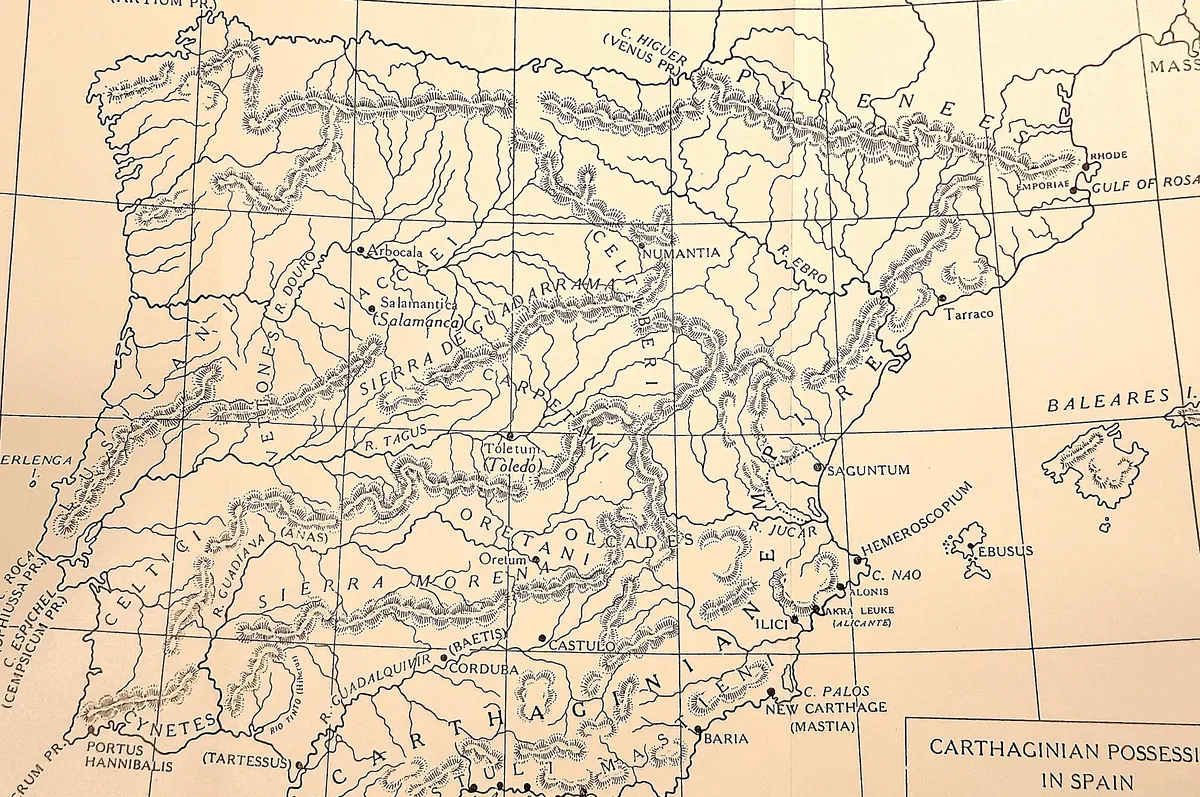
Stripped of Sicily, Sardinia, and Corsica, Carthage rebuilt its power where Rome was not yet watching closely: Spain. Hamilcar Barca, the one Carthaginian commander to leave the First Punic War with his reputation intact, spent the 230s and 220s B.C. conquering and administering the Spanish interior, extracting silver that refilled Carthage's treasury and manpower that rebuilt its army. He took his young son with him. Hannibal later told the story himself, as an old man at the court of King Antiochus, and Polybius set it down: before the army sailed, Hamilcar led the boy to the altar, made him lay his hand on the sacrificial victim, and had him swear never to be a friend to Rome.
 Click to enlarge
“…his father took him by the hand, led him up to the altar, and bade him lay his hand on the victim and swear that he would never be the friend of Rome.” Polybius, Histories, III.11 — trans. W. R. Paton (Loeb Classical Library, 1922; public domain)
Hamilcar died campaigning in 228 B.C.; his son-in-law Hasdrubal extended Carthaginian Spain further and, to fix a boundary with Rome's own allies on the peninsula, agreed a treaty setting the river Ebro as a limit on Carthaginian expansion northward. South of the Ebro, though, sat the city of Saguntum, bound to Rome by an older treaty of friendship that predated the Ebro line and sat awkwardly inside Carthage's now-legitimate sphere. When Hasdrubal was assassinated in 221 B.C. and the twenty-six-year-old Hannibal took command by acclamation of the army, the contradiction was still unresolved. In 219 B.C. Hannibal besieged and took Saguntum after an eight-month siege the Saguntines themselves are said to have fought to starvation and self-destruction rather than surrender. Rome demanded Hannibal's surrender for trial; Carthage's assembly refused; a Roman embassy in Carthage is said to have gathered its toga into a fold and offered the Carthaginian senate the choice of peace or war folded inside it. The senate answered that Rome could choose. The Second Punic War had begun.
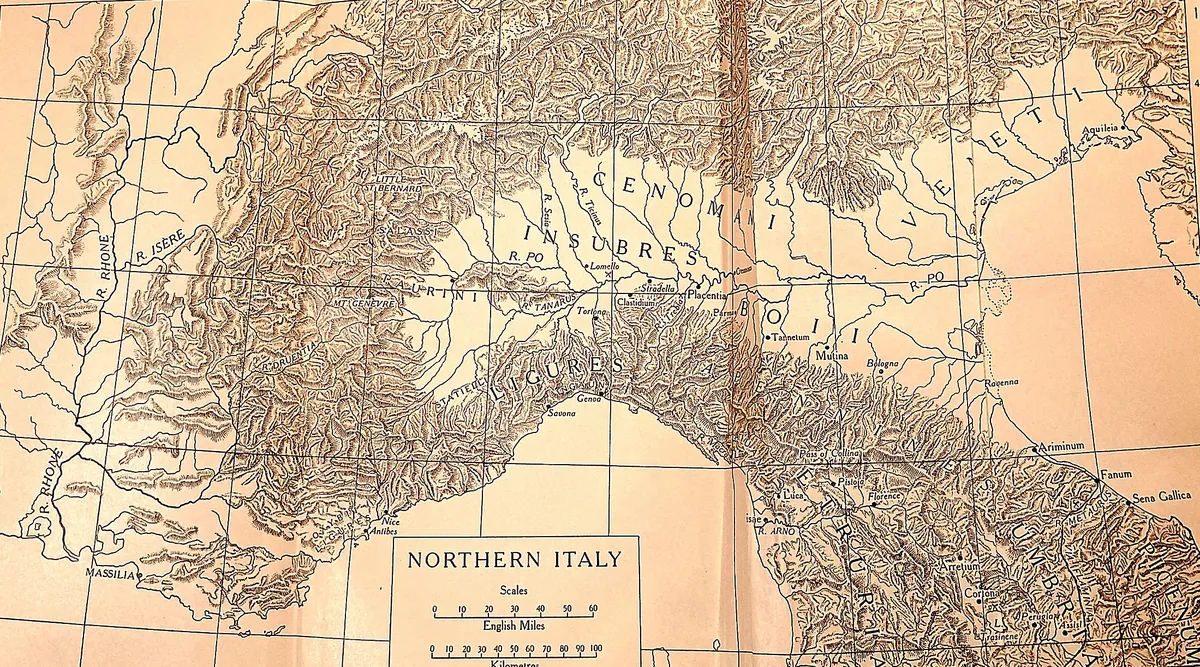
Rome planned to fight this war the way it fought the last one: on someone else's territory, with Roman fleets carrying Roman armies to Spain and Africa. Hannibal made that plan obsolete before it began. In the late spring of 218 B.C. he marched a mixed army of Africans, Spaniards, and Gauls — with a contingent of war elephants — out of Spain, across the Pyrenees, through hostile Gallic territory, and over the Alps into Italy in late autumn, in a crossing ancient writers already treated as one of the most punishing marches in memory. He arrived in the Po valley with a fraction of the force he had started with, but with the local Gallic tribes, recently and resentfully conquered by Rome, ready to reinforce him.
 Click to enlarge
Two consular armies met him in quick succession and were broken in quick succession. At the Trebia river in December 218 B.C., Hannibal lured a Roman army into a freezing river crossing before ambushing it from concealed ground. The following June, at Lake Trasimene, he trapped an entire consular army in a defile between hillside and water and destroyed it in a single morning so complete that, Livy says, a nearby battle-sized earthquake went unnoticed by the combatants. The consul Gaius Flaminius died in the rout. Rome, twice defeated in eighteen months by an enemy operating deep in its own homeland, had never faced anything like it.
The Senate's response was itself an admission of crisis: it named a dictator, Quintus Fabius Maximus, under the old emergency procedure last needed against real existential threats. Fabius's strategy — refuse pitched battle, shadow Hannibal's army, strangle it by attrition and Italy's scorched fields rather than confront it — was correct in hindsight and humiliating in the moment. Soldiers and political rivals alike mocked him as Cunctator, "the Delayer," a coward hiding behind Rome's hills while Italy burned around him.
Scroll to follow the march from Spain to the Trebia, stage by stage.
Hannibal leaves New Carthage, his family's capital in Spain, and marches north. Behind him lies Saguntum, the Roman ally whose eight-month siege in 219 had begun the war.
He beats down the tribes between the Ebro and the mountains, then crosses the Pyrenees near Portus Veneris. Scipio's fleet puts in at Tarraco to stop him — and finds he has already gone by.
Out-marching the Roman fleet, Hannibal crosses the Rhône on rafts above Tarusco, elephants and all, then turns up the river into the country of the Allobroges.
Fifteen days through the passes, harried by mountain tribes and the snow, cost him a large part of his army. Which col he used is still argued — Clapier, Mont Cenis, Montgenèvre all have advocates — so no pass is drawn here.
He descends into the Po valley with a fraction of the force he set out with, and storms the first town in his path, the chief place of the Taurini.
A cavalry clash on the Ticinus is followed, in December, by the first great defeat, on the Trebia. Hannibal is in Italy, the Gauls are joining him, and Rome has lost the opening round.
Sites: Pleiades. Land and rivers: Natural Earth. The route is schematic — no precise ancient track survives — and no Alpine pass is drawn, since historians disagree which one Hannibal used.
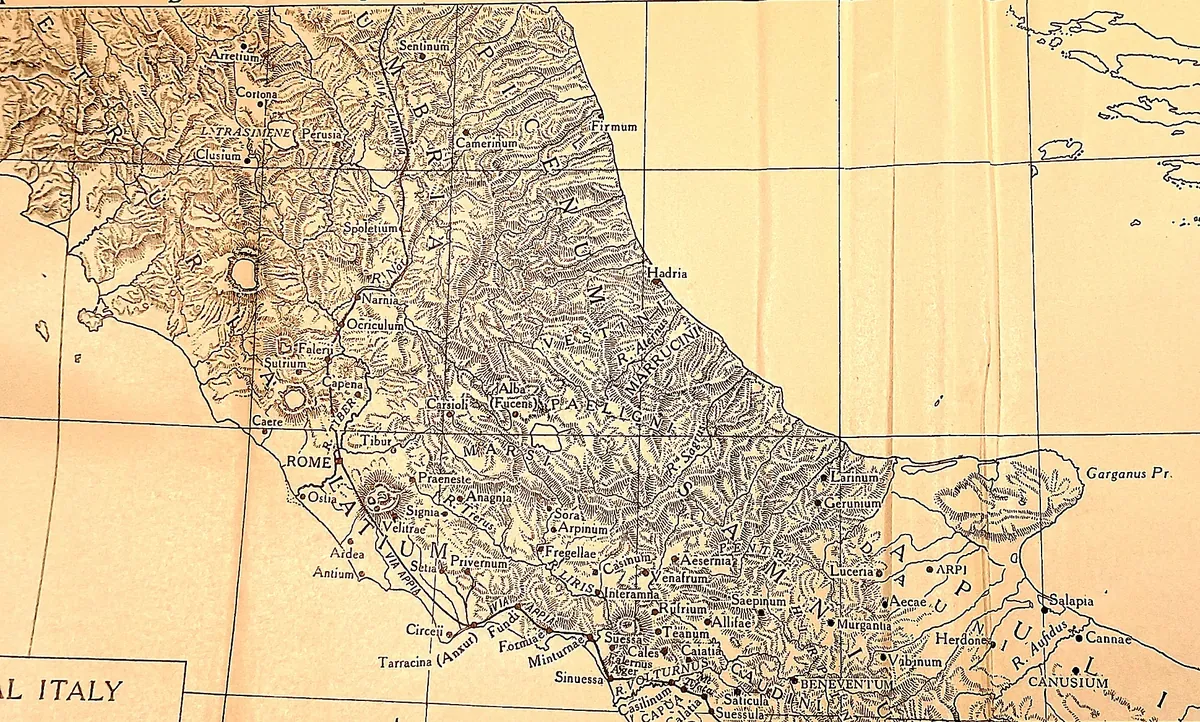
Fabius's term expired, and Rome's patience with delay expired with it. For 216 B.C. the Senate raised the largest army it had ever fielded — perhaps eight legions with allied contingents, on ancient figures that modern historians treat as approximate but roughly credible — and gave joint command to the consuls Lucius Aemilius Paullus and Gaius Terentius Varro, the second of whom favored the decisive battle the electorate now demanded. At Cannae in Apulia, Hannibal let the Roman center push his own line into a deliberate crescent-shaped bow, then closed his African infantry around both Roman flanks while his cavalry, having already routed its Roman counterpart, struck the Roman rear. The result, whatever the exact numbers, was annihilation: ancient sources put Roman dead in the tens of thousands in a single day, among the worst one-day losses any army suffered in the ancient world. Paullus was killed; Varro survived and, remarkably, was thanked by the Senate for not despairing of the Republic.
 Click to enlarge
What Rome did next mattered more than the defeat itself. Several southern Italian cities and the important city of Capua defected to Hannibal; the Macedonian king Philip V opened negotiations with him against Rome; by any conventional measure of the time, the war was lost. Rome refused to act as though it were. The Senate declined to ransom the thousands of Roman prisoners in Hannibal's hands — a hard, controversial decision meant to signal that the state would not bargain — raised fresh legions from citizens previously exempt, including slaves promised freedom for service, and kept the field. Crucially, the core of Rome's Italian allied confederation, unlike Capua, did not break: most of the Latin and central Italian communities that had fought beside Rome for a century calculated, correctly, that their future was safer tied to Rome than to a foreign general far from his own base of supply. Hannibal, victorious in every battle, had no siege train capable of taking Rome itself and no reinforcement Carthage was willing or able to send in strength. He would range across Italy for another decade, undefeated in the field and unable to end the war he had already, in every tactical sense, won.
“One man, by delaying, restored the state for us; he did not put popular opinion before the safety of Rome, and so his glory shines out now, and will keep growing, more and more.” Ennius, as preserved by Cicero, De Senectute, X.32 — trans. Andrew P. Peabody (1887; public domain)
The first map brought him to the Trebia. Scroll to follow the fifteen years that followed — Trasimene, Cannae, the revolt of the south, and the slow closing of the trap.
Hannibal crosses the Apennines and forces a four-day passage of the flooded Arno, losing his remaining baggage animals and the sight of one eye. He walks past the consul Flaminius at Arretium and burns Etruria behind him until Flaminius follows. In a morning fog on the north shore of Lake Trasimene he traps the whole consular army between the hills and the water and destroys it.
Rome names a dictator. Fabius Maximus refuses battle and shadows him, and Hannibal — who cannot take walled cities and cannot stay still — marches away from Rome down Picenum into Apulia and then into the rich Campanian plain. Penned there by Fabius, he breaks out past Casilinum in the dark, and winters at Gerunium. Rome calls Fabius Cunctator, the Delayer, and means it as an insult.
At Cannae in August 216 the largest army Rome has ever fielded is enveloped and annihilated. What follows is the real crisis: Capua, the second city of Italy, opens its gates, and most of Samnium, Lucania, Bruttium and the Greek south goes with it. But the Latin colonies and central Italy hold, and so does Nola, which Marcellus defends against Hannibal three years running. Hannibal has won the field and cannot win the country.
Philip V of Macedon signs a treaty with Hannibal in 215, and Syracuse changes sides after old Hiero dies. Rome fights all of it at once. Marcellus besieges Syracuse for two years against the engines of Archimedes and storms it in 212; Archimedes is killed in the sack. The same year Tarentum is betrayed to Hannibal by night — the port he has wanted since he came — but the Roman garrison holds the citadel and the harbour stays shut.
Rome walls Capua in with a double line of siegeworks and will not be drawn off it. In 211 Hannibal marches up the Latin valley and camps three miles from Rome — Hannibal ad portas — and the Romans neither lift the siege nor come out. He turns away; Capua starves, its magistrates are executed, its self-government abolished. In 209 Fabius takes Tarentum back. The cities that gambled on Hannibal are being paid for it one by one.
Hasdrubal brings a second Carthaginian army over the Alps to join his brother. His dispatch is intercepted, and the consul Claudius Nero slips out of his camp in Apulia with seven thousand picked men, marches the length of Italy in a week, and joins his colleague Livius on the Metaurus without Hasdrubal knowing a second army has arrived. Hasdrubal is beaten and killed. His head is thrown into Hannibal's camp in Bruttium — the first he hears of it.
For his last years in Italy Hannibal holds only the toe, supplied from the sea and never beaten in the field. In 203, with Scipio in Africa and Carthage itself in danger, he is called home. Before sailing from Croton he sets up a bronze tablet in the temple of Juno Lacinia recording his campaigns — the inscription Polybius says he read. Fifteen years after the Trebia, the war leaves Italy for the last time.
Sites: Pleiades. Land, lakes and rivers: Natural Earth. All marches are schematic — no precise ancient track survives — and no border is drawn for Campania, Samnium, Apulia, Lucania or Bruttium, which are regions, not states. Gerunium’s site is uncertain, and the battlefield of the Metaurus is disputed, so the river itself is marked rather than a pinned battle site.
Scroll to follow Publius Cornelius Scipio Africanus as he storms New Carthage, evicts Punic power from Spain at Ilipa, and defeats Hannibal at Zama.
Eight years after the catastrophic slaughter of Cannae, Hannibal Barca remains master of the field in southern Italy, holding court from Croton in Bruttium. Rome is exhausted, bled white of manpower and treasure. When both his father and uncle are slain in Spain by the Carthaginian armies, twenty-five-year-old Publius Cornelius Scipio steps forward when no senior magistrate dares claim the command. The Roman people elect him with extraordinary proconsular imperium to turn the tide of the war in Hispania — the economic powerhouse supplying Hannibal’s mercenaries and silver.
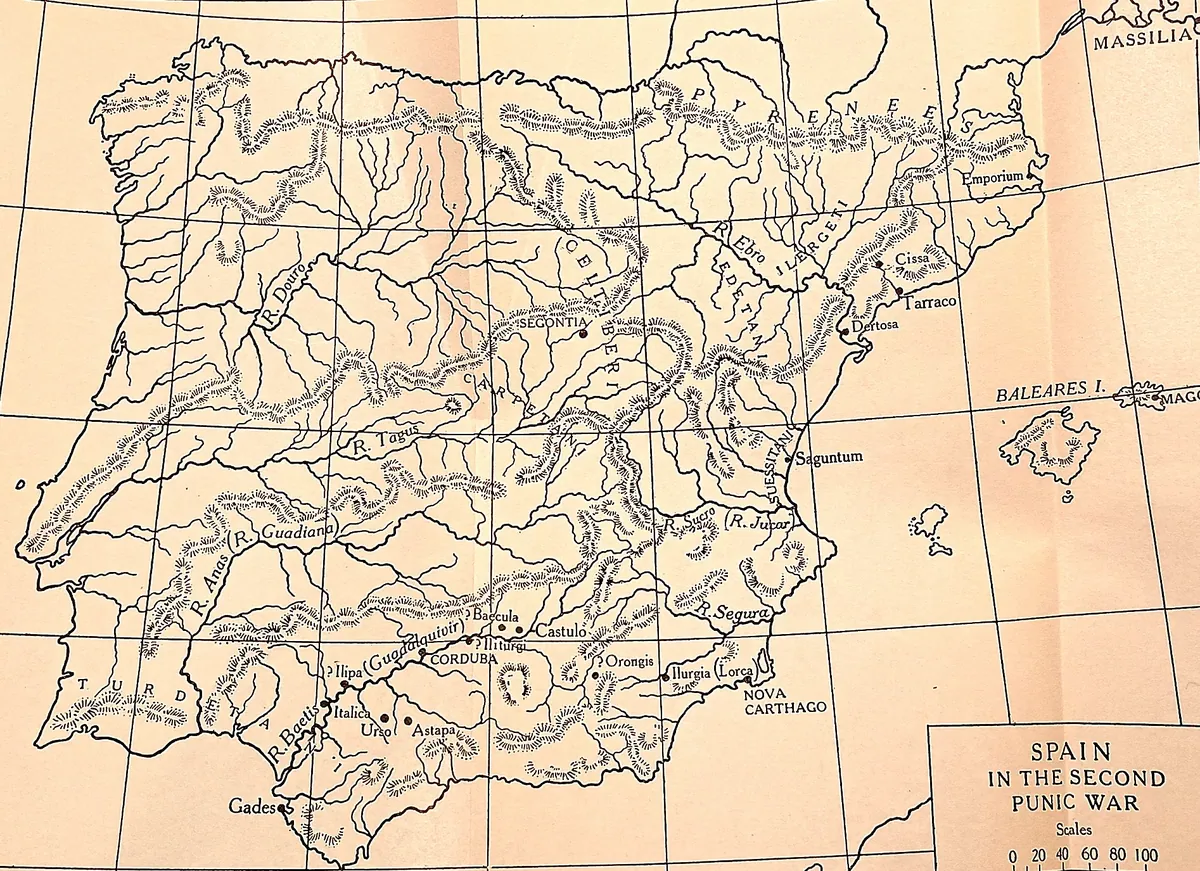
Arriving in Spain, Scipio bypasses the three separate Carthaginian field armies and marches straight on their capital, Carthago Nova (Cartagena). Observing that an adjacent lagoon drains at low tide, Scipio leads a five-hundred-man assault force wading through waist-deep water in the evening dusk to scale the undefended northern wall. The citadel falls in a single afternoon. Scipio captures eighteen Carthaginian warships, 600 talents of silver, immense stores of grain and artillery, and 300 Spanish noble hostages — whom he treats with chivalric clemency, instantly turning Iberian tribal loyalties to Rome.
After checking Hasdrubal Barca at Baecula, Scipio confronts the combined hosts of Mago Barca and Hasdrubal Gisgo on the plains of Ilipa. For days, Scipio arrays his legionaries in the center and Spanish allies on the wings. On the day of battle, he reverses his deployment before dawn: he feeds his troops early, places his Spaniards in the center and his iron-disciplined Roman legionaries on the galloping flanks. Performing an outward wheeling maneuver, the Roman wings crush the Carthaginian flanks while their central Libyan phalanx stands paralyzed. With Gades (Cádiz) opening its gates, Carthage is ejected from Hispania forever.
Returning to Rome in triumph, Scipio is elected consul. Facing fierce resistance from Fabius Maximus and the senatorial old guard, who demand he stay in Italy to face Hannibal, Scipio threatens to appeal directly to the popular assembly. Assigned Sicily with no new legions, he rallies 7,000 enthusiastic volunteers and trains them relentlessly at Syracuse and Lilybaeum. In 204 B.C., his invasion armada of four hundred ships crosses to North Africa, landing near Utica and establishing the fortified camp of Castra Cornelia.
Besieged outside Utica by Hasdrubal and Numidian King Syphax, Scipio feigns peace negotiations while spies map their twin camps. On a moonless night, Roman strike teams set fire to the dry reed huts; as the Carthaginians stumble out unarmed believing it an accidental blaze, the legions encircle the exits and cut them down. Forty thousand perish in the inferno. Following another crushing victory at the Great Plains, a panicked Carthage recalls Hannibal from Italy after sixteen years on Roman soil. Hannibal weeps as his ships pull away from the shores of Croton.
The two greatest commanders of antiquity meet in personal conference on the rolling plain of Zama. Terms are rejected; battle follows. When Hannibal unleashes eighty charging war elephants, Scipio orders his maniples to blow blaring bronze trumpets and step aside, creating straight lanes through which the pachyderms rumble without harming a man. As the veteran infantry grinds in locked combat, Massinissa’s Numidian cavalry returns from chasing the Punic horse to strike Hannibal’s rear. Twenty thousand Carthaginians fall; Hannibal flees to Hadrumetum. Carthage surrenders all warships, territory, and independence. Scipio returns to Rome as Africanus — the savior and new titan of the Mediterranean.
Sites: Pleiades. Land, lakes and rivers: Natural Earth (public domain). Routes are schematic — reconstructed after Polybius, The Histories (Books X–XV), and Livy, Ab Urbe Condita (Books XXVI–XXX). Realm boundaries are labels only.
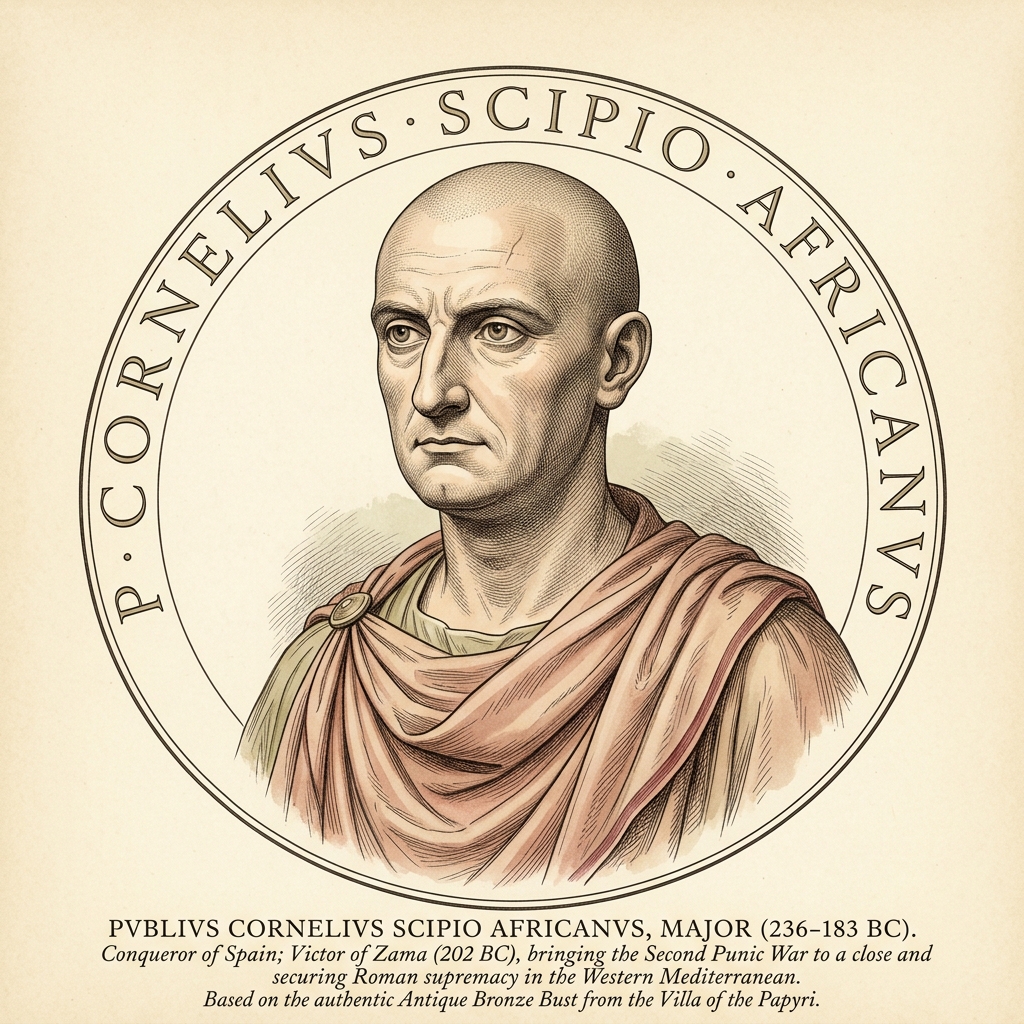
Unable to break Hannibal in Italy directly, Rome fought the war at its edges. In Spain, after both the elder Scipio brothers were killed in battle in 211 B.C., command passed unconventionally to Publius Cornelius Scipio, not yet twenty-five and holding no office higher than a special proconsular commission voted him by the popular assembly rather than the Senate — itself a sign of how far the old rules were bending under the war's pressure. Scipio took the Carthaginian capital in Spain, New Carthage, by a surprise assault in 209 B.C. and, over the following three years, drove every Carthaginian army out of the peninsula.
 Click to enlarge
Elected consul for 205 B.C. against the caution of Fabius Maximus, now an old man still arguing for patience, Scipio proposed to carry the war to Africa itself and force Hannibal's recall. He won the argument, crossed to Africa in 204 B.C., and by 203 B.C. had inflicted enough damage — allied crucially with the Numidian prince Masinissa, who defected from Carthage's cause to Rome's — that Carthage recalled Hannibal from Italy after fifteen unbroken years on Roman soil. The two commanders met at last, and only once, at Zama in 202 B.C. Scipio had studied Hannibal's own tactics for over a decade; he neutralized Hannibal's elephant charge by opening lanes in his infantry line for the animals to pass through harmlessly, and Masinissa's cavalry, superior in numbers for the first time in the war, broke the Carthaginian horse and returned to crush Hannibal's infantry from behind — the same envelopment Hannibal had used at Cannae, now turned against him. It was Hannibal's first and only major defeat in the field.
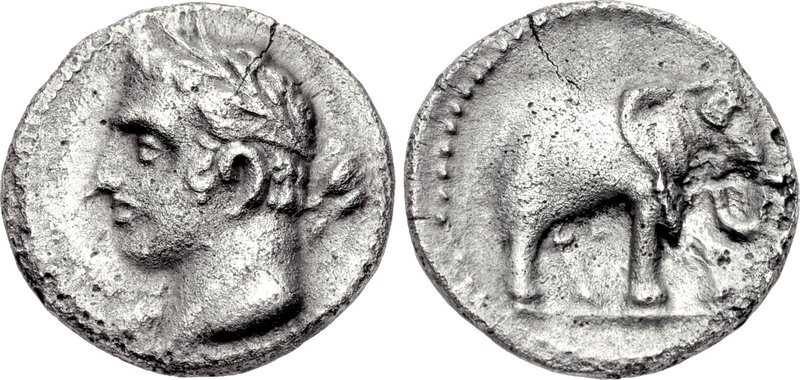
Carthage sued for peace on terms that ended it as a Mediterranean power without ending it as a city: surrender of the war fleet and the elephants, abandonment of Spain, an enormous indemnity payable over fifty years, and a binding promise to make no war anywhere without Rome's permission. Scipio returned to Rome and the honorific that would outlive him — Africanus. Hannibal, remarkably, remained at Carthage for several years afterward as a civil reformer before Roman pressure forced him into exile in the East, where he would end his life rather than be handed over to Rome.
 Click to enlarge
Stripped of its fleet, its army, and its foreign policy, Carthage nonetheless rebuilt itself over the next half-century as a wealthy trading city, paying off its enormous war indemnity ahead of schedule and provoking, in the process, a Roman anxiety that had little to do with any real military threat. The elder statesman Cato, who had served in the Second Punic War as a young man, visited Carthage on a senatorial mission in 153 B.C. and returned alarmed at its recovered prosperity. Ancient writers agree that he made a habit, for years afterward, of ending every speech in the Senate — on any subject at all — by declaring that Carthage must be destroyed. The precise Latin tag posterity remembers, Carthago delenda est, does not appear verbatim in any surviving ancient source; Plutarch gives only a Greek paraphrase of the sentiment. What is well attested is the refrain itself and the deliberate political campaign behind it, not the three tidy words later ages carved onto it.
 Click to enlarge
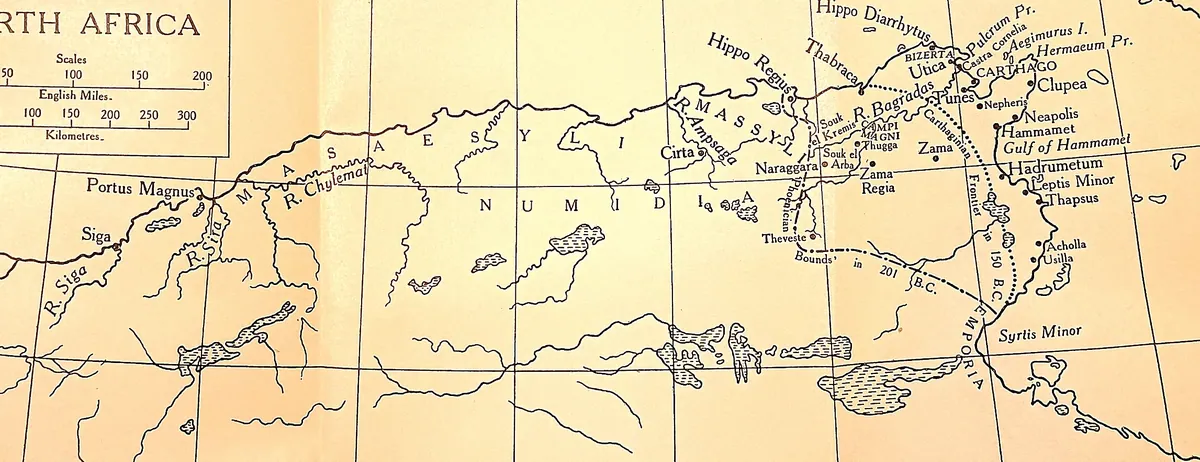
Rome found its pretext in a border war between Carthage and Rome's Numidian ally Masinissa, which Carthage's peace treaty technically forbade it from resisting by force. When Carthage nonetheless armed itself in self-defense, Rome declared this a treaty violation and, through a sequence of escalating demands, required first full disarmament and finally the abandonment of the city itself, to be rebuilt inland away from the sea — a demand no Carthaginian government could accept and survive politically. Carthage chose resistance. The siege that followed (149–146 B.C.) was brutal even by the standards of the previous wars; the city, commanded in its final Roman assault by Scipio Aemilianus, adopted grandson of Africanus, fell street by street after building-to-building fighting that lasted days. The population that survived the siege and the sack was sold into slavery, the city was burned, and its territory was annexed as the Roman province of Africa.
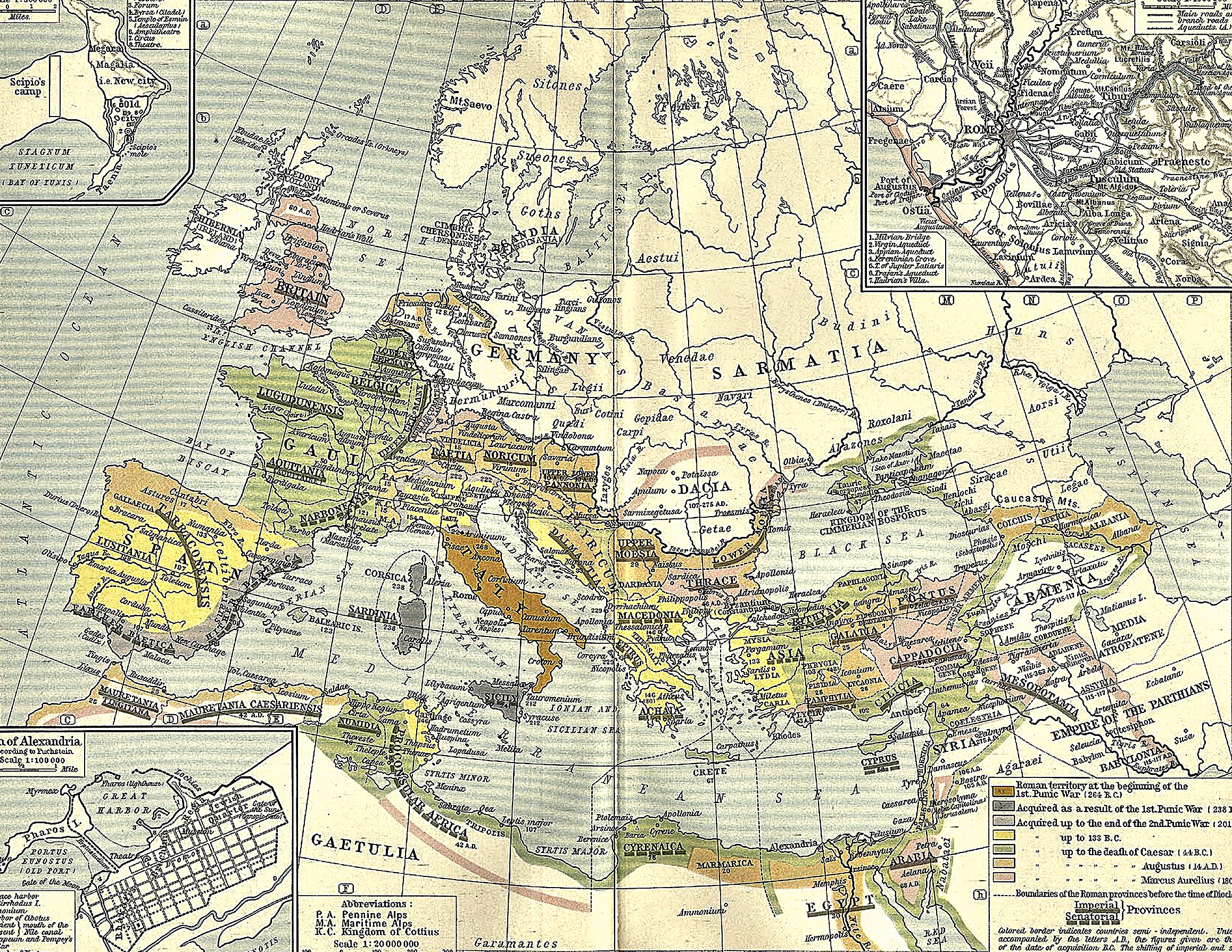
In the same year, 146 B.C., a Roman army under Lucius Mummius destroyed the Greek city of Corinth after crushing a revolt of the Achaean League — an entirely separate war, fought on the opposite side of the Mediterranean, that this chapter's companion piece on Rome's eastern expansion takes up in full. That the West's oldest rival and one of the East's proudest cities fell in the same twelve months was no coincidence of unrelated wars; it was the same Roman Republic, fighting on two fronts across two generations, arriving at the same conclusion in both theatres at once. Master of Italy at this chapter's opening, Rome ended it master of the western Mediterranean outright — and, as the next chapter shows, already deep into the conquest of the Greek world in the east.
 Click to enlarge · zoom
Carthage did not fall to a single battle or a single grievance. It fell to a century of Roman decisions — to fight for Messana, to seize Sardinia while Carthage was crippled, to refuse Hannibal's peace after Cannae, to demand a city undefend itself and then raze it when it would not — each one defensible alone, cumulatively annihilating.
From the first crossing to Sicily to the destruction of Carthage and Corinth: the first provinces, and the kings Rome broke without annexing.
Rome answers the appeal of the Mamertines, Campanian mercenaries holding Messana, and sends a consular army over the strait: its first war outside Italy. Carthage, the Phoenician city of Africa, holds western Sicily, Sardinia and Corsica, and trading towns on the coast of Spain; Hiero of Syracuse rules the southeast of Sicily. In 263 Hiero changes sides and becomes Rome's ally for life.
A land power builds fleets. Rome wins at sea off Mylae (260), loses an army in Africa (255) and whole fleets to storms. In 241 a last fleet, paid for by private loans, destroys the Carthaginian relief convoy off the Aegates Islands. Carthage gives up Sicily and pays an indemnity. Western Sicily becomes Rome's first province, governed after 227 by a praetor sent each year.
While Carthage fights its own mercenaries, Rome seizes Sardinia and Corsica (238) and demands more money; Polybius counts this the truest cause of the next war. In 229 Roman fleets curb the Illyrian queen Teuta and take Corcyra, Apollonia and Epidamnus under protection. Hamilcar Barca, meanwhile, wins Carthage a new empire in Spain; Hasdrubal founds New Carthage and accepts the Ebro as a limit.
Rome turns north and beats the Gauls at Telamon (225) and Clastidium (222), and plants colonies at Placentia and Cremona. In 219 Hamilcar's son Hannibal takes Saguntum, a Spanish town in Rome's friendship. Rome declares war and sends an army to Spain, but Hannibal is already over the Pyrenees and the Alps. In December 218 he beats a consul at the Trebia, and the Po Gauls rise to join him.
Hannibal destroys a Roman army at Lake Trasimene (217) and a larger one at Cannae (216), the worst defeat in Roman memory. Capua goes over to him, then much of the south; Philip V of Macedon makes an alliance with him (215), Syracuse after Hiero's death (214), and Tarentum (212). The Latin colonies hold, and so does central Italy. Rome raises new legions and refuses battle.
Marcellus takes Syracuse (212–211) and Capua is retaken (211). Hasdrubal marches to his brother's aid and is killed on the Metaurus (207). Publius Scipio takes New Carthage (209), drives the Carthaginians from Spain at Ilipa (206) and invades Africa. Recalled to defend his city, Hannibal is beaten at Zama (202). Carthage gives up Spain and its fleet; Masinissa's Numidia becomes Rome's ally.
Two Spanish provinces are formed (197) and the Boii of the Po valley are crushed (191). In Greece, Flamininus beats Philip at Cynoscephalae (197) and proclaims the Greeks free. Antiochus III of Syria, crossing into Greece, is beaten at Thermopylae (191) and Magnesia (190), and at Apamea (188) gives up Asia Minor beyond the Taurus. Rome takes no land there but enlarges its friends, Pergamum and Rhodes.
Philip's son Perseus is beaten at Pydna (168) by Aemilius Paullus. The Macedonian monarchy is abolished and the kingdom split into four republics paying tribute to Rome; Genthius' Illyrian kingdom is broken up the same year. Rhodes, suspected of favouring Perseus, loses its mainland lands. Outside Alexandria a Roman envoy, Popillius Laenas, orders Antiochus IV out of Egypt, and the king obeys.
A pretender, Andriscus, claims the Macedonian throne and is crushed (148); Macedonia becomes a province. When the Achaean League defies Rome, Mummius sacks Corinth (146). The same year Scipio Aemilianus takes Carthage after a three-year siege and razes it; its land becomes the province of Africa. In Spain the Lusitanians and Celtiberians are still at war with Rome, and will be until Numantia falls (133).
Outlines: Ancient World Mapping Center, “Roman Empire c. 60 BC” and “c. AD 200 provinces” (ODbL; after the Barrington Atlas), divided editorially after Shepherd’s Historical Atlas (1911), plate 32: Italy at the Arno–Rubicon line and the Volturnus, Hiero’s kingdom in Sicily, Barcid Spain, and Macedon, Greece and the Illyrian coast. Spain, Numidia and Macedonia are drawn at their later extent, so early limits are too large. Coastlines and rivers: Natural Earth. Sites: Pleiades.