c. 1100–900 B.C.The age of villages
For three centuries after the palaces burned, Greece was a land of small villages. Houses were of mud brick on stone footings; the dead were burned rather than buried in chambered tombs; pots were decorated with compass-drawn circles and then with the bands and meanders that give the age its name, Geometric. There were no kings of the old kind. Each community was led by a basileus, the word that had meant a palace official under the wanax and now meant a local chieftain: a big man with a hall, a herd, a following, and a claim to descent from the heroes. The Odyssey, composed at the end of this age, describes such men: Odysseus is a king who knows his own swineherd and can build his own bed, and his palace has one great hall and a courtyard with a dung heap.
Movement did not stop with the fires. The dialect map of classical Greece is the fossil of these centuries: Doric in the Peloponnese, Crete and Rhodes, where tradition said the Dorians had come down from the north; Ionic in Attica, Euboea, the central islands and the coast of Asia Minor, where the Athenians claimed to have led the settlers; Aeolic in Thessaly, Boeotia, Lesbos and the north-west corner of Asia. The tradition told these as invasions and expeditions with named leaders. The archaeology shows only that people were moving and that Greek came to be spoken on both shores of the Aegean.
c. 950 B.C.Lefkandi, and the first gold since Mycenae
The darkness was not total. At Lefkandi on the coast of Euboea a building fifteen metres wide and nearly fifty long was raised about 950 B.C. and almost at once dismantled and covered with a mound over the burial of a warrior, his cremated bones wrapped in cloth in a bronze urn from Cyprus, a woman laid beside him with gold at her breast, and four horses in a pit. The cemetery around it holds gold, faience and bronze from Egypt and the Levant. Someone in Euboea was rich, and someone was sailing to Euboea from the east. The Euboeans would be the first Greeks to sail the other way.
c. 1000–800 B.C.The Phoenicians take the sea
The peoples who profited first from the wreck of the Bronze Age were the Canaanite merchant cities of the Lebanese coast, Tyre, Sidon and Byblos, whom the Greeks called Phoenicians. Spared the worst of the destruction, and pressed from behind by Assyria, they took over the sea-trade the palaces had lost. They dealt in purple dye from the murex shell, in cedar, in glass and worked metal and ivory, and above all in the metals of the west: silver from Spain, copper from Cyprus and Sardinia, tin from beyond the straits. They planted trading stations along the way: Kition in Cyprus, Motya and Panormus in western Sicily, Nora and Tharros in Sardinia, Utica in Africa, and Gades beyond the Pillars of Heracles, which tradition dated to about 1100 B.C., though the earliest finds are some three centuries later.
And on a peninsula of the African coast facing Sicily they founded, in 814 B.C. by the reckoning of the historian Timaeus, a city they called simply Qart-hadasht, the New City, which the Greeks pronounced Karchedon and the Romans Carthago. The Greek and Roman story made its founder a Tyrian princess, Elissa or Dido, fleeing her brother; Virgil later gave her a love affair with the ancestor of Rome. The earliest pottery from the site reaches back to about 800 B.C., close enough to the tradition. Carthage would become the greatest city of the western Mediterranean and, six centuries later, Rome’s enemy to the death.
c. 800–750 B.C.Letters from the Phoenicians
The Phoenicians also carried the alphabet. Their script wrote consonants only, twenty-two of them, and could be learned in weeks where cuneiform and Linear B had taken years. Greeks who traded with them, probably in Euboea or in the mixed settlements of the Syrian coast such as Al Mina, borrowed the signs and did something no Semitic scribe had done: they used spare letters to write the vowels. Herodotus knew and said that the Greeks had their letters from the Phoenicians. The earliest Greek inscriptions are scratched on pots of about 770 to 740 B.C.: a jug from Athens promising itself as a prize to the best dancer, and a cup from the Euboean settlement of Pithekoussai off Naples that jokes about Nestor’s cup in the Iliad. The first uses of Greek writing were verse and drink.
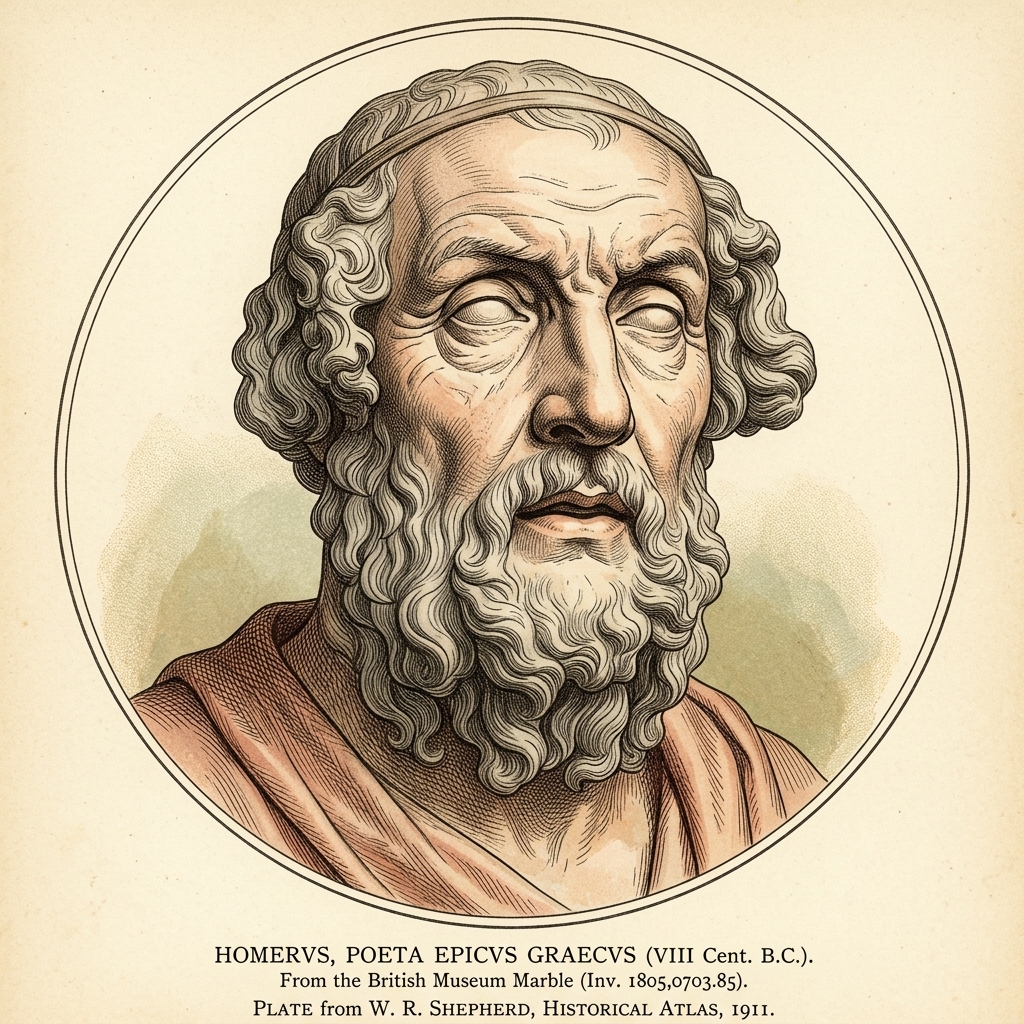
Writing made it possible to fix the songs. Somewhere in the eighth century, on the Ionian coast or the islands, the poet the Greeks called Homer composed the Iliad and, most think, the Odyssey; whether one man made both, and whether he wrote or dictated, are questions as old as scholarship. Hesiod of Boeotia, a generation later, wrote of the gods’ genealogy and of a farmer’s year, and complained of bribed judges and a brother who had cheated him. From 776 B.C., by the list the Greeks kept, the cities sent athletes to Olympia. The Greeks had begun to think of themselves as one people.
c. 770–730 B.C.The Greeks sail west
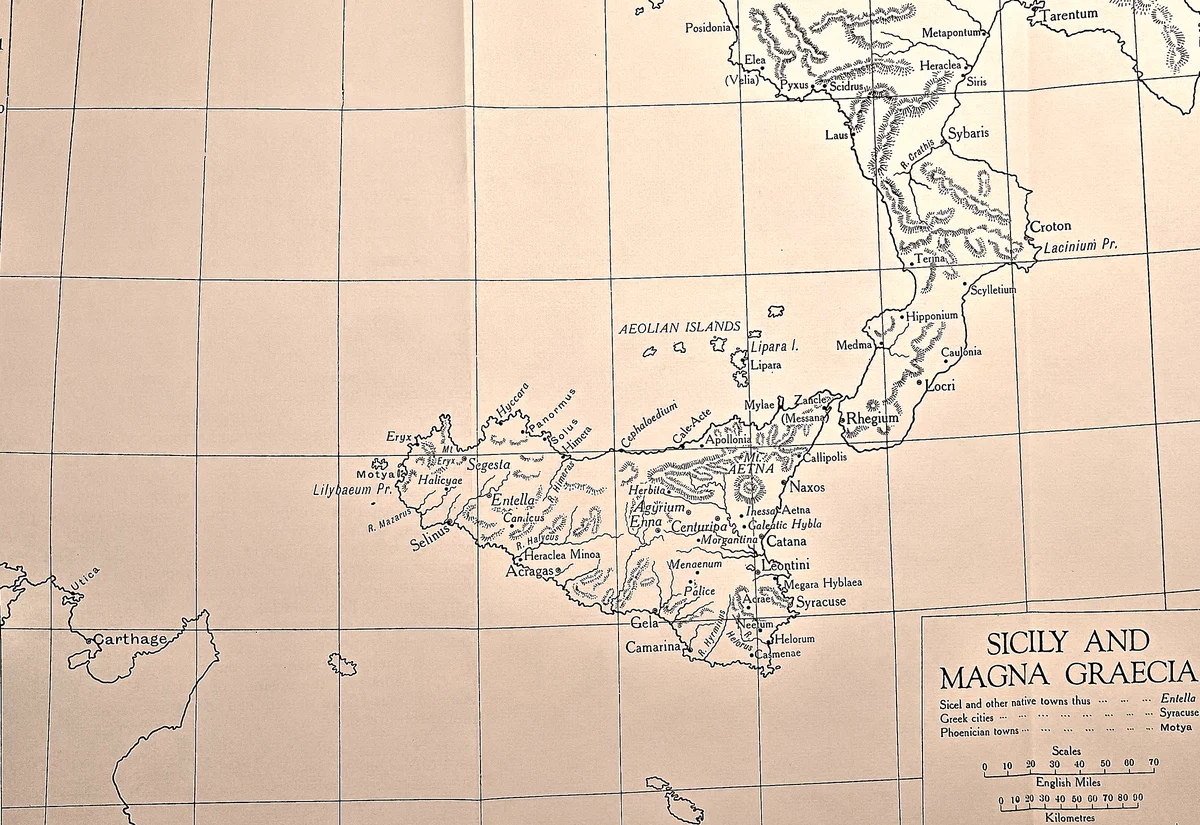
The Euboeans led. About 770 B.C. they were settled on the island of Pithekoussai in the bay of Naples, trading iron and Greek pottery with the Etruscans, and soon crossed to found Cumae on the mainland, the first Greek city in Italy. Within a generation the whole movement had begun that the next atlas maps: Naxos in Sicily in 734 B.C. and Corinthian Syracuse the year after, by the dates Thucydides gives; Sybaris, Croton and Spartan Taras on the Italian coast; Megarian and Milesian towns on the way to the Black Sea. Each colony was a new city, independent of its mother, tied to it by cult and custom, and each carried the alphabet, the gods and the games.
In Sicily the two seafaring peoples met. Thucydides records that the Phoenicians had held trading posts all round the island and withdrew to the western corner, to Motya, Soluntum and Panormus, as the Greeks came in from the east. From that corner the war between Greek and Phoenician Sicily would be fought for three hundred years, with Carthage as the Phoenician champion, until in 264 B.C. it drew in a third power, Rome. The Punic Wars begin here, on the shores of a Sicily divided between two alphabets.
 Click to enlarge
Why it mattered
Out of the darkness the Greeks emerged with the tools that would make them: an alphabet anyone could learn, an epic that told them who they were, a festival that gathered them, and the habit of founding new cities across the sea. At the same time, and by the same sea-lanes, the Phoenicians planted Carthage. The Mediterranean of the next thousand years, Greek in the east and the west’s northern shores, Punic in Africa and western Sicily, until Rome swallowed both, was drawn in these two hundred years.