Eras II–III · Atlas study

The Greek World, 750–323 B.C.

From the first colonies in the west to the death of Alexander: where the Greeks lived, who ruled them, and who led them.

Three maps · 22 steps  ·  Spain to the Caucasus, then the Aegean
Editorial outlines over Natural Earth coastlines; sites from Pleiades. Scroll each map, or step through it with the buttons beneath the plate.
✦   ❧   ✦
Scroll to begin ↓
750–323 B.C. · Three frames

A world of cities

Greece was never one state. In 750 B.C. it was several hundred small cities around the Aegean, sharing a language, gods and festivals but little else. These three maps follow those cities over four centuries: across the sea to found new ones, against the Persian empire, and through the long wars among themselves that ended with a Macedonian king as master of them all.

The first map uses a wide frame, from Spain to the Caucasus, because the Greeks came to live around both seas. The other two close in on the Aegean, where Athens, Sparta, Thebes and Macedon fought for the leadership of Greece. A gold outline marks what changed at each step.

Platec. 550 B.C. · A Mediterranean overview

The Greeks around both seas

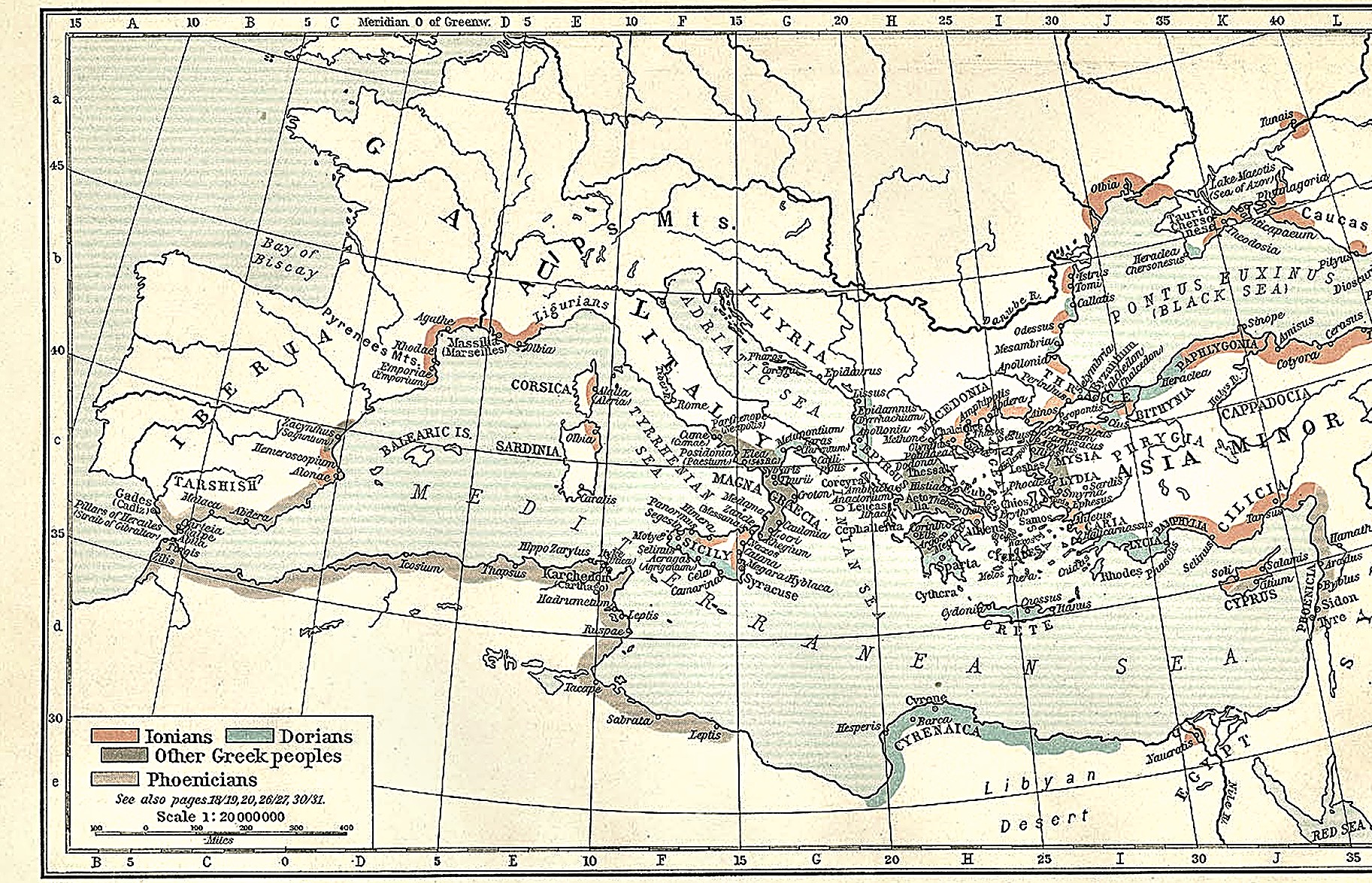
Shepherd plate · c. 550 B.C. Shepherd atlas map of Greek and Phoenician settlements around the Mediterranean and Black Sea about 550 B.C. Tap to enlarge · zoom
Greek and Phoenician settlements, c. 550 B.C. The plate separates Ionian, Dorian, and other Greek settlements from the Phoenician network. Its colours mark peoples and settlements, not a united Greek state. William R. Shepherd, Historical Atlas (1911), public domain; restored from the University of Texas scan.
Map I · The colonies

The Greeks across the sea, 750–513 B.C.

From the first trading post in Italy to Darius on the Danube: the Greek cities spread round two seas, and the Persian empire reaches them.

c. 750 B.C.

The Greeks go west

By the traditional date of the first Olympic games (776), Greeks from Euboea are trading with the Etruscans from a base on the island of Pithekoussai, and soon found Cumae on the Italian shore. Phoenicians from Tyre are ahead of them: Carthage was founded, by tradition, in 814, and Gades lies beyond the straits. From the Phoenicians the Greeks take their alphabet.
c. 700 B.C.

Sicily and the south

Within a generation Greeks settle eastern Sicily and the coasts of southern Italy. Thucydides, the source for the Sicilian dates, puts Naxos in 734 and Corinthian Syracuse a year later. Achaeans found Sybaris and Croton, Spartans Taras (706), Corinthians Corcyra. Each colony is a new, independent city, tied to its mother city by cult and custom, not by government.

c. 650 B.C.

Into the Black Sea

Megarians found Chalcedon and, opposite it, Byzantium (by tradition 668); Milesians settle Cyzicus, Sinope and Istros, and a later tradition credits Miletus with ninety colonies. Parians take Thasos, where the poet Archilochus fought the Thracians; Rhodians and Cretans found Gela (688). Inland of Ionia, Gyges makes Lydia a power and attacks Miletus and Smyrna.

c. 600 B.C.

Africa, Gaul and the Pontus

Theraeans, sent by the Delphic oracle as Herodotus tells it, found Cyrene in Libya (c. 631). Phocaeans found Massalia (c. 600), and Greek traders work from Naucratis in the Nile delta. Olbia, Pantikapaion and the western Pontic towns ring the Black Sea. Lydia under Alyattes pushes east until, in 585, a battle with the Medes at the Halys is broken off by an eclipse.

c. 546 B.C.

Persia reaches the sea

Akragas (580) and Emporion are founded, and Phocaeans settle Alalia in Corsica. Croesus of Lydia makes the Ionian cities pay him tribute, then crosses the Halys against Cyrus the Persian, who has overthrown the Medes. Sardis falls, and Cyrus' generals take the Ionian cities one by one. Most Phocaeans sail away rather than submit; after a sea battle off Alalia they settle Elea.

c. 513 B.C.

Darius in Europe

Cyrus takes Babylon (539) and its Syrian lands; his son Cambyses conquers Egypt (525), and Cyrene and Cyprus submit. Darius crosses the Bosporus on a bridge of boats, marches against the Scythians beyond the Danube, and leaves Megabazus to subdue Thrace; Amyntas of Macedon gives earth and water. Persia now rules every Greek city in Asia and many in Europe.

c. 750 B.C.
Greek colonies, Lydia and Persia, 750–513 B.C. Pithekoussai and Cumae Eastern Sicily Southern Italy and Corcyra Gela, Locri and Himera Thasos, Chalcidice and the Thracian coast Cyzicus, Lampsacus, Abydos and Chalcedon Byzantium and Selymbria Sinope, Istros and Trapezus Massalia, Naucratis and the Pontic towns Cyrene Akragas, Emporion, Alalia, Elea and the far Pontus Greece The east Greeks: Aeolis, Ionia, Doris and the islands Macedon Thrace Phoenician towns and Carthage Phoenicia Lydia Phrygia and the lands to the Halys Cappadocia and Armenia Egypt Syria and Mesopotamia Cyprus HELLAS MACEDONIA THRACIA LYDIA PERSIAN EMPIRE AEGYPTVS MARE INTERNVM PONTVS EVXINVS ETRVSCI IBERI CELTAE SCYTHAE ILLYRII LIBYES PHRYGIA MEDI ASSYRIA → BABYLON → MACEDONES THRACES AEGYPTVS Delphi Pithekoussai c. 770 Chalcis mother city Carthago trad. 814 Gades Phoenician Tyre mother of Carthage Syracuse 733 Taras 706 Corinth mother city Byzantium 668 Darius crosses Gela 688 Sinope Istros 657 Miletus mother of the Pontic cities Sardis Gyges falls c. 546 Cyrene c. 631 submits 525 Massalia c. 600 Olbia Epidamnus 627 Akragas 580 Emporion c. 575 Alalia battle c. 540 Phocaea abandoned Memphis Cambyses 525
Greek homelandGreek coloniesSubject to PersiaKingdom of LydiaPersian empirePhoenician cities and Carthagechanged this step

Colonies are drawn as coastal spots of about 30 km round each city, grouped by the wave that founded them; foundation dates follow Thucydides (6.3–5), Herodotus and the later chronographers and are often traditional. Empires are broad editorial outlines. Coastlines and rivers: Natural Earth. Sites: Pleiades.

Persia now held the Greeks of Asia and the northern Aegean. The next two maps close in on the Aegean, where the free cities of the mainland met the empire.

Plate500–c. 450 B.C. · Persia and the Athenian empire

Two moments in the Persian struggle

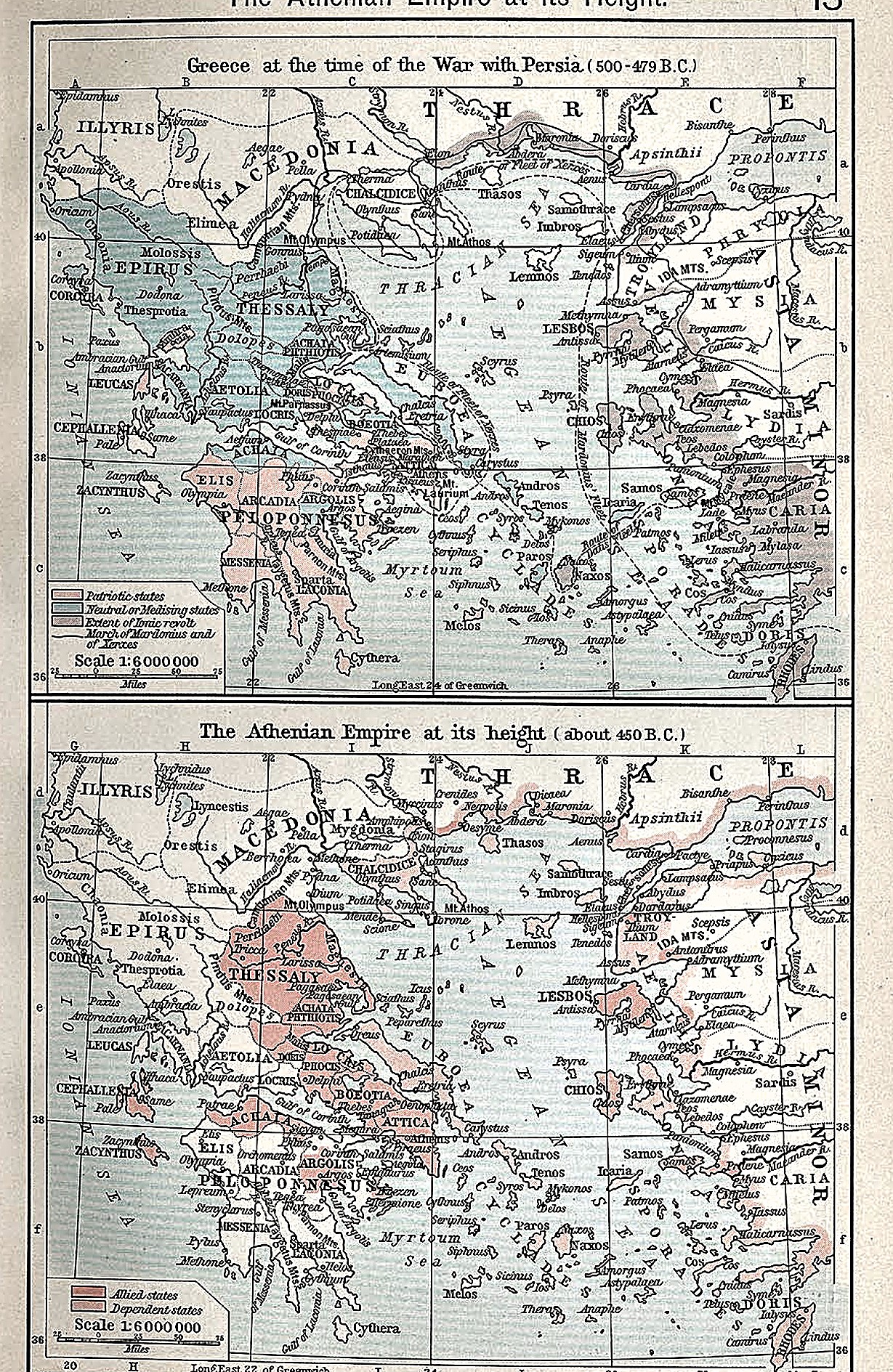
Shepherd plate · 500–c. 450 B.C. Two Shepherd atlas maps showing Greece during the Persian Wars and the Athenian empire at its height Tap to enlarge · zoom
Greece during the Persian Wars; the Athenian empire at its height. The upper map fixes the theatre of 500–479 B.C.; the lower shows the Delian League after Athens had turned it into an empire. William R. Shepherd, Historical Atlas (1911), public domain; restored from the University of Texas scan.
Map II · Persia and Athens

Persia and Athens, 499–404 B.C.

The Persian Wars, the Athenian empire that grew out of them, and the war with Sparta that ended it.

499 B.C.

The Ionian Revolt

The Persian king rules from the Aegean to the Indus. In 499 Aristagoras of Miletus leads the Ionian cities in revolt; Sparta refuses him help, but Athens sends twenty ships and Eretria five. The rebels march inland and burn Sardis (498), and Caria, the Hellespont and Cyprus join them. Herodotus calls those Athenian ships the beginning of the troubles between Greeks and barbarians.

490 B.C.

Marathon

Persia crushes the Ionian fleet at Lade and sacks Miletus (494); Mardonius recovers Thrace and Macedon (492). In 490 Datis and Artaphernes cross the Aegean, take Naxos, sack Eretria, and land at Marathon, where the Athenians and Plataeans charge and drive them to their ships. Herodotus gives the dead as 6,400 Persians and 192 Athenians.

480 B.C.

Xerxes

Xerxes bridges the Hellespont and marches through Thrace; Herodotus' figure of more than five million men is impossible, but no larger army had entered Europe. Thessaly, Thebes and most of Boeotia go over to him, while thirty-one Greek states hold together under Sparta. Leonidas falls at Thermopylae, Athens is abandoned and burned, and the allied fleet wins at Salamis.

479 B.C.

Plataea and Mycale

Mardonius, left in Greece with the army, burns Athens a second time, then is killed and his army destroyed at Plataea by the Spartan regent Pausanias. The Greek fleet crosses to Ionia and burns the Persian camp at Mycale, on the same day, tradition said. Samos, Chios, Lesbos and the Ionian cities rise, and the Athenians besiege Sestos on the Hellespont.

454 B.C.

From league to empire

In 478 Athens and the islanders form a league at Delos, paying ships or money assessed by Aristides. Cimon destroys a Persian fleet and army at the Eurymedon (c. 466). Naxos and Thasos try to leave and are forced back. In 454 the treasury moves from Delos to Athens and the tribute lists begin. Athens holds Boeotia after Oenophyta (457), while Sparta fights its helots in Messenia.

431 B.C.

The Peloponnesian War

Athens gives up Boeotia and Megara in the Thirty Years' Peace (446), but crushes Samos (440–439), allies with Corcyra (433) and besieges Potidaea (432). In 431 Sparta and its allies invade Attica. Pericles keeps the Athenians behind their walls and uses the fleet; the plague, which Thucydides survived and described, kills Pericles in 429. Thucydides judged Sparta's fear of Athens the war's truest cause.

413–411 B.C.

Sicily and Decelea

The Peace of Nicias (421) does not hold. Athens destroys Melos (416) and sends a great armada against Syracuse (415); in 413 it is annihilated. Sparta fortifies Decelea in Attica, and more than twenty thousand slaves desert, Thucydides says. Chios, Lesbos, Miletus, Rhodes, Euboea and Byzantium revolt, and Persia's satraps pay for a Spartan fleet.

404 B.C.

The fall of Athens

Athens rebuilds its fleet and wins at Arginusae (406), but Lysander destroys it at Aegospotami (405). Starved by blockade, the city surrenders in 404: its long walls are pulled down, its fleet is cut to twelve ships, and the Thirty rule with a Spartan garrison. Sparta takes over the islands; the Greeks of Asia, promised to the King for Persian gold, pass to Cyrus the Younger.

499 B.C.
The Aegean from the Ionian Revolt to the fall of Athens, 499–404 B.C. Attica Megara Boeotia Phocis and Locris Aetolia and Acarnania Thessaly Epirus Macedon Chalcidice Amphipolis and the lower Strymon The Thracian coast The Thracian Chersonese Byzantium and Perinthus Thrace The Hellespont and Propontis Aeolis and Ionia Doris and the Carian coast Asia Minor Euboea Thasos, Samothrace, Lemnos, Imbros, Scyros Lesbos, Chios and Samos The Cyclades Rhodes and Cos Crete Corcyra and the Ionian islands Corinth and Sicyon Argos and the Argolid Arcadia Elis and Achaea Laconia Messenia ATTICA BOEOTIA PHOCIS AETOLIA THESSALIA MACEDONIA THRACIA IONIA ASIA ARGOLIS ARCADIA ELIS LACONIA MESSENIA MARE IONIVM MARE AEGAEVM PONTVS EVXINVS ILLYRII to Sicily, 415–413 BOEOTIA PHOCIS AETOLIA THESSALIA EPIRVS MACEDONIA THRACES CRETA ARGOLIS Athens Sparta Miletus Aristagoras sacked 494 Sardis burned 498 Eretria sends five ships sacked 490 Marathon 490 Naxos taken 490 forced back c. 470 Lade 494 Thermopylae 480 Artemisium 480 Salamis 480 Abydos Xerxes' bridges Plataea 479 besieged 429–427 Mycale 479 Sestos taken 479–478 Delos treasury moved 454 Thasos revolt 465–463 Eurymedon c. 466 Potidaea revolt 432 Corcyra allied 433 Pylos Athenian 425 Amphipolis lost 424 Melos destroyed 416 Decelea fortified 413 Chios revolts 412 Aegospotami 405
AthensAthens' allies and subjectsSpartaSparta's alliesPersian empireSided with Persia, or occupiedIn revoltchanged this step

Regions are editorial outlines, clipped to Natural Earth coastlines; islands are shown whole. A region takes the colour of its leading cities, so smaller towns that stood apart (Plataea, Melos) are named in the notes. Membership of the Athenian alliance follows the tribute lists from 454. Sites: Pleiades.

Athens lost its empire, though not for long its walls or its fleet. The last map follows the contest for leadership that Sparta, Thebes and finally Macedon each won in turn.

Plate431 and 362 B.C. · Two balances of power

From the Peloponnesian War to Theban leadership

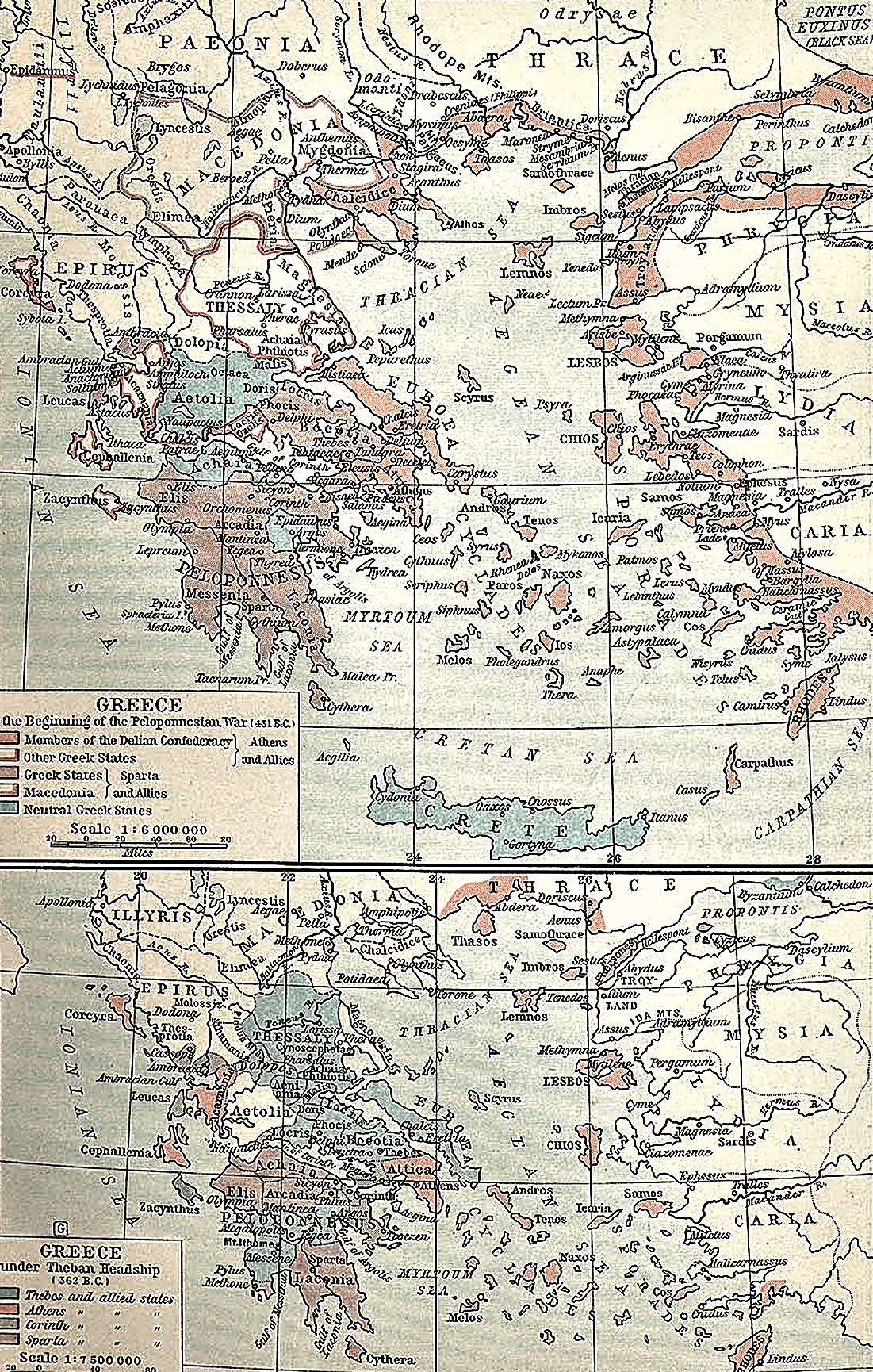
Shepherd plate · 431 and 362 B.C. Two Shepherd atlas maps showing the alliances at the beginning of the Peloponnesian War and Greece under Theban leadership in 362 B.C. Tap to enlarge · zoom
Greece in 431 and 362 B.C. The upper map divides the alliances at the opening of the Peloponnesian War; the lower records the brief Theban hegemony after Leuctra. William R. Shepherd, Historical Atlas (1911), public domain; restored from the University of Texas scan.
Map III · The fourth century

Sparta, Thebes and Macedon, 395–323 B.C.

Three leading powers in seventy years, the King of Persia holding the balance, and a Macedonian king at the end.

395 B.C.

Sparta's empire

Sparta rules Athens' old empire through governors and garrisons, and goes to war with Persia for the Greeks of Asia, under Thibron (400) and then King Agesilaus (396). With Persian gold, Thebes, Athens, Corinth and Argos rise against Sparta in 395, and Lysander falls at Haliartus. The next year Conon's fleet, in the King's pay, destroys Sparta's navy off Cnidus.

386 B.C.

The King's Peace

After eight years of war the Persian king sets the terms. The Greek cities of Asia, and Cyprus, are his; every other city is to be autonomous, except Lemnos, Imbros and Scyros, which go to Athens. Sparta, as the peace's enforcer, breaks up the Boeotian League, splits Mantinea into villages (385) and seizes the citadel of Thebes (382).

371 B.C.

Leuctra

Theban exiles retake their citadel (379), and Athens forms a new league (378), promising its members no tribute and no settlers. At Leuctra (371) the Theban army of Epaminondas, massed fifty shields deep on its left, breaks the Spartan line. King Cleombrotus and about four hundred of the seven hundred Spartiates present are killed, according to Xenophon.

362 B.C.

Mantinea

Epaminondas invades Laconia, the first enemy army there in centuries, and frees Messenia, where the helots found Messene (369); the Arcadians build Megalopolis. Pelopidas carries Theban power into Thessaly. At Mantinea (362) Epaminondas wins and is killed. Xenophon ends his history there: after the battle, he says, Greece was in more confusion than before.

348 B.C.

Philip

Philip II takes the Macedonian throne (359) and rebuilds the army around a long-speared phalanx. He takes Amphipolis (357), Pydna and Potidaea (356) and Methone (354), where he loses an eye. Athens' allies break away in the Social War (357–355). After the Crocus Field (352) Philip heads the Thessalians, and in 348 he destroys Olynthus while Demosthenes urges Athens to act.

338 B.C.

Chaeronea

The peace of Philocrates (346) ends the Sacred War on Philip's terms. He conquers Thrace (342–340), though Perinthus and Byzantium beat off his sieges. At Chaeronea (338) he defeats Athens and Thebes, with his eighteen-year-old son Alexander commanding a wing. Philip garrisons Thebes, spares Athens, and gathers every Greek state but Sparta into a league at Corinth that votes war on Persia.

334 B.C.

Alexander crosses

Philip is murdered (336). Alexander crushes a Theban revolt and razes the city (335), then crosses the Hellespont with about 37,000 men by Diodorus' count. He beats the satraps at the Granicus (334), takes Sardis, and restores democracy to the Ionian cities; Miletus and Halicarnassus are taken by siege. The Persian fleet holds the islands until 332.

323 B.C.

After Alexander

Alexander destroys the Persian empire at Issus (333) and Gaugamela (331) and marches on to India. In Greece, Antipater beats Agis III of Sparta at Megalopolis (331). When news comes that Alexander has died at Babylon (June 323), Athens and the Aetolians lead a Greek rising, the Lamian War, and shut Antipater up in Lamia. Macedon wins it in 322.

395 B.C.
The Aegean from the Corinthian War to the death of Alexander, 395–323 B.C. Attica Megara Boeotia Phocis and Locris Aetolia and Acarnania Thessaly Epirus Macedon Chalcidice Amphipolis and the lower Strymon The Thracian coast The Thracian Chersonese Byzantium and Perinthus Thrace The Hellespont and Propontis Aeolis and Ionia Doris and the Carian coast Asia Minor Euboea Thasos, Samothrace, Lemnos, Imbros, Scyros Lesbos, Chios and Samos The Cyclades Rhodes and Cos Crete Corcyra and the Ionian islands Corinth and Sicyon Argos and the Argolid Arcadia Elis and Achaea Laconia Messenia ATTICA BOEOTIA PHOCIS AETOLIA THESSALIA MACEDONIA THRACIA IONIA ASIA ARGOLIS ARCADIA ELIS LACONIA MESSENIA MARE IONIVM MARE AEGAEVM PONTVS EVXINVS ILLYRII Illyrians beaten 358 PHOCIS AETOLIA THESSALIA EPIRVS THRACES CRETA ARGOLIS ELIS Athens Sparta Cnidus 394 Coronea 394 Sardis Agesilaus surrenders Thebes citadel seized 382 garrisoned razed 335 Mantinea split 385 362 Olynthus league broken 379 destroyed 348 Leuctra 371 Messene founded 369 Megalopolis c. 368 Agis killed 331 Pella Philip's capital Amphipolis 357 Methone 354 Potidaea 356 Delphi Sacred War 356–346 Chaeronea 338 Perinthus 340 Byzantium siege fails 340 Corinth League 337 Granicus 334 Miletus besieged Halicarnassus besieged Lamia Antipater besieged
SpartaSparta's allies and garrisonsAthensAthens' second leagueThebes and BoeotiaAllies of ThebesMacedonBeing won by MacedonLeague of Corinth, under MacedonPersian empireIn arms against Macedonchanged this step

Regions are editorial outlines, clipped to Natural Earth coastlines; islands are shown whole, and a region takes the colour of its leading cities. In 395 the dashed teal marks the coalition of Thebes, Athens, Corinth and Argos against Sparta. Sites: Pleiades.

323 B.C. · The inheritance

Greek without Greece

When Alexander died, Greek was the language of kings and settlers from Egypt to the Indus, and the cities of old Greece were small states in a world of great monarchies. The Lamian War was their last attempt to act together against Macedon. What Alexander's generals made of his empire, and how Rome came to inherit it, is the story of the next chapters.

Continue: Alexander's campaign, 334–323 B.C. →
Then: the heirs of Alexander →
Meanwhile in the west: the rise of Rome, 509–146 B.C. →