In two wars, an emperor carries Rome across the Danube, breaks the fortress system of Decebalus, and turns a dangerous neighbor into an imperial province.
A.D. 101–106 · The lower Danube and Carpathian basin
After Cassius Dio, archaeology, and the surviving narrative in stone on Trajan’s Column. A narrative chapter with an interactive campaign map.
✦ ❧ ✦
Scroll to begin ↓
†A.D. 100 · A fortified kingdom beyond the river
The bridge, the mountain kingdom, and Rome’s new frontier
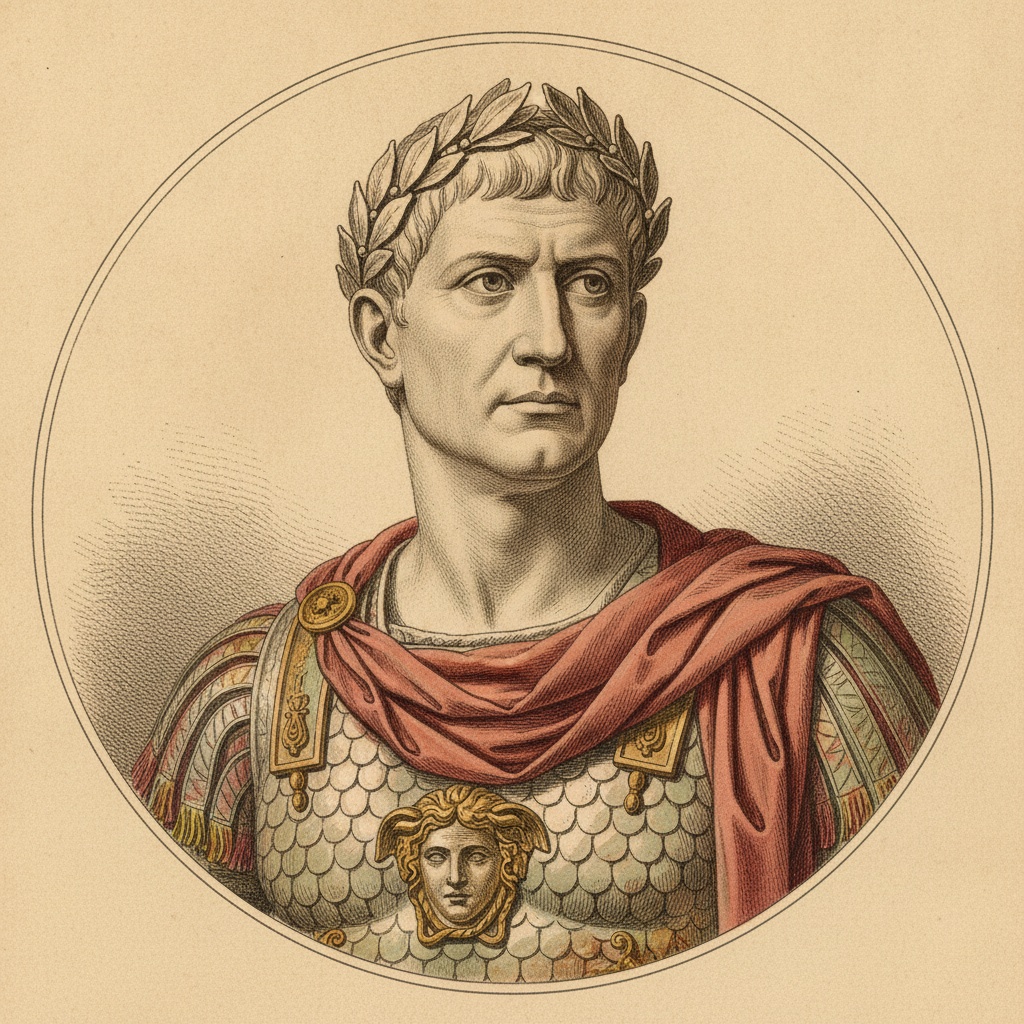
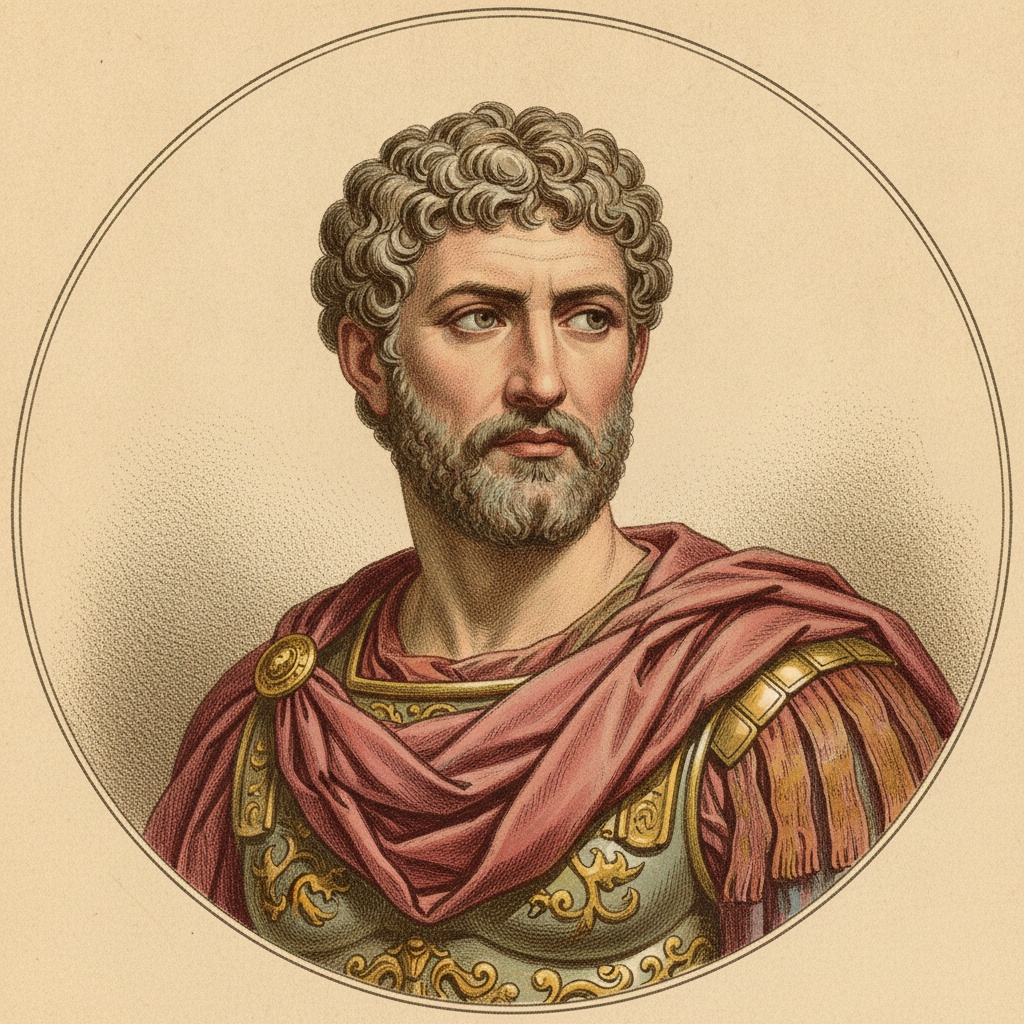
TrajanRoman emperor and commander, r. 98–117 A.D.
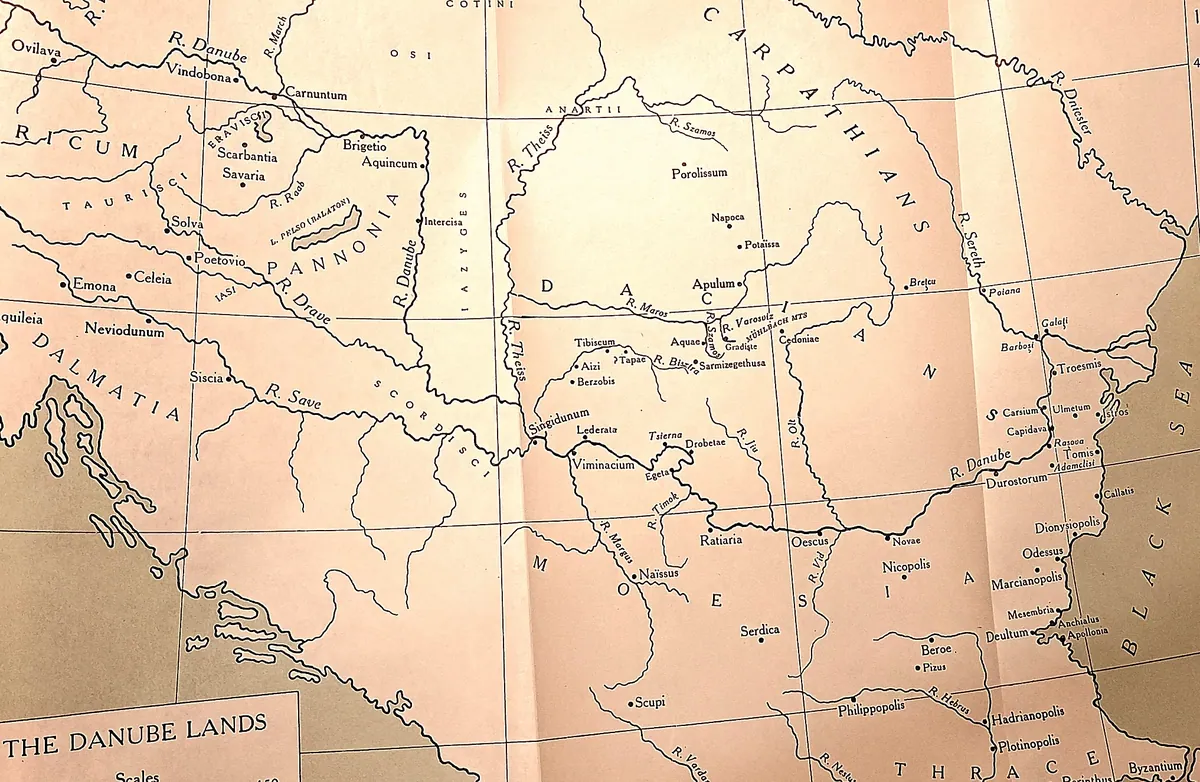
When Trajan became emperor, the Dacian king Decebalus ruled a rich, organized, and heavily fortified state above Rome’s Danube frontier. The river divided two powers, but it did not keep them apart. Roads and passes ran north into the Carpathian basin; raiders, deserters, merchants, and envoys moved in both directions; and from the high country around Sarmizegetusa a Dacian king could threaten the Roman provinces of Pannonia and Moesia.
Plate · Pannonia, Dacia, MoesiaClick to enlarge
The whole Danube front. Carnuntum, Aquincum and Viminacium on the river at the left, the Iron Gates below them, and inside the Carpathian arc the Dacian heartland with Sarmizegethusa in the mountains. Downstream the Moesian bank runs to the Black Sea. Every campaign in this chapter is a crossing of the line on this sheet, or a march up into the arc above it.
The Cambridge Ancient History (1st ed., Cambridge University Press), map plate “The Danube Lands” — photographed from the fold-out sheet and cleaned.
Dacia was not a shapeless wilderness waiting for Rome. Its political reach shifted with the loyalties of neighboring peoples, but its center was formidable. In the Orăștie Mountains, walls of dressed stone and timber enclosed a linked group of hill-forts. Workshops, water channels, terraces, and sanctuaries stood beside the defenses. Their masonry combined techniques from the classical Mediterranean with a local Iron Age tradition. The surviving ruins confirm what Rome’s war monument prefers to obscure: Trajan attacked a vigorous kingdom with its own craftsmen, sacred places, and command of difficult ground.
Nor was this the first trial of strength. In the reign of Domitian, war on the lower Danube had brought Roman reverses as well as victory. A Roman army under Cornelius Fuscus was destroyed; a later army beat Decebalus near Tapae, but pressure elsewhere forced Domitian to settle. Decebalus became Rome’s client and received money and technical assistance. Such arrangements were ordinary instruments of frontier government. Rome paid allied kings because an orderly neighbor could be cheaper than occupation. Yet after Domitian’s murder, hostile authors recast his settlement as a national humiliation: Rome, they said, was paying tribute to a barbarian.
Trajan inherited both the strategic problem and the insult. Adopted by the elderly emperor Nerva in A.D. 97, he was already a senior soldier commanding on the Rhine. When Nerva died the next year, Trajan did not hurry to Rome. He remained with the frontier armies before entering the capital, a useful declaration of where imperial power rested. Dacia offered him a dangerous neighbor, a disputed treaty, and a theatre in which a new emperor could prove that the failures of an earlier reign would not be repeated.
IA.D. 101–102 · The first Dacian war
Beyond the Danube
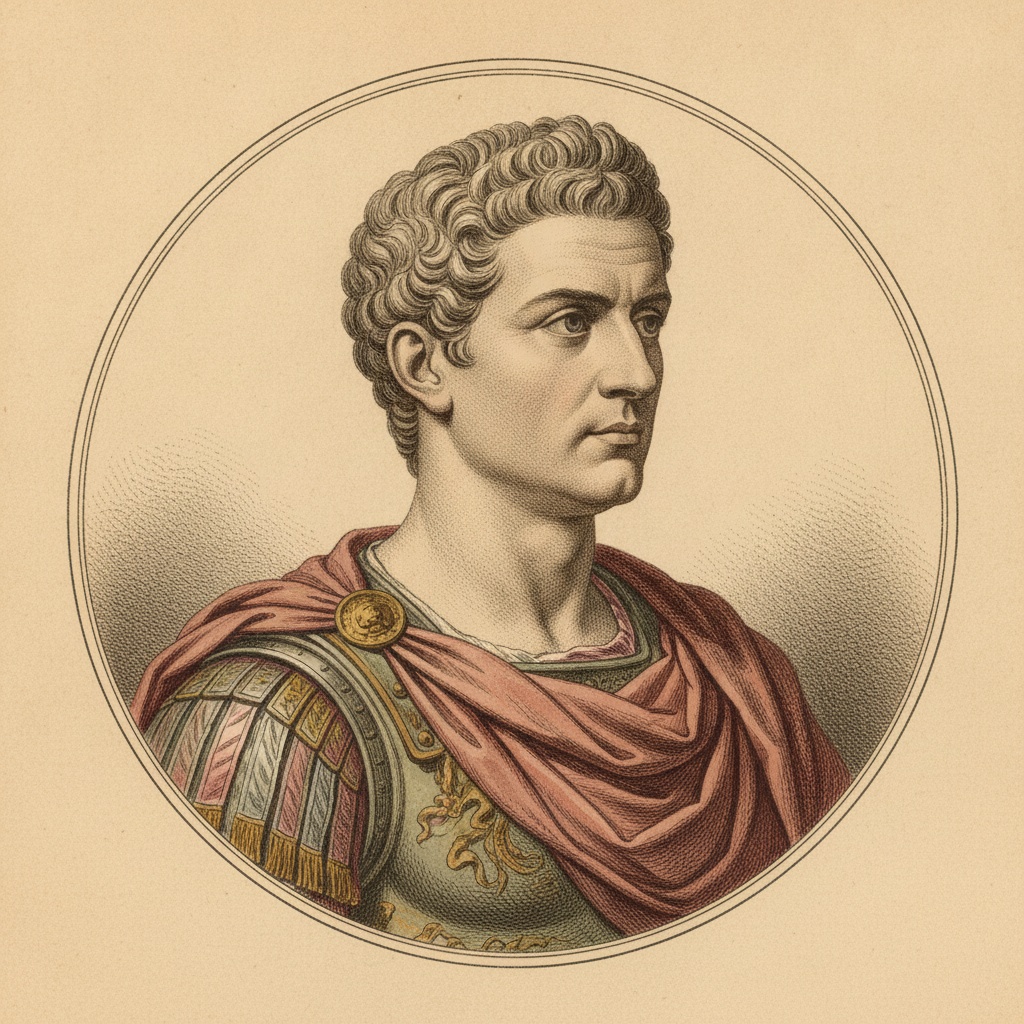
DomitianHis Dacian settlement became Trajan’s grievance.
Trajan prepared before he crossed. Forces were drawn toward the Danube, roads improved, and the riverbank secured. The opening scenes of Trajan’s Column linger over sentries, boats, bridges, marching columns, sacrifice, and construction. The monument is propaganda, not a field diary, but on one point it is persuasive: Roman victory began with organized labor.
In A.D. 101 the emperor led his army across pontoon bridges and into the Banat. One line of advance ran from Lederata through Berzobis toward the constricted approach traditionally associated with Tapae. There Decebalus accepted battle. The surviving account supplies no dependable order of battle, and the Column compresses action into emblematic scenes, yet the result is clear. The Dacians withdrew and the Romans pressed toward the fortress country.
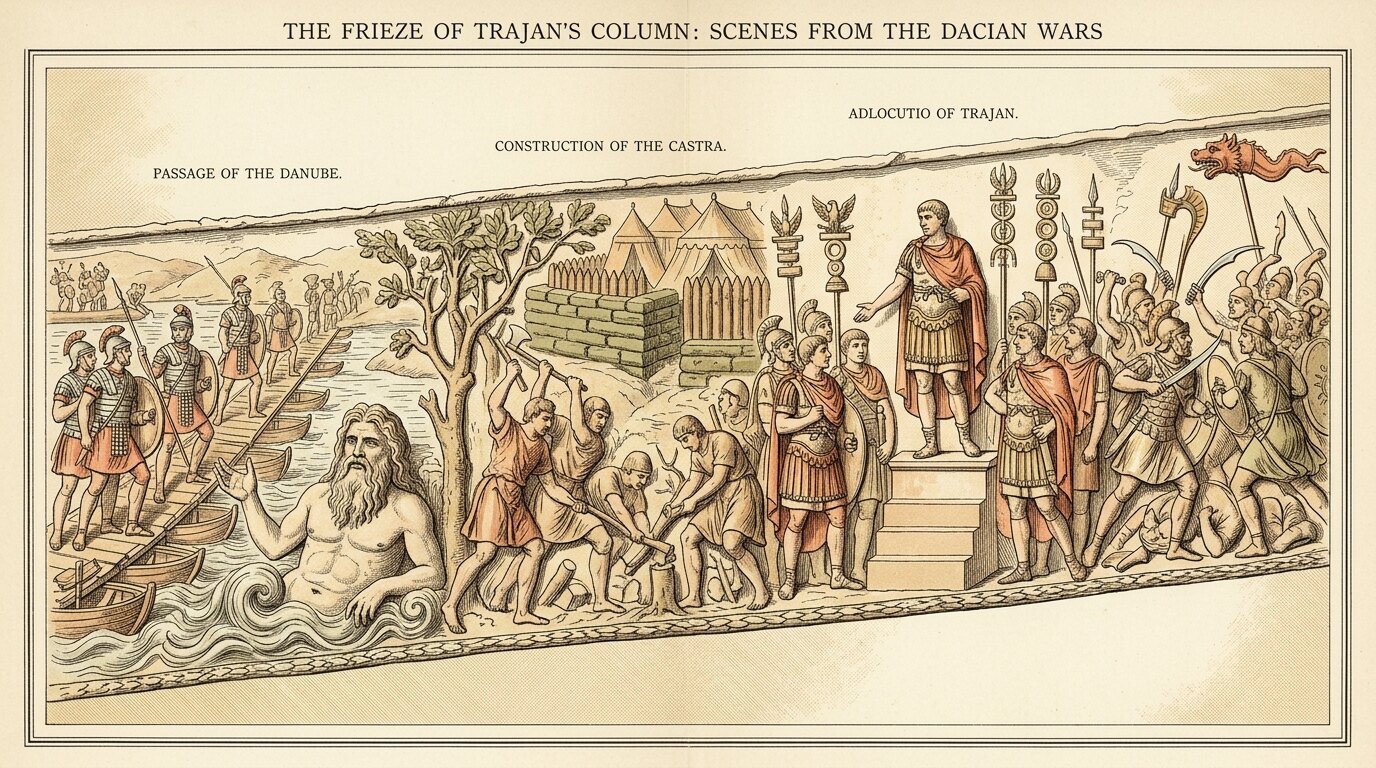
The Column · Opening band, A.D. 101Click to enlarge
The four things the Column says first. Read left to right, as the band itself is read. The army files over a pontoon bridge of linked river barges while the bearded river-god Danuvius watches from the water — the sculptor’s way of saying that the river consented. Then the work: legionaries felling timber, cutting ditch and turf rampart for the camp. Then Trajan on a low tribunal addressing the assembled standards. Only last, at the right, the fighting — legionaries in segmented plate against hill-men swinging the two-handed falx beneath a dragon standard. Three of the four scenes are engineering, ceremony and order; the battle is the smallest of them. That proportion is the monument’s argument about what Roman victory consisted of.
Restored plate in the manner of W. R. Shepherd’s Historical Atlas (1911), drawn for this chapter after the scene sequence of the Column. A reconstruction, not a photograph of the marble.
The advance did not end the war. Roads had to be cut through forest, camps raised, food brought across the river, and each captured position held behind the army. With winter approaching, Decebalus shifted the danger. Dacian forces and allies crossed into Moesia far to the east, compelling Trajan to transfer troops toward the lower Danube. The fighting remembered at Adamclisi was hard enough for Rome to monumentalize it later with the Tropaeum Traiani. A battle monument is not a casualty return, but this was plainly no effortless imperial parade.
By A.D. 102 Roman pressure had returned to the mountains. Decebalus sought terms before the fortress core was completely destroyed. He accepted conditions meant to make a second resistance impossible: weapons and military specialists were to be surrendered, forts dismantled, deserters returned, and an independent foreign policy abandoned. Roman garrisons remained at strategic points. Trajan took the victory title Dacicus and went home to celebrate a triumph. Decebalus kept his throne, but only inside a settlement designed to strip kingship of the means to defend itself.
Era V · Nerva, Trajan, and Hadrian
Trajan Conquers Dacia, 101–106 A.D.
Scroll to follow two invasions, a winter counterattack, the bridge that fixed Rome north of the Danube, and the fall of a mountain kingdom.
On the eve of war · 100 A.D.
A Kingdom Inside Rome's Frontier
North of the Danube, Decebalus had welded the Dacian hill-forts into the strongest kingdom on Rome's European frontier. Domitian had paid him a subsidy and supplied engineers after an inconclusive war. Trajan inherited that settlement and judged a fortified client kingdom overlooking the middle Danube intolerable.
Spring–Autumn 101 A.D.
Across the Danube and Through the Banat
Trajan concentrated a massive field army on the river, crossed by pontoon bridge at Lederata, and drove north through Berzobis. Near the narrow Tapae corridor his legions defeated Decebalus's army. The approach to the Dacian capital was open—but winter, distance, and a counterattack elsewhere prevented a quick conquest.
Winter 101–102 A.D.
Decebalus Turns the War East
Dacian and allied forces crossed the frozen lower Danube into Moesia, forcing Trajan to shift the war hundreds of miles east. The Roman counter-stroke culminated near modern Adamclisi, where the later Tropaeum Traiani memorialized a costly victory. With Roman columns again threatening his capital, Decebalus sued for peace.
The armed peace · 103–105 A.D.
A Bridge That Made Conquest Permanent
The treaty left Decebalus on his throne but ordered him to surrender weapons, engineers, and fortifications. Neither side treated the peace as final. At Drobeta, Apollodorus of Damascus threw a monumental bridge across the Danube: Rome could now reinforce an army north of the river in any season, without trusting boats or weather.
The second war · 105–106 A.D.
The Mountain Citadels Close Like a Fist
When war resumed, Trajan no longer sought submission. Columns advanced from the Drobeta bridge and the western crossing, reducing the interlocking fortresses of the Orăștie Mountains. They converged on Sarmizegetusa Regia, cut its water supply, and stormed the Dacian political and sacred center.
Summer 106 A.D.
A Kingdom Becomes a Province
Decebalus fled and killed himself before Roman cavalry could capture him. The Dacian kingdom ceased to exist; its central territories became the province of Dacia, guarded by roads, forts, and legions north of the Danube. A new provincial capital, Ulpia Traiana Sarmizegetusa, rose away from the destroyed royal stronghold.
100 A.D.
Dacian core (schematic)Roman Dacia after 106Roman advanceDanube bridge
Sites: Pleiades; Sarmizegetusa fortress context: UNESCO. Land, lakes and rivers: Natural Earth (public domain). Campaign routes and the Dacian core wash are schematic, not surveyed borders. Tapae is placed approximately because its Pleiades record has no point geometry. Narrative sequence: Cassius Dio, Book 68; the official Trajan’s Column project; the lost details of both wars remain debated.
IIA.D. 102–105 · A settlement neither ruler trusted
The peace and the bridge
The peace of 102 was not a return to the old frontier system. It placed Roman soldiers inside Dacia, restricted Decebalus’s diplomacy, and demanded that he dismantle the very defenses on which his power depended. To obey fully was to remain king in name while Rome controlled the conditions of survival. To rebuild was to give Trajan the case for a war of annexation.
Cassius Dio presents the second war as the consequence of Dacian treaty-breaking. Decebalus, he says, gathered weapons, received deserters, repaired forts, sought allies, and attacked peoples who had opposed him. This may preserve the formal Roman indictment, but it is not an impartial view from the frontier. Rome had imposed terms a sovereign king could scarcely observe without surrendering sovereignty. The interval was an armed peace in which both sides prepared for the settlement to fail.
The most visible Roman preparation stood at Drobeta. There, in a gorge where the Danube ran deep and violent, Apollodorus of Damascus designed a permanent bridge carried on masonry piers. Dio, writing after its wooden superstructure had already been removed, could still see the piers and marveled at the difficulty of founding them in the river. Pontoon bridges could carry an invasion, but they depended on current, season, and boats. This bridge made movement and supply predictable. It also announced that Rome intended to remain on the northern bank.
“Trajan constructed over the Ister a stone bridge for which I cannot sufficiently admire him.”Cassius Dio, Roman History, Book 68 (Earnest Cary translation)
Engineering did not make war inevitable by itself. It made a different kind of war possible: one that could be reinforced in winter, supplied on a fixed line, and continued until the mountain kingdom ceased to exist. When the Senate again declared Decebalus an enemy, Trajan returned in person. This time there would be no client king at the end.
The Column · Midpoint band, A.D. 103–105Click to enlarge
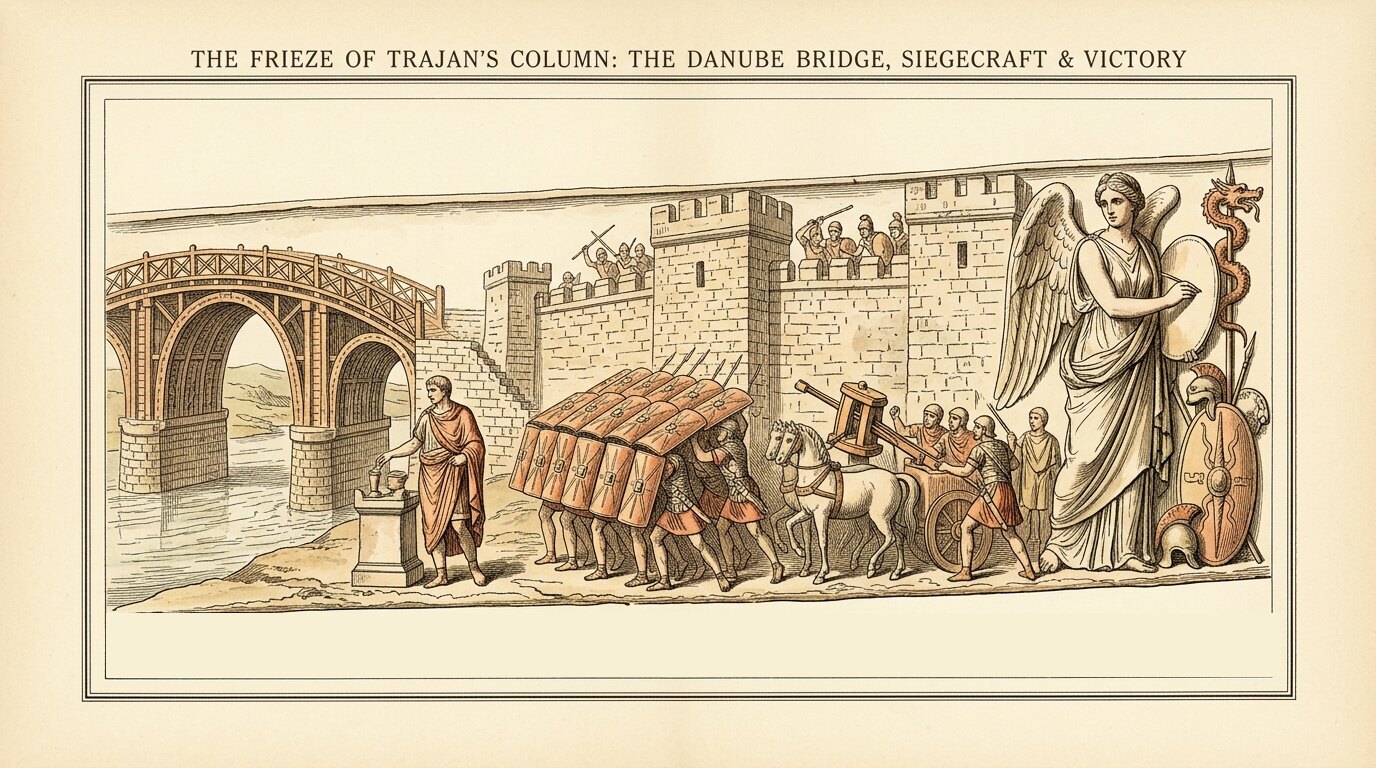
The bridge, and the hinge of the story. At the left is the structure Dio could not sufficiently admire: the timber arches on their masonry piers, with Trajan pouring a libation at the bridgehead altar. In the centre, siege work — shields locked overhead into a tortoise against a citadel wall, and the carroballista, the cart-mounted bolt-thrower, giving covering fire. At the right stands the winged Victory who on the real Column separates the First Dacian War from the Second, writing on a shield set between trophies of captured arms. She is not a scene but a paragraph break, and everything after her belongs to the war that ended the kingdom.
Restored plate in the manner of W. R. Shepherd’s Historical Atlas (1911), drawn for this chapter after the scene sequence of the Column. A reconstruction, not a photograph of the marble.
IIIA.D. 105–106 · The second Dacian war
The closing of the mountain roads
Decebalus tried diplomacy, alliance, and stratagem because he could no longer expect to beat the assembled imperial army in open battle. Dio says that he appealed to neighboring peoples: if Dacia were destroyed, he warned them, Rome would face each of them alone. The argument reveals the stakes more clearly than the Roman language of punishment. The war was deciding whether an independent power could remain inside the arc of Rome’s Danubian provinces.
Dio also tells a darker story. Decebalus captured the Roman commander Longinus and offered to exchange him only if Trajan restored territory and paid the costs of war. Longinus killed himself rather than become leverage against the emperor. The episode comes through a hostile literary tradition and its details cannot be checked, but it shows how ancient readers understood the contest: not simply as armies moving on a map, but as a struggle over loyalty, dignity, and the personal authority of two rulers.
The Roman advance of 105–106 was deliberate. Columns moved north from the Danube, joined roads to forts, and reduced the approaches to the Orăștie strongholds. Dio’s surviving phrase is well chosen: Trajan fought with “safe prudence rather than with haste.” Sarmizegetusa Regia was not merely a palace behind one wall. It was the center of a defensive landscape, supported by outlying citadels that watched the valleys and protected the routes into the high country. Rome had to unravel the system before it could take the center.
The Column · Ritual, cavalry and auxiliariesClick to enlarge
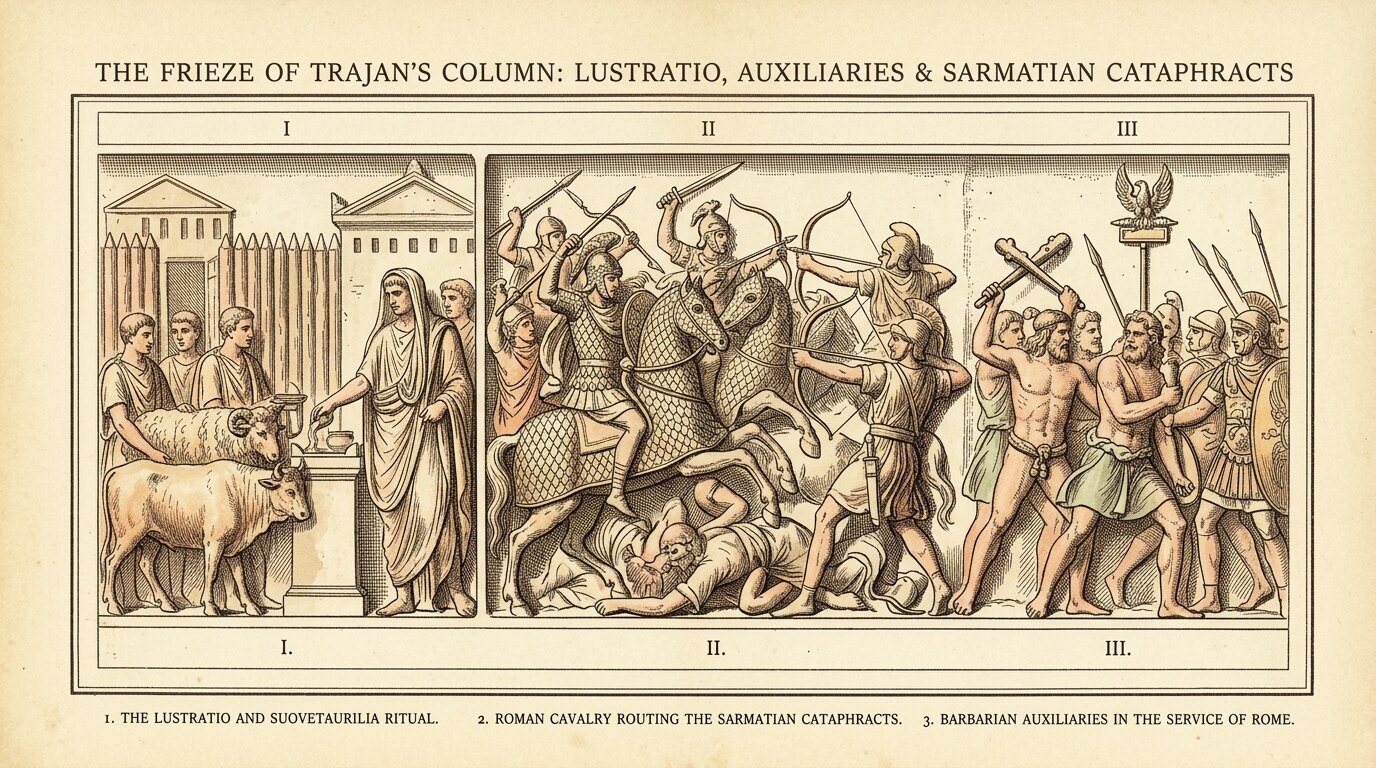
Who actually fought these wars. Three panels. In the first, Trajan as Pontifex Maximus, his toga drawn over his head, pours the offering while the sacrificial animals are led round the camp palisade — the lustratio, the purification of the army before a campaign. In the second, the Roxolani cataphracts: horse and rider both sheathed in scale, the heaviest cavalry Rome met on this frontier, broken here by legionaries and eastern archers. In the third, bare-chested Germanic warriors with clubs advancing under the legionary eagle. The Column is candid about this: a large part of the army that took Dacia was not Roman, and the sculptor gives the auxiliaries their own dress, weapons and hair rather than dressing everyone as a legionary.
Restored plate in the manner of W. R. Shepherd’s Historical Atlas (1911), drawn for this chapter after the scene sequence of the Column. A reconstruction, not a photograph of the marble.
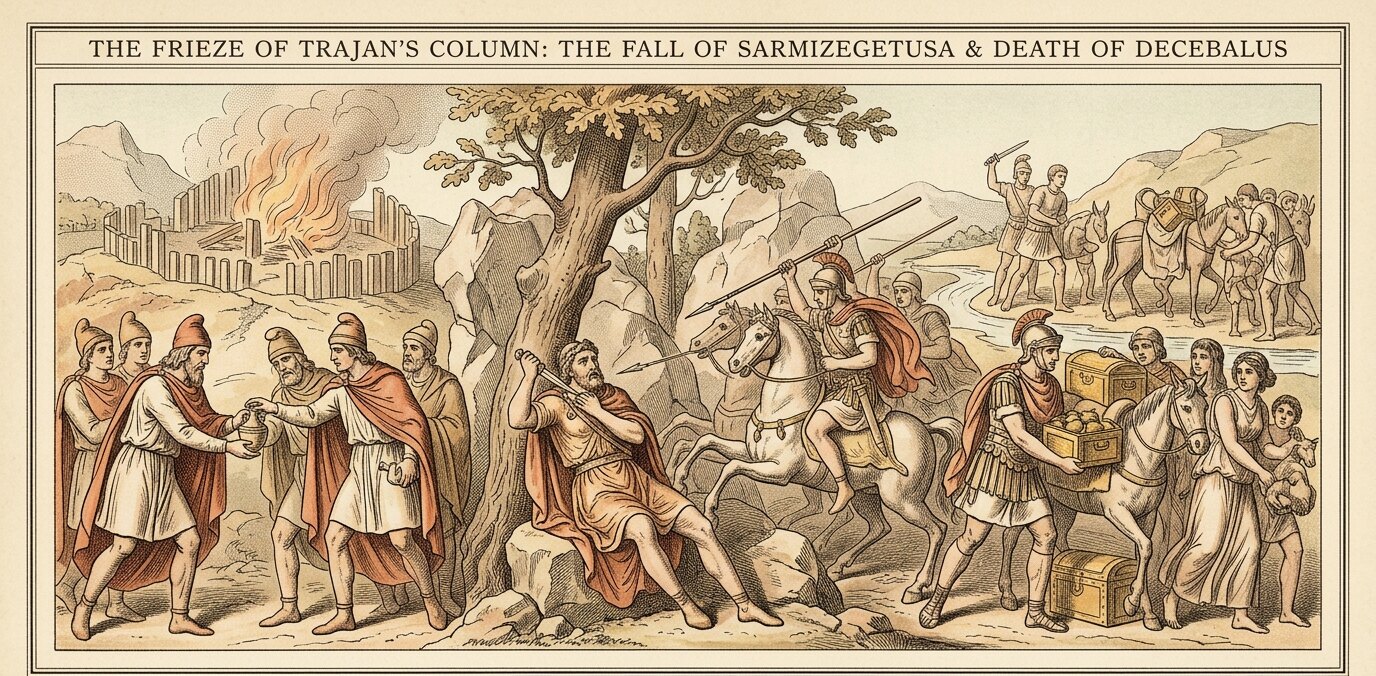
Trajan’s Column shows assaults, burning buildings, felled trees, fortified camps, Dacian embassies, and Roman soldiers at unending work. Near the climax, defenders suffer thirst and men pass a cup among the doomed. Archaeology confirms that the Dacian capital possessed a sophisticated water system; whether the relief records the cutting of a particular conduit or shapes events into a comprehensible siege narrative is less certain. What is secure is the outcome. The fortresses fell, the sacred and political center was destroyed, and resistance broke into flight.
Decebalus escaped the capital with Roman cavalry behind him. Cornered before capture, he cut his own throat. The Column preserves the moment as Rome wished to remember it: the king still free enough to choose death, but enclosed by the riders of the victorious emperor. Dio says that his head was taken to Rome. The image grants Decebalus courage while denying him a future. He becomes, in the victor’s monument, the last independent Dacian king.
The Column · Upper bands, A.D. 106Click to enlarge
How the victor chose to end it. The stronghold burns at the left while the Dacian nobles pass a vessel of poison among themselves rather than be taken — the scene the text above describes. In the centre, under an oak, Decebalus draws the curved sica across his own throat as the auxiliary cavalry closes; the rider reaching for him is traditionally identified with Tiberius Claudius Maximus, who recorded the capture of the king’s body on his own tombstone. At the right the gold and silver are lifted from the bed of the diverted Sargetia and loaded onto mules, and the Dacian families are led away with their herds. Treasure and deportation are the last word: the kingdom is not merely beaten but removed, and its wealth pays for the forum in which the Column stands.
Restored plate in the manner of W. R. Shepherd’s Historical Atlas (1911), drawn for this chapter after the scene sequence of the Column. A reconstruction, not a photograph of the marble.
‡What it changed
A province and a monument
HadrianHe kept Dacia but dismantled the bridge’s span.
The conquest did not turn every land once influenced by Decebalus into Roman territory. It carved a province from Dacia’s center and southwest, a salient thrust north of the Danube and encircled by the Carpathians. Legions, auxiliary forts, roads, and colonies secured it. The royal Sarmizegetusa was left in ruins; the Roman colony of Ulpia Traiana Sarmizegetusa rose some distance away, its borrowed name advertising succession on Roman terms.
The province drew soldiers, administrators, merchants, miners, and settlers from across the empire. Its gold-bearing districts were worked under Roman rule, although the familiar claim that gold alone caused the invasion outruns the evidence. The first impact was not a clean replacement of one population by another. War killed, displaced, and enslaved people; communities also survived beyond and within the new frontier. Over generations, Latin became one of the province’s enduring inheritances.
Dacia also exposed the cost of expansion. It was defensible only through permanent military effort, and the bridge that had enabled conquest could serve an invader moving south. Hadrian retained the province after succeeding Trajan in 117, but removed the bridge’s superstructure. A century and a half later, under pressure elsewhere, Aurelian withdrew Roman government and the army south of the Danube. Trajan’s conquest was durable, not irreversible.
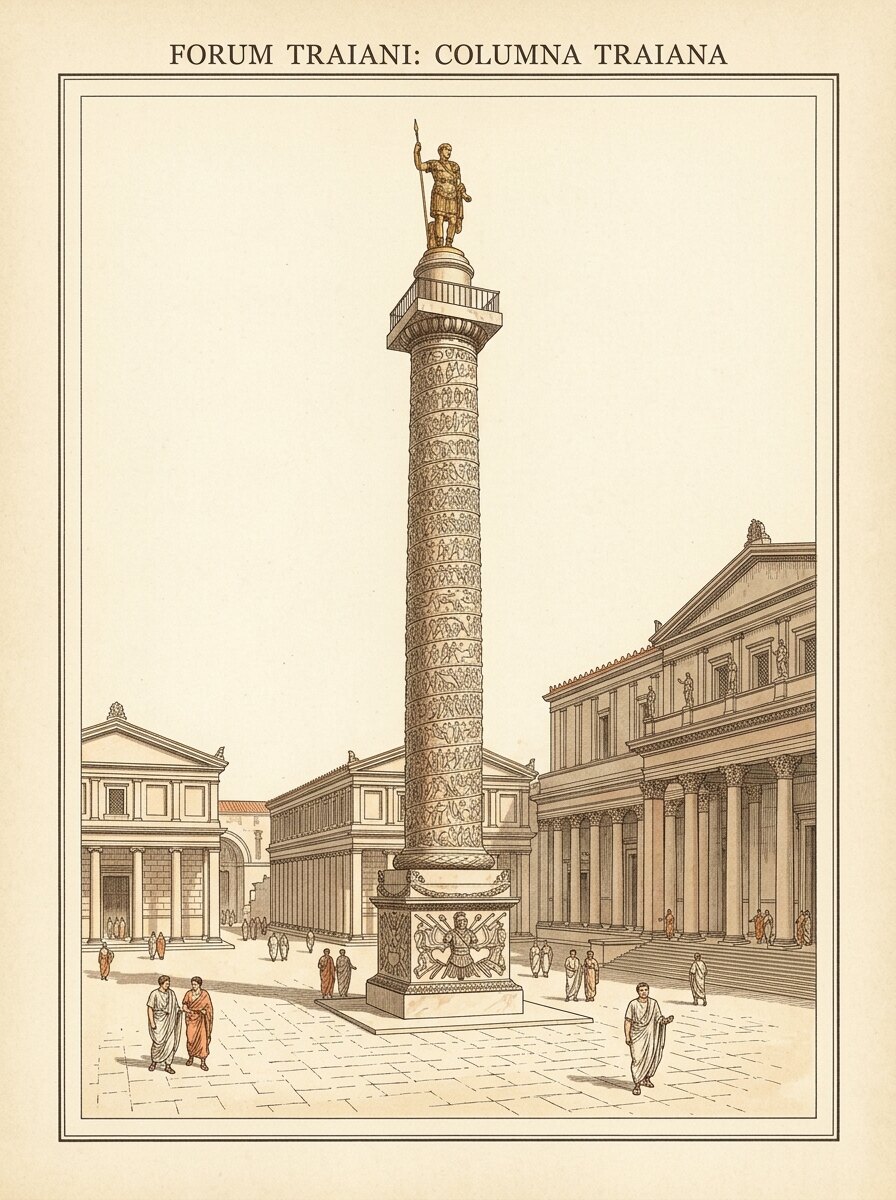
In Rome the victory became architecture. The spoils helped pay for a new forum, and in A.D. 113 Trajan’s Column rose at its center. Its spiral relief turned years of confused fighting into a controlled ascent: the emperor sacrifices, speaks, receives envoys, directs construction, and advances; the Dacian kingdom contracts until its king dies. Almost nothing remains of the Dacians’ own account. Their strongest surviving narrative was commissioned by the man who conquered them.
The monument · Forum of Trajan, A.D. 113Click to enlarge
The monument the last paragraph describes. One hundred Roman feet of Luna marble in nineteen drums, with a stair of a hundred and eighty-five steps cut inside the shaft and a spiral of relief wound round the outside. The court is narrow on purpose: the libraries on either side had upper galleries, and the upper bands of the frieze — unreadable from the pavement — were meant to be looked at from them. On the summit stands the gilded bronze Trajan of the original monument, not the St Peter that Sixtus V put there in 1588; the base below held the golden urns of Trajan and Plotina, making the pedestal an imperial tomb inside the city’s sacred boundary. The captured Dacian arms carved round that base are the same spoils the frieze above spends two wars collecting.
Restored plate in the manner of W. R. Shepherd’s Historical Atlas (1911), drawn for this chapter after the scene sequence of the Column. A reconstruction, not a photograph of the marble.
✦ ❧ ✦
Rome crossed the river to silence a kingdom. In doing so, it created a province whose memory outlasted the bridge, the legions, and the empire that built them.
Next · The Crisis of the Third Century
The empire, year by year
The Flavians and the Antonines, A.D. 70–192
Scotland won and lost twice, Dacia taken, Mesopotamia held for three years, and the Danube defended.
A.D. 70
Order restored
Vespasian holds Rome. His son Titus takes Jerusalem after a five-month siege and the Temple is burned; on the Rhine the Batavian revolt is ended by negotiation and force. In Britain the new governors push north against the Brigantes and west into Wales.
A.D. 74
Flavian tidying
Masada, the last Jewish stronghold, falls (73 or 74). Commagene and rough Cilicia are annexed (72), and legions move up to the Euphrates. Roads are driven into the angle between the upper Rhine and the Danube, the Agri Decumates, shortening the line between the two armies.
A.D. 84
Agricola in Caledonia
Julius Agricola, governor of Britain for seven seasons, carries Roman arms into Scotland and defeats the Caledonians at Mons Graupius (83 or 84), a site still not identified. On the Rhine, Domitian's war with the Chatti (83) extends the frontier into the Taunus.
A.D. 89
Dacia and the Danube
Decebalus of Dacia invades Moesia (85) and destroys a Roman army. Domitian's generals win at Tapae (88), and peace in 89 makes Decebalus a client, paid a subsidy. Troops are drawn from Britain and the forts north of the Forth are given up. At Mogontiacum the governor Saturninus rebels and is put down.
A.D. 106
Trajan's Dacia
Trajan fights two Dacian wars (101–102, 105–106). Apollodorus bridges the Danube at Drobeta, Sarmizegetusa falls and Decebalus kills himself; Dacia becomes a province with a new capital, Ulpia Traiana. The same year the Nabataean kingdom is annexed as Arabia, with its capital at Bostra.
A.D. 116
The widest reach
Trajan annexes Armenia (114), takes northern Mesopotamia and in 116 the Parthian capital, Ctesiphon, and sails down the Tigris to the Persian Gulf. Behind him revolts break out in the new provinces, and the Jewish communities of Cyrene, Egypt and Cyprus rise (115–117). Hatra holds out against him.
A.D. 122
Hadrian draws the line
Trajan dies in 117. Hadrian gives up the eastern conquests at once, returning to the Euphrates, and sets about fixing the frontiers: palisades in Germany, and in Britain a wall of stone from the Tyne to the Solway, begun about 122. He spends much of his reign touring the provinces.
A.D. 135
The last Jewish war
Hadrian refounds Jerusalem as a Roman colony, Aelia Capitolina. Simon bar Kosiba (Bar Kokhba) leads a revolt in 132 that takes three years and heavy losses to crush. Afterwards the province is renamed Syria Palaestina, and Jews are barred from Jerusalem.
A.D. 142
The Antonine Wall
Antoninus Pius, who never leaves Italy as emperor, has his governor advance again into Scotland and build a turf wall between the Forth and the Clyde, celebrated on the coinage of 142–143. His reign is the longest peace the empire knew.
A.D. 166
War with Parthia, and plague
The Parthians invade Armenia and Syria (161). Under Lucius Verus the Roman armies take Dura on the Euphrates, restore a client king at Edessa and burn Seleucia and Ctesiphon (165). The returning troops bring an epidemic that spreads across the empire. The Antonine Wall has been abandoned.
A.D. 172
The Danube breaks
The Marcomanni and Quadi cross the Danube, besiege Aquileia and sack Opitergium, the first invaders in Italy for nearly three centuries; the date is disputed (167 or 170). The Costoboci raid through the Balkans as far as Eleusis. Marcus Aurelius commands on the Danube from Carnuntum for most of a decade.
A.D. 192
What Commodus left
Marcus dies on campaign in 180, at Vindobona or Sirmium; the sources differ. Commodus makes peace with the northern peoples and returns to Rome. On the last day of 192 he is strangled by a wrestler in a palace plot. The frontiers he leaves are, almost everywhere, those Hadrian fixed.
A.D. 70
Roman provinceItaly (citizens)Client kingdomBeing conquered / partly heldIn revoltGiven upchanged this step
Province outlines: Ancient World Mapping Center, “Roman Empire c. 60 BC”, “c. AD 117 extent” and “c. AD 200 extent and provinces” (ODbL; after the Barrington Atlas). Each territory is drawn at its c. 60 BC or c. AD 200 extent from the date it came under Roman rule, so earlier inland limits are drawn too large. Trajan's eastern provinces are the AD 117 extent beyond the AD 200 frontier. The Agri Decumates are cut from the AD 200 provinces along the Rhine and Danube, and Britain at the line of Hadrian's Wall; the Antonine Wall is drawn schematically between the Forth and the Clyde. Invasion arrows are schematic. Coastlines and rivers: Natural Earth. Sites: Pleiades.