A Dalmatian soldier divides the empire among four and rebuilds the state from the ground; he tries to destroy the church and retires, it was said, to grow cabbages; and the son of his colleague conquers Rome under a Christian sign and founds a second one on the Bosporus.
A.D. 284–337 · Nicomedia, Trier, Rome and Constantinople. Told from Lactantius, who taught at Diocletian’s court, Eusebius, who knew Constantine, Aurelius Victor, Zosimus, and the laws and inscriptions.
✦ ❧ ✦
A.D. 284–299The Dalmatian and his colleagues
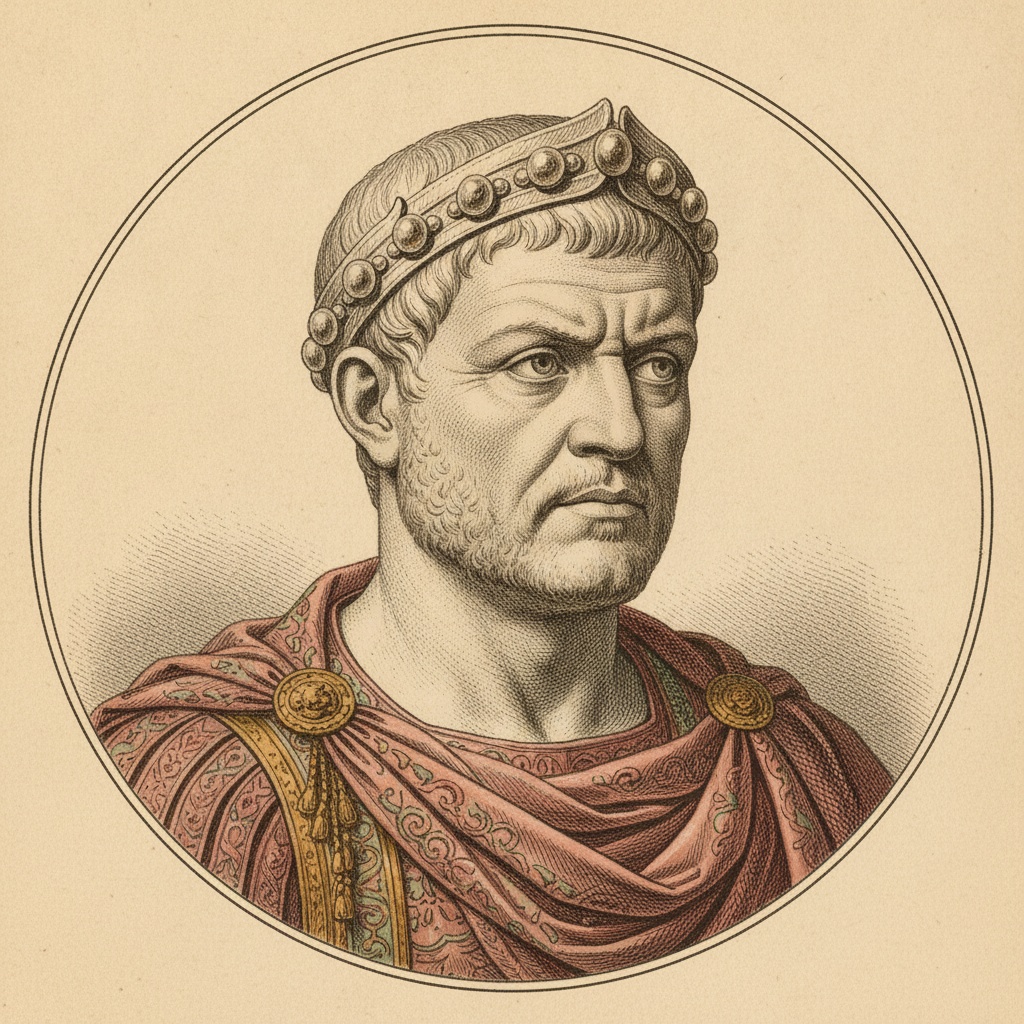
DiocletianEmperor, A.D. 284–305
The emperor Carus took Ctesiphon in 283 and died in his tent, struck by lightning it was said; his son Numerian was found dead in his closed litter on the road home, some days after his staff had begun to notice the smell. On 20 November 284 the army at Nicomedia proclaimed the commander of the household cavalry, Diocles, a Dalmatian of humble birth who had risen the way Aurelian and Probus had, and his first act on the tribunal was to run his sword through the praetorian prefect Aper, whom he accused of the murder. As Diocletian he beat Carus’ other son at the river Margus the next spring and found himself, like Gallienus, unable to be everywhere at once. His answer was to share. In 285 he made Maximian, a rough Pannonian soldier he trusted, his Caesar, and in 286 his colleague as Augustus, keeping the East for himself and giving Maximian the West; he called himself Jovius and Maximian Herculius, the son of Jupiter and the strong servant who does his labours. Maximian put down the peasant risings in Gaul, the Bagaudae, and lost Britain to Carausius, the admiral he had sent to clear the Channel of Saxon pirates, who kept the fleet and ruled the island for seven years as a Roman emperor in his own right. On 1 March 293 the two Augusti each adopted a Caesar, Constantius for the West and Galerius for the East, each with his own army and his own share of the frontiers. There were now four emperors, all soldiers from the Danube provinces, none of them from Rome, and Diocletian meant the arrangement to outlive him: each Augustus would retire, each Caesar would succeed him and appoint a new Caesar, and the succession would never again be decided in a camp.
For a dozen years it worked. Constantius took back Britain in 296 from Carausius’ murderer and successor Allectus, and the medallion struck to celebrate it shows London kneeling to welcome him. Galerius was beaten in Mesopotamia by the Persian Narseh in 296, then in 298 fell on the Persian camp in Armenia, captured the king’s wives and treasury, and marched to Ctesiphon; the peace made at Nisibis in 299 gave Rome five provinces beyond the Tigris and a protectorate over Armenia that lasted forty years. Diocletian himself suppressed a usurper in Egypt after an eight-month siege of Alexandria, and Maximian campaigned in Africa. The frontiers were quiet for the first time in sixty years.
A.D. 284–305The state remade
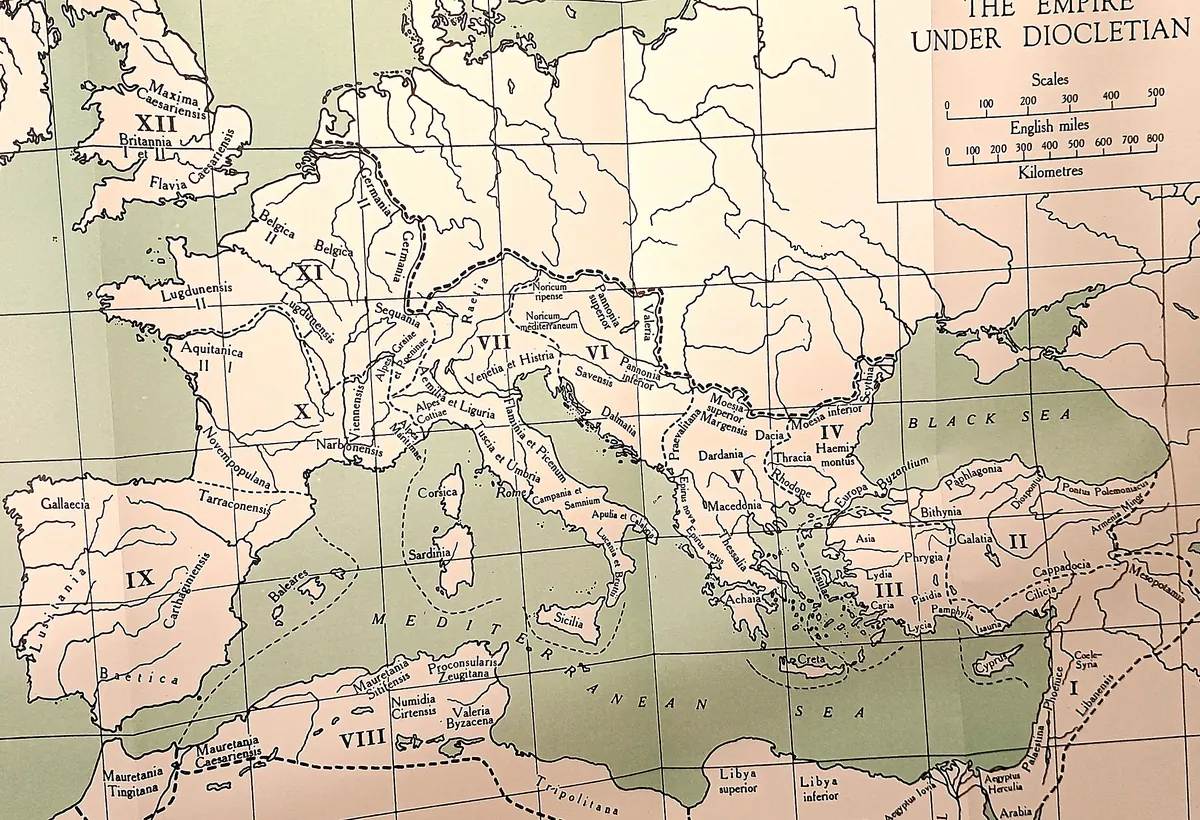
Behind the wars Diocletian rebuilt the government from the ground, and the empire of the next three centuries is his. The provinces were cut in half and half again, to about a hundred, so that no governor commanded enough to revolt, and grouped into twelve dioceses under deputies of the praetorian prefects; the governors lost their troops, which went to separate military commanders, the duces. The army was enlarged, Lactantius complained, by each of the four emperors trying to have as many men as any one of their predecessors, and the frontiers were fortified with new roads and forts from the Rhine to the Euphrates. To feed it, the whole empire was surveyed and every unit of land and every working person assessed, so that the government could announce each year, in a proclamation called the indiction, how much grain, oil, meat, cloth and recruits it needed and levy it in kind, which is what the ruined coinage had made necessary. A new coinage in good gold and silver was issued in 294 and a decree of 301, the Edict on Maximum Prices, fixed the legal ceiling for over a thousand goods and services, from a bushel of wheat to a lion, on pain of death; fragments of it survive on the walls of a dozen eastern cities, and Lactantius, who saw it fail, says goods disappeared from the markets and the law was allowed to lapse. The court changed as much as the state. The emperor no longer pretended to be a magistrate. He wore a diadem and a purple robe sewn with jewels, sat behind curtains, was addressed as lord and approached on the knees with a kiss of the hem, and was seen rarely; Rome was not his residence, and Diocletian visited it once, in 303, for his twentieth anniversary, and left early because he disliked the crowd. The four rulers lived on the frontiers, at Nicomedia, Sirmium, Milan and Trier, and the Senate of Rome was left to its dignities.
Plate · The empire under DiocletianClick to enlarge
The new administrative map. The old provinces cut into roughly a hundred small ones and grouped into twelve dioceses, numbered on the plate; civil and military commands separated; and four courts, at Trier, Milan, Sirmium and Nicomedia, none of them Rome. This sheet, not the Augustan one, is the empire of the next three centuries.
The Cambridge Ancient History (1st ed., Cambridge University Press), map plate “The Empire under Diocletian” — photographed from the fold-out sheet and cleaned.
A.D. 303–311The Great Persecution and the retirement
In 302 Diocletian ordered the burning of the Manichaeans, a new religion from Persia, as an enemy import, and on 23 February 303 at Nicomedia, having consulted the oracle of Apollo, he began on the Christians. The first edict ordered the churches destroyed, the scriptures surrendered and Christians deprived of rank and of the right to plead in court; further edicts in the same year and the next imprisoned the clergy and then ordered everyone to sacrifice. Lactantius, who taught rhetoric in Nicomedia at the time, blames Galerius for driving the old emperor to it, and the persecution was in fact severe in the East, where Galerius and his Caesar Maximinus ruled, mild in Italy and Africa, and almost nothing in Constantius’ Gaul and Britain, where a few churches were pulled down. It lasted, on and off, ten years, produced the martyrs whose names fill the calendar and the traitors, the men who had handed over the books, who divided the African church for a century, and it failed completely. On 1 May 305, at Nicomedia and at Milan on the same day, Diocletian and Maximian abdicated, the first Roman emperors ever to do so voluntarily, and retired to Split and to Lucania. Galerius and Constantius became Augusti, and two new Caesars, Galerius’ nephew Maximinus and his friend Severus, were named. Two men were passed over, Constantius’ son Constantine, a hostage at Galerius’ court, and Maximian’s son Maxentius, and the system Diocletian had built to abolish the hereditary principle broke on the fact that soldiers preferred the sons of their generals.
Constantine slipped away from Galerius, rode across Europe to his father, and when Constantius died at York on 25 July 306 the British army proclaimed him. In October the praetorians at Rome proclaimed Maxentius. Severus marched on Rome and his soldiers deserted to their old commander Maximian, who had come out of retirement to help his son; Galerius marched on Rome and turned back; Maximian quarrelled with his son, fled to Constantine, who had married his daughter, tried to betray him too, and was allowed to hang himself at Marseille in 310. At Carnuntum in 308 Diocletian was brought out of his garden to preside over a conference that made Licinius, a friend of Galerius, the new Augustus of the West, which gave the empire six emperors. Galerius, dying in 311 of a disease Lactantius describes with satisfaction, issued from his deathbed an edict ending the persecution and asking the Christians to pray for him. Diocletian died at Split soon afterwards, in the palace whose walls are still the centre of the town.
A.D. 312–324Constantine
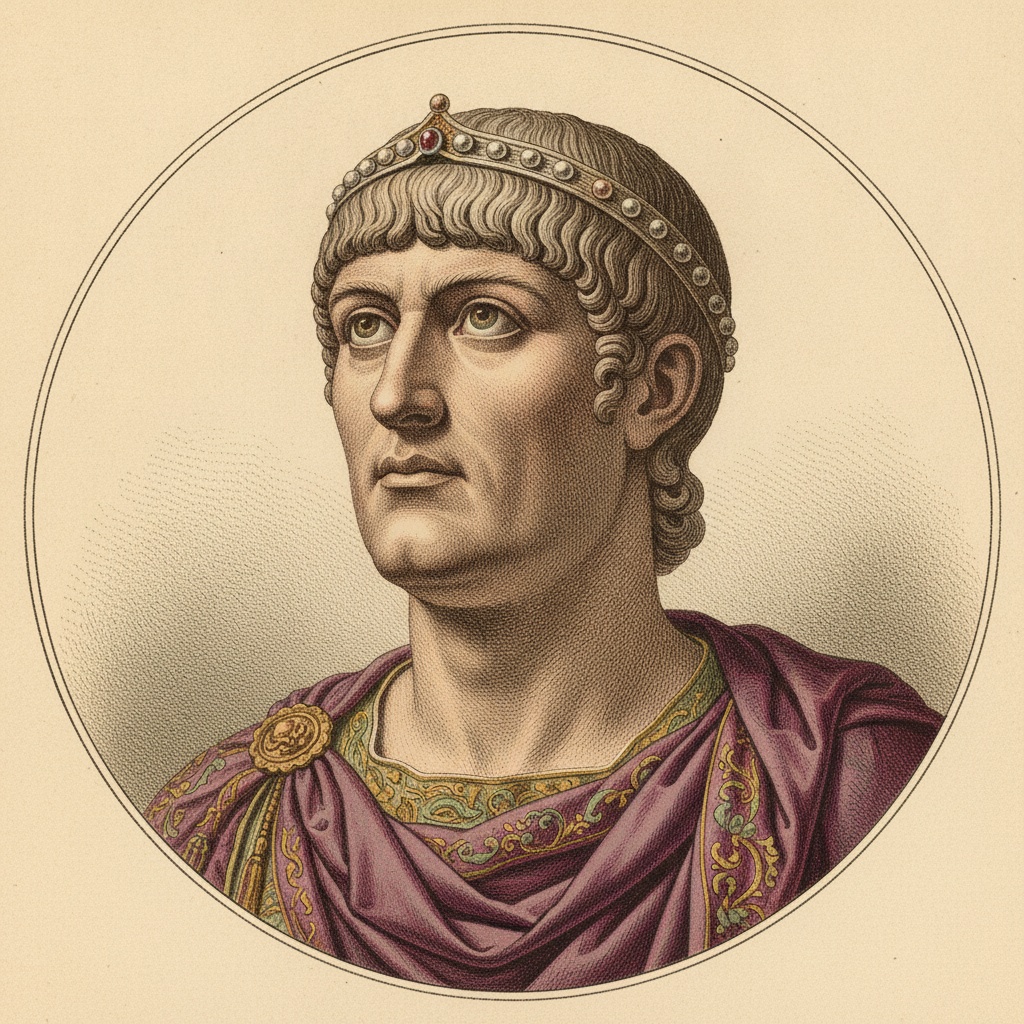
ConstantineEmperor, A.D. 306–337
In 312 Constantine invaded Italy from Gaul with a small army, took Susa, Turin and Verona, and marched on Rome, where Maxentius had a larger force and walls that had stopped two emperors already. Maxentius came out to fight, on 28 October, with the Tiber at his back and one bridge of boats behind him, and when his line broke the bridge broke too and he drowned with most of his guard. Constantine had, before the battle, ordered a sign to be painted on his soldiers’ shields. Lactantius, writing a few years later, says he was told to in a dream and describes the sign as the first two letters of Christ’s name crossed; Eusebius, who says he heard it from the emperor himself long afterwards under oath, describes a cross of light seen above the sun on the march with the words, in Greek, by this conquer. The triumphal arch the Senate built for him at Rome attributes the victory to the prompting of the divinity, without saying which. What is not in doubt is that from 312 Constantine treated the Christian God as his patron and the Christian church as a public institution. In February 313 he met Licinius at Milan, gave him his sister, and the two agreed on the letter to the provincial governors, usually called the Edict of Milan, that restored the churches’ property and granted every man the freedom to follow the religion he chose. Licinius went east and beat Maximinus, the last persecutor, at Tzirallum in Thrace that spring.
Two Augusti were one too many. They fought in 316 on the Save and made a peace that gave Constantine the Balkans, and in 324 they fought for the whole: Constantine won at Adrianople in July and, after his son Crispus had destroyed Licinius’ fleet in the Hellespont, at Chrysopolis across the water from Byzantium on 18 September. Licinius surrendered on a promise of his life and was hanged the next year. For the first time since Diocletian’s division in 286 the empire had one master, and he was a Christian.
A.D. 324–337One empire, one church, one city
Within weeks of Chrysopolis Constantine marked out the walls of a new capital on the site of Byzantium, where the Bosporus meets the Sea of Marmara and a fleet can hold both, and dedicated it as Constantinople on 11 May 330. It had a senate, a corn dole from Egypt, palaces, baths, a hippodrome, the statues of half the cities of Greece, and from the start churches rather than temples; it was the eastern Rome, and within a century it was the only Rome that mattered. He put the coinage on a footing it kept for seven hundred years, a gold solidus struck at seventy-two to the pound, which he paid for by confiscating the temple treasures. He completed the separation of the field army from the frontier garrisons that Gallienus and Diocletian had begun, with mobile comitatenses under two new masters of the soldiers and the frontier limitanei under their dukes, and he recruited Germans into the highest commands. He exempted the clergy from civic burdens, let bishops judge civil suits, made Sunday a day of rest in 321 and gave the churches money to build; and, having become the patron of the church, found it split. The bishops of Africa had been divided since 313 over whether a bishop consecrated by a traitor was a bishop; Constantine tried councils, then force, and gave up. In the East, Arius, a presbyter of Alexandria, taught that the Son was a creature, and in 325 Constantine called the bishops of the whole empire to Nicaea, sat among them, paid their expenses, and pressed them to accept the word homoousios, of one substance with the Father, which most of them signed and a great many did not believe. The creed of Nicaea is still recited; the quarrel over it lasted sixty years and is the subject of the next chapter.
In 326 he had his eldest son Crispus executed and, soon after, his wife Fausta killed, for reasons no source explains and every source guesses at. He fought the Goths across the Danube in 332 and the Sarmatians in 334, settled a great number of the latter in the empire, and in 337 was preparing a Persian war when he fell ill. He was baptised on his deathbed by Eusebius, bishop of Nicomedia, the leader of the Arian party, having postponed it, as many did, so as to die with his sins washed, and died at Pentecost, 22 May 337, near Nicomedia. His body was laid in the church he had built at Constantinople among the cenotaphs of the twelve apostles, as the thirteenth.
Chapter 25 · Map study
From Four Rulers to One, AD 293–330
How did imperial power move from Diocletian’s shared rule to Constantine’s new centre on the Bosporus? Scroll through six turning points.
284–305 · The tetrarchy
An empire with several courts
Diocletian, emperor from 284, establishes the tetrarchy in 293: two senior emperors and two junior colleagues. Nicomedia is a principal residence of Diocletian; Milan of Maximian; Trier of Constantius. Galerius uses Balkan residences including Sirmium and Thessalonica.
These are mobile courts within one empire. The cities shown are important bases, not four permanent national capitals. The Rhine, Danube and eastern approaches help explain their geography.
305–306 · Succession breaks down
A new claimant in Britain
Diocletian and Maximian abdicate in 305. The planned succession soon unravels. When Constantius dies at York in 306, his troops proclaim his son Constantine emperor. At Rome, Maxentius also claims power.
The new system cannot keep dynastic ambition and military acclamation from producing competing emperors.
312 · The struggle for the West
Rome decides the western contest
Constantine invades Italy and defeats Maxentius at the Milvian Bridge, just north of Rome, on 28 October. Maxentius dies in the Tiber. Constantine emerges as master of the western provinces.
The marker locates Rome; at this scale it does not pinpoint the battlefield. Constantine’s later accounts associate his victory with divine help and Christian symbolism.
303–313 · Persecution and toleration
The agreement at Milan
The persecution begun under Diocletian in 303 had struck Christian communities, with severity varying across the empire. Galerius grants toleration in 311.
At Milan in 313, Constantine and Licinius agree on religious freedom and restoration of Christian property. The agreement commonly called the Edict of Milan strengthens toleration; it does not make Christianity the empire’s official religion.
324 · The final civil war
The contest reaches the straits
After years of rivalry, Constantine defeats Licinius near Adrianople and then at Chrysopolis, on the Asian shore of the Bosporus. Licinius surrenders. Constantine now rules the whole empire.
The crowded cluster around the straits matters: Europe and Asia meet here, close to the Danubian frontier and the routes into the eastern provinces.
325–330 · A new imperial centre
From Nicaea to Constantinople
In 325 Constantine summons bishops to Nicaea to address divisions within Christianity. In 330 he dedicates Constantinople, rebuilt on the site of Byzantium.
Rome retains its prestige, but the Bosporus gains an imperial centre that will outlast Constantine, who dies in 337. The map’s arc is complete: several courts devised to share power give way to one emperor and a new city.
AD 293
Residence or council cityCity near a decisive battle
Diocletian and Constantine were the two Roman rulers who changed the most, and they should be taken together because the second finished what the first began: the army doubled and divided into field force and frontier; the provinces split and the civil and military powers separated; the taxes levied in kind by a survey; the emperor a sacred monarch approached on the knees; Rome no longer the capital. The one point on which they differed was religion. Diocletian tried to destroy the church and made it the best organised body in the empire; Constantine adopted it, and by giving it money, law and a place at court made it, within two generations, the one institution that would outlive the empire itself. Neither of them meant what they did to be the end of the ancient world, but from where we stand it looks like the beginning of the next one.