A.D. 337–353The sons of Constantine
Constantine left the empire to be shared among his three sons and two nephews. In the summer of 337, before the sons had been proclaimed, the soldiers at Constantinople murdered the nephews, their fathers, Constantine’s half-brothers, and every male relative they could find except two small boys, Gallus and Julian, and the sources agree that the second son, Constantius, at the least allowed it. In September the three brothers became Augusti: Constantine II in Gaul and Britain, Constans in Italy, Africa and the Balkans, Constantius II in the East. The eldest invaded the second’s territory in 340 and was killed in an ambush outside Aquileia, and for ten years the empire had two masters. Constantius fought a Persian war he could neither win nor lose. Shapur II, who had come to the throne as an infant in 309 and would reign seventy years, besieged Nisibis three times, in 338, 346 and 350, and failed each time before walls the Romans held to be impregnable, and the one pitched battle, a night action at Singara, was a slaughter on both sides. In the West, Constans, who had visited Britain in the winter of 343, the last emperor to do so, made himself hated by the army, and on 18 January 350 at Autun the commander of his guards, an officer of barbarian descent named Magnentius, was proclaimed at a dinner party and Constans was hunted down and killed near the Pyrenees.
Constantius made peace with Persia and marched west. On 28 September 351, at Mursa on the Drave, the two largest armies the empire could raise fought all day and into the night, and although Magnentius lost, the winner lost more; contemporaries put the dead at over fifty thousand and thought, rightly, that the empire could not afford them. Magnentius held out in Gaul until 353 and killed himself at Lyon, and Constantius was sole emperor, as his father had been, with fewer soldiers.
A.D. 353–361Constantius, the Caesar Gallus, and the Caesar Julian
Constantius was a suspicious, conscientious, colourless man who ruled by a court of eunuchs and notaries, kept his father’s religion in his father’s way, and could not be in the East and the West at once. He tried his cousins. Gallus, made Caesar in 351 and sent to Antioch, ruled it as a tyrant for three years and was recalled, stripped and beheaded in Istria in 354. Julian, the other survivor of the massacre of 337, a bookish young man who had been brought up by Arian bishops in a Cappadocian castle and had secretly stopped believing them at Athens, was made Caesar on 6 November 355 and sent to Gaul with a handful of men to be a figurehead while the generals fought. He turned out to be a general. In August 357 at Strasbourg he attacked seven Alamannic kings with an army a third the size of theirs and destroyed them, capturing their leader Chnodomar; in the following years he crossed the Rhine three times, rebuilt the forts, brought the corn fleet from Britain back into the river, and cut the tax of Gaul by two-thirds while collecting it in full, the historian Ammianus, who served in those campaigns, says with admiration. In the same year Constantius visited Rome for the only time in his life, and Ammianus describes him gazing at the Forum of Trajan and admitting he could never build such a thing; he carried off an obelisk instead, which still stands by the Lateran. His energies went into the church, where he was determined to replace the creed of Nicaea with a formula the Arians could accept, and at councils at Sirmium, Rimini and Seleucia in 357 to 359 he nearly did; Jerome wrote afterwards that the world groaned to find itself Arian. Athanasius of Alexandria, exiled five times by four emperors, was the immovable object.
In 359 Shapur returned in force, and Amida on the upper Tigris fell after seventy-three days; Ammianus was inside and escaped at night through the Persian lines. Constantius, needing men, ordered Julian to send him the best of the Gallic army. The Gallic army, which had enlisted on condition it never served east of the Alps, refused, surrounded the palace at Paris in February 360, and proclaimed Julian Augustus on a shield. He sent envoys; Constantius sent threats; both marched, and on 3 November 361, at Mopsucrenae in the Taurus, Constantius died of a fever, having named Julian his heir with his last breath so as to spare the empire a war.
A.D. 361–364Julian
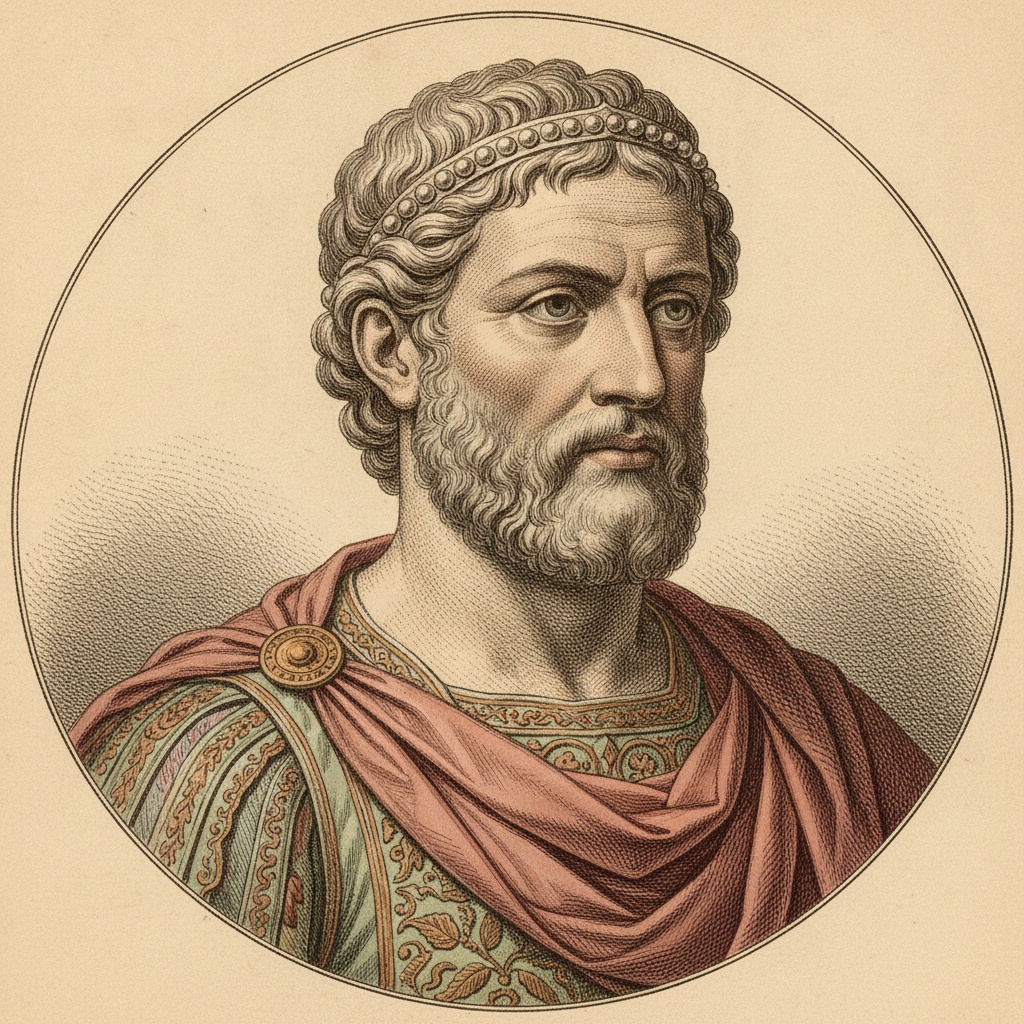
Julian entered Constantinople at thirty, a philosopher with an unkempt beard and the temper of a reformer, and announced that he was a pagan. He had been initiated by the Neoplatonist Maximus of Ephesus into a religion of the sun in which the old gods were the faces of one, and he meant to restore it not by persecution, which he thought vulgar, but by example and by law. He reopened the temples, sacrificed hecatombs, wrote a treatise against the Galileans, as he called them, and in June 362 forbade Christians to teach the classics, on the ground that a man who does not believe in Homer’s gods has no business explaining Homer; Ammianus, who admired him, calls the law inhuman. He recalled the bishops Constantius had exiled, so that, Ammianus says, they might tear each other to pieces. He cut the court to a fraction, tried the worst of Constantius’ ministers before a tribunal at Chalcedon, and remitted taxes. Antioch, where he wintered in 362, laughed at his beard and his sacrifices, and he answered the city in a satire on himself, the Beard-hater, that no other emperor could have written. He gave the Jews leave to rebuild the Temple at Jerusalem, and the work stopped, Ammianus reports, when fireballs burst from the foundations.
His answer to the Christians was to be a victory that Constantine had never won. In March 363 he marched from Antioch with the largest army Rome had sent east since Trajan, some sixty-five thousand men, and a fleet of a thousand boats on the Euphrates, took the Persian forts one by one, and in May beat Shapur’s army under the walls of Ctesiphon. He could not take the city, burned his fleet so as to march inland, found the country stripped and the Persians unwilling to fight, and turned north up the Tigris in the heat, harassed at every mile. On 26 June, riding without his breastplate to a skirmish near Samarra, he was struck through the side by a spear whose owner was never identified, and died in his tent at midnight, discoursing on the soul, Ammianus says, like Socrates. The officers chose Jovian, a guards commander, who bought the army’s escape by giving Shapur Nisibis, Singara and the five provinces beyond the Tigris; the people of Nisibis, who had beaten Shapur three times, were marched out of their city and it was handed over. Jovian restored the church, and in February 364, on the road to Constantinople, was found dead in a freshly plastered bedroom heated by a charcoal brazier.
A.D. 364–375Valentinian and Valens
The army chose again, at Nicaea, and chose well: Valentinian, a Pannonian officer of peasant stock, forty-three, a Christian who had been passed over by Julian, hot-tempered, uneducated and able. He made his brother Valens Augustus in the East within a month, and the two divided the empire at Sirmium, its army, its officials and its treasury, so thoroughly that it was never really one again. Valens, who was a lesser man and knew it, put down a usurper, Procopius, who had seized Constantinople in the name of Julian’s house, and then spent three years across the Danube against the Goths, whose king Athanaric made peace with him in 369 on a boat in mid-river, having sworn never to set foot on Roman soil. Valentinian spent his reign on the Rhine and the upper Danube, fighting the Alamanni, building a chain of forts whose remains line both rivers, and governing from Trier. He was the last emperor to hold the Rhine. His generals held the rest: in 367 Britain was overrun by a combination of Picts, Scots and Saxons that the sources call the barbarian conspiracy, and the elder Theodosius, a Spaniard, restored the province in two campaigns; in 373 the same man put down the revolt of the Moorish prince Firmus in Africa, and was executed at Carthage in 376 for reasons the sources do not give. Valentinian founded schools, provided doctors for the poor of Rome, protected the peasants from the tax collectors as far as an emperor could, and let the churches alone, being, Ammianus says, the one emperor of the century who kept out of theology. In November 375 at Brigetio on the Danube he received an embassy of the Quadi who blamed Rome for their own raids, and in the fury of answering them burst a blood vessel and died. His generals proclaimed his four-year-old son by a second wife, Valentinian II, beside his sixteen-year-old son Gratian, who had been Augustus since 367.
A.D. 376–378The Goths cross, and Adrianople
About 370 a people no Roman had seen, the Huns, came out of the steppe beyond the Don. Ammianus, who collected what could be learned, describes them as almost part of their horses, living on raw meat softened under the saddle, without houses, kings or fixed law, and fighting with a speed and a bow no one could match. They broke the kingdom of the Greuthungi, whose old king Ermanaric killed himself, and drove the Tervingi, the Goths Valens had fought, off their lands north of the Danube. In 376 the greater part of that people, under Fritigern and Alavivus, came to the river and asked to be admitted to the empire as subjects and soldiers, and Valens, at Antioch, agreed, on the ground that so many recruits would let him commute the provincial levy for gold. They were ferried across for days, Ammianus says, in numbers no one counted; the Greuthungi, whom he had refused, crossed behind them unopposed. The Roman commanders on the spot, Lupicinus and Maximus, held the Goths in a camp without the food they had been promised and sold them dog meat at a slave a dog, and when Lupicinus invited the chiefs to dinner at Marcianople and tried to hold them, Fritigern walked out sword in hand, and the Goths were at war with an empire they had asked to join.
They beat Lupicinus, plundered Thrace, were joined by Gothic miners, slaves and prisoners who knew where the granaries were, and fought a drawn and bloody battle against the emperor’s advance guard at the Willows in 377. Valens came from Antioch in the spring of 378; Gratian, marching from Gaul to join him, was delayed by an Alamannic invasion and beat it, and sent word to wait. Valens, who was told the Goths numbered ten thousand and was jealous of his nephew, did not wait. On 9 August 378, after a march of eight miles in the August sun to a camp outside Adrianople, he attacked before his men had eaten or drunk, while Fritigern was still sending envoys to negotiate. The Gothic cavalry, which had been out foraging, came back in the middle of the battle and fell on the Roman left; the infantry was crushed together so closely, Ammianus says, that men could not raise their swords, and two-thirds of the eastern field army died in the dust. Valens was never found; one story said he was carried wounded to a farmhouse which the Goths burned without knowing who was inside. Ammianus, ending his history there, says that nothing like it had happened since Cannae. Gratian gave the East to the son of the executed general, Theodosius, in January 379, and the map takes up the story.
Why it mattered
The forty years from Constantine’s death to Adrianople are the empire’s last as a single military power, and they show it spending that power on itself. Mursa killed more Roman soldiers than any barbarian battle, Julian’s Persian expedition lost the Tigris frontier that Diocletian had won, and Valens admitted a whole people whom he could neither feed nor control because the army needed the recruits. What survived intact was the state Diocletian and Constantine had made: the bureaucracy, the tax, the two courts and the church, which were about to prove more durable than the legions. The Goths who won at Adrianople never went home, and the question of what to do with a foreign nation inside the frontier, armed, unbeaten and under its own kings, would decide the fate of the western half of the empire in the century that follows.