A religious insurrection in Prague unchains three decades of total war across Central Europe — breaking the Habsburg dream of universal Catholic empire and forging the sovereign state system of modern Europe.
1618–1648 · The Holy Roman Empire, Bohemia, the Baltic & the Rhine
Drawn from The New Cambridge Modern History, Vol. IV, The Decline of Spain and the Thirty Years War, with eyewitness testimonies and cartography from William R. Shepherd’s Historical Atlas.
✦ ❧ ✦
Scroll to begin ↓
I23 May 1618 · The Hradčany Castle
The Defenestration of Prague
On the morning of 23 May 1618, a deputation of Protestant Bohemian nobles, armed and in full fury, climbed the stairs of the royal castle of Hradčany in Prague. For decades, the fragile peace of the Holy Roman Empire had rested upon the Compromise of Augsburg (1555), an agreement summed up in the harsh Latin formula cuius regio, eius religio — whose realm, his religion. Each ruling prince determined whether his subjects prayed as Catholics or Lutherans. But in the Crown lands of Bohemia, where Hussite, Lutheran, and Catholic communities lived side by side, the Habsburg emperor Rudolf II had been forced in 1609 to grant the Letter of Majesty (Majestätsbrief), a charter guaranteeing freedom of conscience to Protestant estates.
That compromise shattered with the approach of the Archduke Ferdinand of Styria. Educated by the Jesuits at Ingolstadt, Ferdinand was a prince of unbending piety who took an oath to restore Catholicism to every corner of his patrimony, declaring he would rather rule over a desert than a realm of heretics. When imperial regents closed Protestant churches at Broumov and Hrob, the Bohemian estates saw the coming extinction of their rights.
Led by Count Heinrich Matthias von Thurn, the delegates crowded into the council chamber. After a bitter interrogation over who had authored the imperial ban, they seized the two Catholic governors, Jaroslav Bořita of Martinice and Vilém Slavata, along with their secretary Filip Fabricius, dragged them to the window, and hurled them fifty feet down into the castle ditch. Miraculously, cushioned by a mound of dung and loose compost that had accumulated below, all three survived and crept away under fire.
The Protestant leaders treated the act as biblical justice, consciously invoking the murder of Jezebel. The Catholics cried that angels and the Virgin Mary had caught the falling men in their mantles. But the political meaning was unmistakable: Bohemia was in open rebellion, and the institutional arbitration of the Empire had broken down into armed revolt.
II8 November 1620 · Bohemia Broken
White Mountain and the Counter-Reformation
The Bohemian rebels deposed Ferdinand and offered their crown to Frederick V, the young Calvinist Elector Palatine and head of the Protestant Union. Frederick accepted, entering Prague in November 1619. His gamble was reckless. Calvinism was not even recognized by the Peace of Augsburg; the Lutheran princes, led by John George of Saxony, distrusted him; and his father-in-law, James I of England, refused to send an army to his aid.
Ferdinand II, newly elected Holy Roman Emperor, struck back with devastating force. He allied with his cousin Philip III of Spain and pledged imperial territories to Maximilian I, the formidable Duke of Bavaria and head of the Catholic League. In the autumn of 1620, an imperial-Bavarian army under the veteran Walloon general Johann Tserclaes, Count of Tilly, marched directly on Prague.
On 8 November 1620, on the low chalk ridge of the White Mountain (Bílá Hora) outside the city walls, the armies collided in the fog. The Bohemian ranks, poorly paid, disorganized, and exhausted by winter marches, held their ground for barely two hours. A ferocious charge by Bavarian infantry and imperial cuirassiers shattered their flank. Frederick V fled the capital so precipitously that he left his royal insignia and coronation robes behind, earning the mocking epitaph of the "Winter King."
The vengeance that followed transformed Central Europe. On 21 June 1621, twenty-seven leading Bohemian nobles and magistrates were beheaded in the Old Town Square of Prague; twelve of their heads were hung in iron cages from the Old Town Bridge Tower, where they swung in the wind for ten years. Ferdinand abolished the Letter of Majesty, confiscated three-quarters of all landed property in the kingdom, and granted the estates to foreign Catholic officers and adventurers. More than thirty thousand Protestant families, including the philosopher Jan Amos Comenius, were driven into permanent exile. Bohemia was forcibly re-Catholicized, its diet stripped of power, and its crown declared the hereditary possession of the House of Habsburg.
III1625–1626 · The Mercenary Enterprise
Wallenstein and the Economics of Plunder
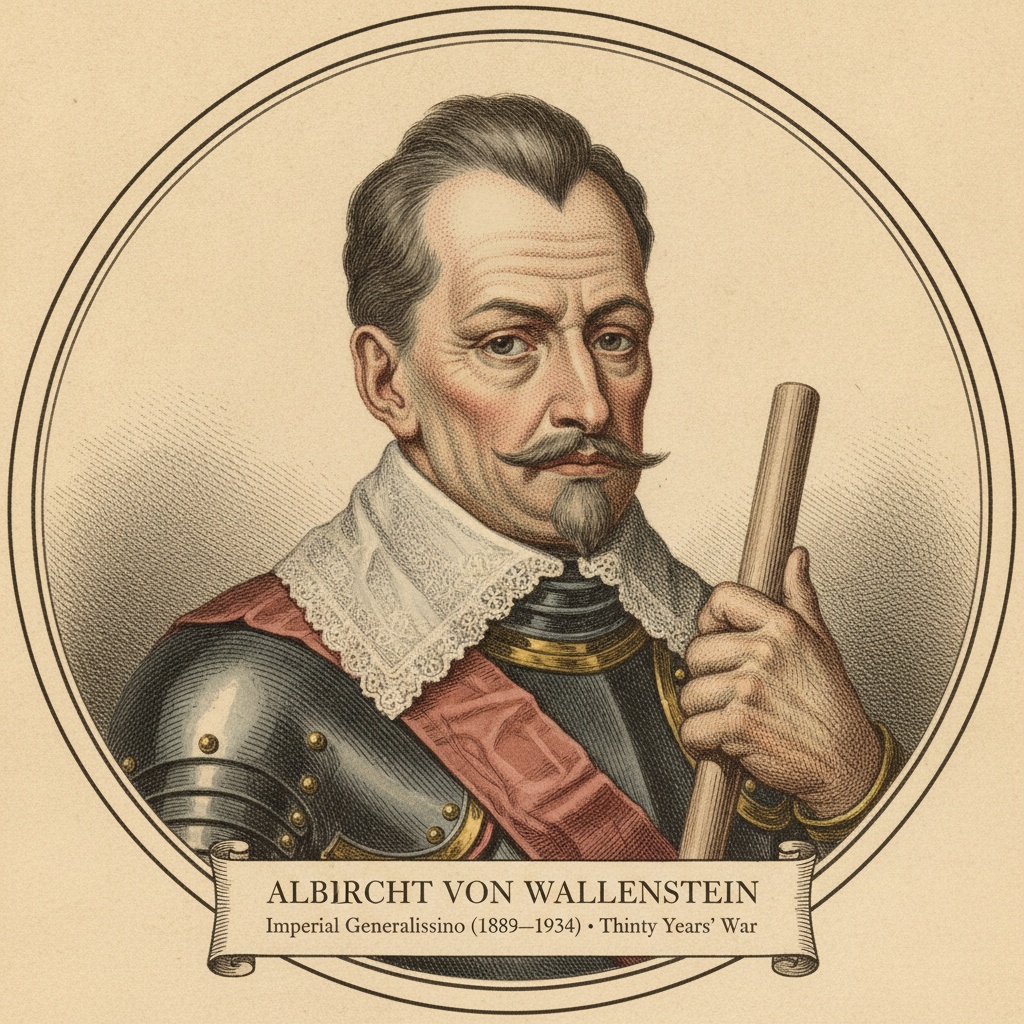
Albrecht von WallensteinImperial Generalissimo, 1583–1634Click to enlarge
The Bohemian victory did not end the war; it metastasized it. When Spanish troops seized Frederick's hereditary lands in the Palatinate and gave the Rhine crossing to Spanish garrisons, Protestant princes across Europe panicked. In 1625, King Christian IV of Denmark, backed by Dutch and English subsidies, marched into northern Germany to defend the Protestant circles and secure Baltic bishoprics for his sons.
Ferdinand II faced an insurmountable crisis: his treasury was empty, and the army of the Catholic League under Tilly answered to Bavaria, not Vienna. At this desperate juncture, an obscure Bohemian nobleman named Albrecht von Wallenstein approached the emperor with a revolutionary proposal. Wallenstein offered to raise, equip, and field an imperial army of twenty thousand men — expanding soon to fifty thousand — entirely at his own expense, on the condition that he hold supreme command and the unrestricted right to levy contributions upon the territories his soldiers occupied.
Wallenstein was no religious crusader; he was the supreme military entrepreneur of the seventeenth century. Born of minor Bohemian Protestant nobility, he had converted to Catholicism, fought loyally for Ferdinand, and used the ruin of his fellow Bohemians to amass immense wealth. He had bought up confiscated estates at pennies on the dollar, forged a partnership with the Antwerp financier Hans de Witte to manipulate the currency, and converted his sprawling duchy of Friedland into a giant armaments manufactory, producing grain, uniforms, iron shot, and gunpowder on an industrial scale.
His military system solved the financial dilemma of early modern warfare by turning plunder into systematic taxation. Instead of relying on disorderly sack, Wallenstein imposed regular cash payments, grain levies, and quartering obligations on every town and territory within marching distance, friend and foe alike. As the Latin aphorism ran, bellum se ipsum alet — the war shall feed the war.
In April 1626, Wallenstein smashed the Protestant mercenary army of Ernst von Mansfeld at the Dessau Bridge over the Elbe. Four months later, Tilly caught and routed Christian IV of Denmark at Lutter am Barenberge. Together, the imperial armies swept north to the Baltic, overrunning Holstein, Schleswig, and Jutland. Denmark was knocked out of the war, signing the Peace of Lübeck in 1629.
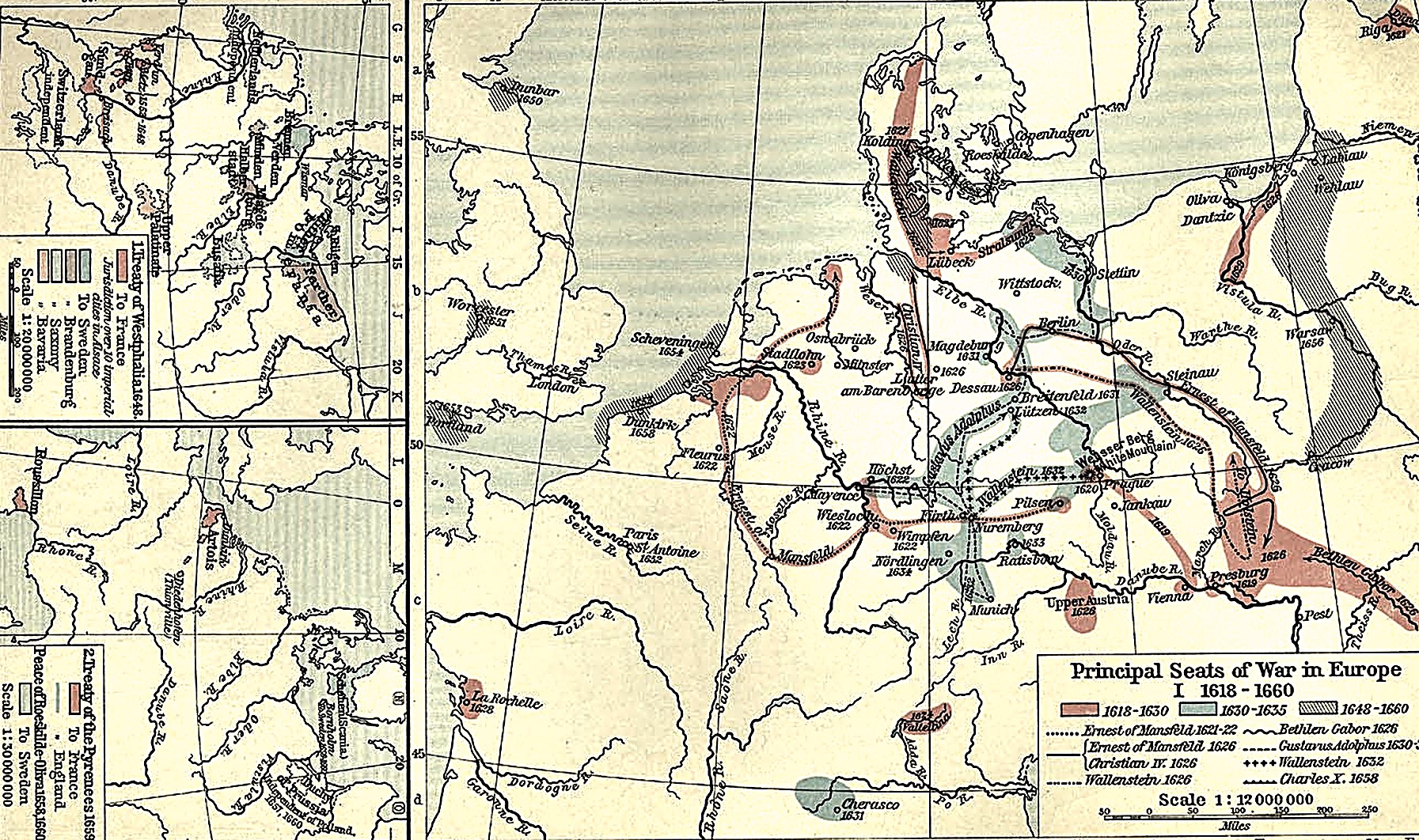
Atlas Plate · Shepherd 121
Click to inspect plate
The Strategic Geography of the War — Over thirty years, Germany was crisscrossed by four successive waves of military intervention: the initial Bohemian–Palatine struggle along the Upper Danube and Rhine (1618–1623); the Danish intervention across Lower Saxony to the Baltic (1625–1629); the Swedish lightning advance from Usedom down the Oder and Elbe to Munich (1630–1634); and the grinding, multi-front French and Swedish war of attrition against the Austrian and Spanish Habsburgs (1635–1648).
William R. Shepherd, Historical Atlas (New York: Henry Holt, 1911), plate 121. Cleaned and restored in the modern house style.
The Age of Religious War · The Holy Roman Empire
The Thirty Years' War: A Bohemian Revolt Consumes the Empire, 1618–1648
Scroll to follow the war as it spreads outward from Prague — through Denmark, Sweden, and finally Catholic France — until the Peace of Westphalia remakes Europe.
1618
The Defenestration of Prague
On 23 May 1618, Protestant nobles of Bohemia fling two Catholic imperial regents and their secretary from a high window of the Hradčany castle in Prague. The men survive the seventy-foot fall — into a dung-heap, the Catholics said; by the grace of the Virgin, they preferred — but the insult cannot be undone. The Bohemian estates renounce their Habsburg king and offer the crown to Frederick V, the young Calvinist Elector Palatine on the Rhine. A local quarrel over churches and charters has become a challenge to the House of Austria and to the Catholic order of the whole Empire.
1620
The White Mountain
The answer is swift. The army of the Catholic League under the veteran Tilly, joined by the imperial forces of Ferdinand II, climbs out of Bavaria and marches on Prague. On 8 November 1620, in barely an hour on the slopes of the White Mountain above the city, the Bohemian rebellion is broken. Frederick — mocked ever after as the Winter King, for a reign of a single season — flees into exile. Spanish armies pour up the Rhine to seize his Palatinate. Bohemia is re-Catholicised at the point of the sword. The rising is crushed, yet the war has only found its first breath.
1625–1629
The Danish Intervention
Alarmed by Habsburg power spreading to the Baltic, Christian IV of Denmark takes up the Protestant cause and leads an army into Lower Saxony. Against him the Emperor unleashes a new and terrible instrument: Wallenstein, a Bohemian magnate who raises a private host of a hundred thousand men and feeds it by plundering the lands it crosses. Tilly wrecks the Danes at Lutter in 1626; Wallenstein sweeps north to the sea — but the free port of Stralsund, stiffened by Swedish and Scots defenders, holds against him. Denmark makes peace in 1629, and Ferdinand, at the height of his fortune, issues the Edict of Restitution to claw back a century of Protestant gains.
1630–1631
The Lion of the North
In July 1630 Gustavus Adolphus, king of Sweden and the finest soldier of the age, lands his disciplined, mobile army near Peenemünde on the Pomeranian coast. As he gathers allies, catastrophe sears the war into memory: in May 1631 Tilly's army storms Magdeburg and burns it to the ground, and twenty thousand townsfolk perish. The horror drives Protestant Saxony into Gustavus's arms. In September, on the plain of Breitenfeld outside Leipzig, the Swedish king turns Tilly's flank and annihilates the imperial army — the first great Protestant victory of the war, and proof that the Habsburg tide can be turned.
1632–1634
Lützen and Nördlingen
Gustavus drives deep into Catholic Bavaria; at the Lech in 1632 he forces the river and Tilly falls, mortally wounded. But the recalled Wallenstein maneuvers him back north, and at Lützen in November the Swedes win the field — and lose their king, cut down in the fog and powder-smoke. Sweden fights on, yet the spell is broken. Wallenstein, grown overmighty and suspected of treating with the enemy, is murdered by his own officers in 1634. That autumn a Spanish-imperial army destroys the leaderless Swedes at Nördlingen, and the exhausted German princes make the Peace of Prague with the Emperor.
1635–1648
France, Rocroi, and the Peace of Westphalia
Now the mask falls. Cardinal Richelieu — a prince of the Catholic Church — throws Catholic France openly against the Habsburgs, for it is dynastic power, not creed, that has always been the true stake. At Rocroi in 1643 the young Duke of Enghien breaks the vaunted Spanish infantry, and Spain's supremacy ends on that field. Franco-Swedish armies ravage Bavaria and burst into Bohemia at Jankau. Germany, its population cut by a third in places, can bear no more. In 1648 the powers sign the Peace of Westphalia at Münster and Osnabrück: the Empire's princes win near-sovereignty, the Dutch and Swiss their independence, and the dream of a single Catholic monarchy over Europe is buried for good.
1618
Habsburg / Catholicanti-Habsburg coalitionmajor battle / stormPeace of Westphaliaimperial marchProtestant / French march
Events after C. V. Wedgwood, The Thirty Years War (1938) and S. R. Gardiner, The Thirty Years' War, 1618–1648. Land, lakes and rivers: Natural Earth (public domain). Routes are schematic; the Empire's internal frontiers are labelled, never drawn.
IV6 March 1629 · The Zenith of Empire
The Edict of Restitution and Imperial Overreach
By 1629, Ferdinand II had achieved what no Holy Roman Emperor had managed since Charles V: complete military mastery over the German princes. Flushed with victory and egged on by his Jesuit confessor, Father William Lamormaini, the emperor issued the fateful Edict of Restitution on 6 March 1629.
The Edict rolled the clock back seventy-seven years. It declared that all ecclesiastical property secularized by Protestant princes since the Treaty of Passau in 1552 must be returned immediately to the Catholic Church. This encompassed two archbishoprics (Magdeburg and Bremen), twelve bishoprics (including Halberstadt, Lübeck, Minden, and Verden), and over five hundred monastic houses scattered throughout northern Germany. Furthermore, it explicitly reaffirmed that Calvinists enjoyed no legal rights whatever under imperial law.
The decree was a legal and economic earthquake. Vast territories that had been thoroughly Protestant for three generations were suddenly ordered to surrender their lands, evict their clergy, and submit to Catholic administrators. Even loyal Lutheran princes who had sided with the emperor, such as John George of Saxony, realized that their hereditary possessions were forfeit to imperial decree.
Simultaneously, the German princes — Catholic and Protestant alike — grew terrified of Wallenstein's private army. At the Diet of Regensburg in the summer of 1630, Maximilian of Bavaria and the Catholic electors issued an ultimatum to the emperor: Ferdinand must dismiss Wallenstein and reduce his army, or the electors would refuse to crown his son King of the Romans. Seeking to secure his dynastic succession, Ferdinand capitulated. In August 1630, Wallenstein was stripped of his command and retired in icy silence to his estates in Jičín. At the exact moment the imperial war machine was dismantled, a new invader stepped ashore on the Baltic coast.
V1630–1631 · The Swedish Lightning
The Lion of the North and the Pyre of Magdeburg
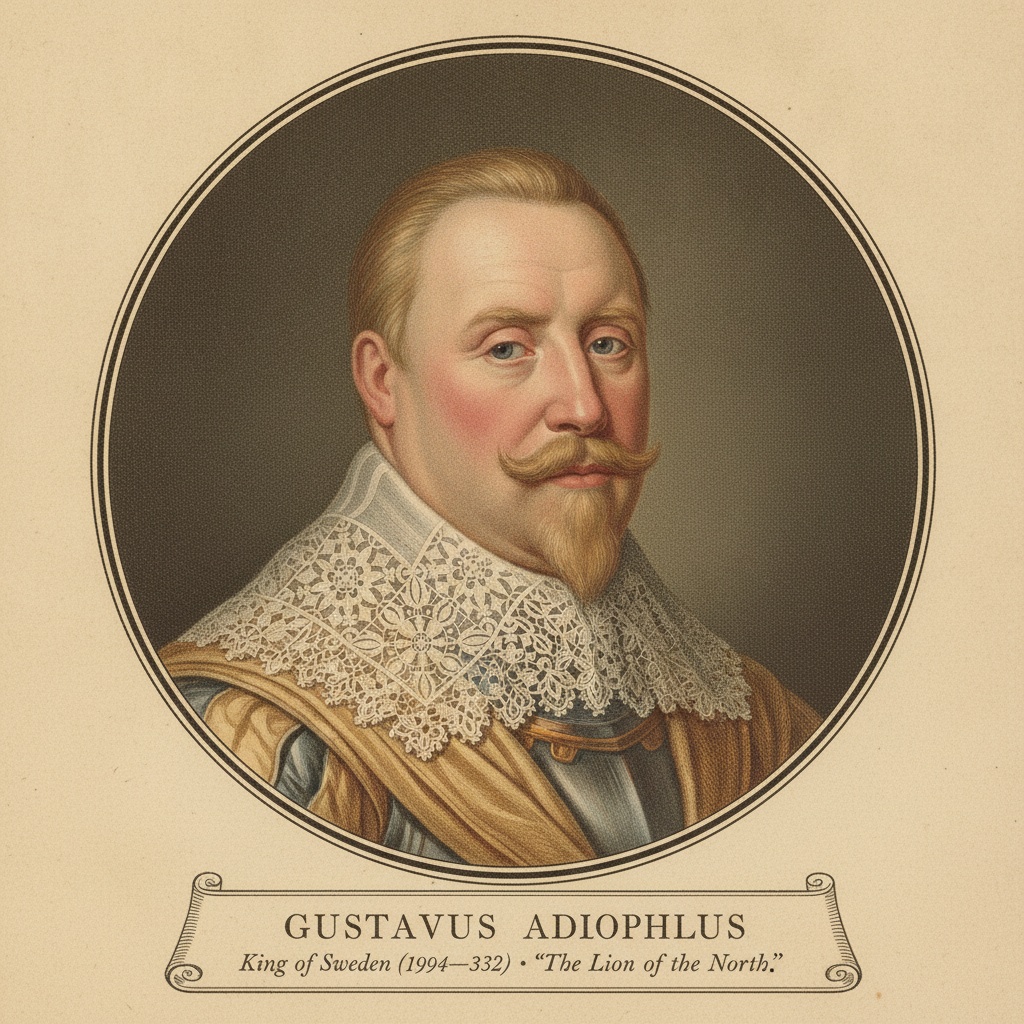
Gustavus AdolphusKing of Sweden, 1594–1632Click to enlarge
On 6 July 1630, Gustavus Adolphus, King of Sweden, landed at Peenemünde on the island of Usedom with barely fourteen thousand men. Kneeling on the sand, the king offered a public prayer of thanksgiving before ordering his troops to dig entrenchments. Europe knew Sweden as an impoverished kingdom on the frozen rim of Christendom, but under Gustavus it possessed the most disciplined and tactically innovative army on earth.
Where imperial armies still deployed in massive, unwieldy tercios of Spanish pikemen thirty ranks deep, Gustavus had revolutionized the battlefield. He equipped his infantry with lighter matchlocks and paper cartridges, reduced his line to six ranks, and drilled his musketeers to deliver devastating rolling volleys by ranks. Between the infantry battalions he embedded light, mobile three-pounder bronze cannons ("leather guns" and regimental field pieces) that advanced with the line. His cavalry did not wheel and fire pistols from the saddle in the traditional caracole; they drew sabres and charged at the gallop.
Initially, the Protestant princes of Saxony and Brandenburg hesitated to join the Swedish king, terrified of imperial retribution. That hesitation ended in ashes. In the spring of 1631, Tilly laid siege to the great Protestant bastion of Magdeburg on the Elbe, which had declared for Gustavus. On 20 May 1631, imperial troops breached the ramparts. For three days, soldiers ran amok in a frenzy of slaughter, rape, and plunder. Fires broke out across the timbered houses; within thirty-six hours, one of the wealthiest cities in Germany was reduced to smoking embers, and twenty thousand citizens — men, women, and infants — perished in the flames or were tossed into the Elbe.
"Then was there naught but beating and burning, plundering, torturing, and murdering... In the midst of all this horrific confusion and crying, the whole city was set on fire in different places, so that in less than twelve hours all was consumed and laid in ashes, except the cathedral, the convent of Our Lady, and a few houses around about. More than twenty thousand souls were lost, and scarce five thousand escaped alive."
Otto von Guericke, Burgomaster of Magdeburg, Geschichte der Belagerung, Eroberung und Zerstörung von Magdeburg (1631)
The sack of Magdeburg horrified the Protestant world and gave German the grim new verb magdeburgisieren — to utterly wipe from the earth. Driven by outrage and fear of Tilly's advance, Elector John George of Saxony cast his lot with Sweden. On 17 September 1631, outside Leipzig, the combined Swedish and Saxon army met Tilly at the Battle of Breitenfeld.
It was the decisive tactical clash of the century. Although the Saxon contingent broke and fled before the imperial cavalry, Gustavus's disciplined Swedes adjusted their line with astonishing speed. Pouring lethal volleys of grapeshot and musket fire into the lumbering imperial tercios, the Swedish infantry tore Tilly's veterans to ribbons. By nightfall, the imperial army had lost seven thousand dead, six thousand captured, and its entire artillery train. The invincibility of the Catholic League was broken forever. Gustavus swept through the "Priests' Alley" along the Main and Rhine, taking Mainz, Frankfurt, and Nuremberg, before forcing the crossing of the Lech in April 1632, where Tilly was mortally wounded by a cannonball.
VI1632–1634 · The Death of Giants
Lützen, Eger, and the Ruin of the Generalissimo
With Swedish outposts at the gates of Vienna and Munich in Swedish hands, a humiliated Ferdinand II had no choice but to recall Wallenstein on the general's own imperious terms. Wallenstein raised a new army in weeks, outmanoeuvred Gustavus outside Nuremberg at the Alte Veste, and forced the Swedish king to march north into Saxony.
On 16 November 1632, the two greatest commanders of the age met in a dense November fog on the plain of Lützen, southwest of Leipzig. The fighting was savage, hand-to-hand combat amidst smoke and rain. Leading a cavalry charge to relieve his faltering left wing, Gustavus Adolphus became separated in the swirling fog, was surrounded by imperial cuirassiers, shot through the back and neck, and trampled into the mud. When his riderless horse, its saddle drenched in blood, galloped past the Swedish lines, Bernhard of Saxe-Weimar took command, rallyed the troops with the cry of revenge, and drove Wallenstein's army from the field.
The Swedes held the battlefield, but the "Lion of the North" was dead at thirty-seven. The Swedish chancellor, Axel Oxenstierna, assumed direction of the Protestant coalition, forming the League of Heilbronn, but the moral and charismatic centre of the Protestant cause had vanished.
Wallenstein, increasingly incapacitated by gout and disillusioned by Habsburg ingratitude, withdrew to Bohemia and began conducting his own unauthorized peace negotiations with Sweden, France, and Saxony. Suspecting treason, Ferdinand II secretly outlawed his generalissimo in January 1634 and released his officers from their oath of obedience. On 25 February 1634, at the fortress of Eger (modern Cheb), Scottish and Irish mercenaries in imperial service — led by Walter Butler and John Gordon — murdered Wallenstein's closest lieutenants at a banquet. Captain Walter Devereux then burst into the bedchamber where the exhausted generalissimo stood in his nightshirt, ran him through with a halberd, and claimed the emperor's bounty.
Seven months later, on 6 September 1634, a combined imperial and Spanish army under the Cardinal-Infant Ferdinand crushed the Swedish field army at the Battle of Nördlingen. Southern Germany fell back under Catholic control; the German Protestant princes abandoned Sweden and made peace with the emperor in the Peace of Prague (1635). The religious civil war among Germans had essentially ended. But the international war was about to begin.
VII1635–1645 · The Mask Dropped
Richelieu and Reason of State
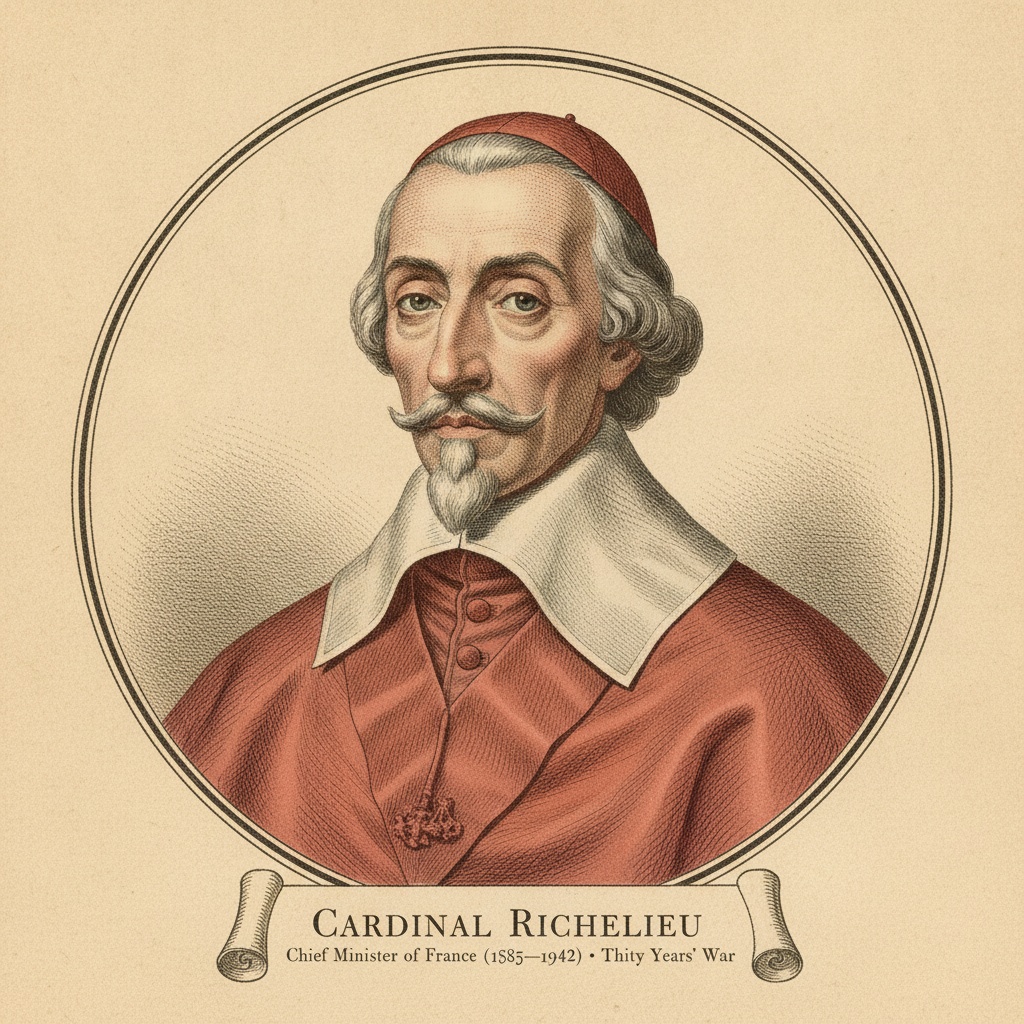
Cardinal RichelieuChief Minister of France, 1585–1642Click to enlarge
With Sweden broken at Nördlingen, one man decided that the Habsburgs must not be allowed to unify Germany: Armand Jean du Plessis, Cardinal Richelieu, the Chief Minister of King Louis XIII of France. For fifteen years, Richelieu had waged a covert, subsidised proxy war, bankrolling Dutch privateers and Swedish regiments with French silver while keeping France's own armies out of the field.
Now, proxy war was no longer enough. If Spain and Austria consolidated their grip on the Empire, France would remain encircled on all borders: Spain to the south, the Spanish Netherlands to the north, and the Spanish Road along Franche-Comté and the Rhine. In May 1635, a French herald rode to Brussels and formally declared war on the King of Spain.
The intervention of France stripped the Thirty Years' War of its last confessional disguise. A prince of the Roman Catholic Church, wearing cardinal's purple, forged a direct military alliance with the Protestant crown of Sweden, the Calvinist Dutch Republic, and German Protestant mercenaries to wage open war against the Catholic Habsburg Emperor and the Catholic King of Spain. When Pope Urban VIII and devout French Catholics denounced him for betraying the faith, Richelieu answered with the cold doctrine of raison d'état — the supreme interest of the state overrode all private and religious claims.
"In matters of state, he who has the power often has the right, and he who is weak can hardly keep from being wrong in the opinion of the vast majority of the world... Private persons forgive injuries because God will judge their cause in the next world; but states cannot afford to wait, for they have no life after this world. Their salvation is now or never."
Cardinal Richelieu, Testament Politique (1688)
For thirteen agonizing years after 1635, the war degenerated into an immense war of attrition. Spanish tercios invaded northern France and advanced within eighty miles of Paris in 1636 before being checked at Corbie. Gradually, French resources and Swedish tenacity began to tell. In May 1643, at the Battle of Rocroi in the Ardennes, the twenty-one-year-old French prince Louis II de Bourbon, Duke of Enghien (later the Grand Condé), encircled and annihilated the veteran Spanish tercios, breaking the military myth of Spain that had dominated European warfare since the days of Gonzalo de Córdoba.
VIII1635–1648 · The Wasteland
The Anatomy of Ruin
While diplomats bargained and generals maneuvered, Central Europe experienced a catastrophe unmatched until the twentieth century. The armies that marched through Germany — Imperial, Swedish, French, Spanish, Bavarian, Saxon, Hessian — had long ceased to fight for religious doctrine. They fought for bread, shoes, horses, and survival.
When supply lines failed, regiments dissolved into roving armed swarms. The peasant in his field was viewed simply as prey. Villages were put to the torch to force inhabitants to reveal buried stores of grain and silver. Tortures such as the notorious "Swedish draught" (Schwedentrunk), where boiling dung-water was forced down victims' throats through a funnel, became routine instruments of extortion.
"The first thing these troopers did was, that they stabled their horses: thereafter each fell to his appointed task: which task was neither more nor less than ruin and destruction... All that they had no mind to take with them they cut in pieces. Some thrust their swords through the hay and straw as if they had not enough sheep and swine to slaughter: and some shook the feathers out of the beds and in their stead stuffed in bacon and other dried meat... Our maid was so handled in the stable that she could not come out; which is a shame to tell of. Our man they laid bound upon the ground, thrust a gag into his mouth, and poured a pailful of filthy water into his body: and by this, which they called a Swedish draught, they forced him to lead a party of them to another place."
Hans Jakob Christoffel von Grimmelshausen, The Adventurous Simplicissimus (1668), Book I, Ch. IV (trans. A. T. S. Goodrick, 1912)
The greatest killer was not the musket ball or the pike, but typhus, dysentery, bubonic plague, and starvation that followed in the wake of armies. Modern demographic research estimates that between twenty and forty percent of the entire population of the Holy Roman Empire perished between 1618 and 1648. In regions directly astride the military corridors — Mecklenburg, Pomerania, the Altmark, Silesia, the Middle Rhine, Württemberg, and the Palatinate — local population losses exceeded fifty to sixty-five percent. Whole districts stood depopulated for decades, farmland reverting to briars and wolf packs roaming through abandoned hamlets.
IX24 October 1648 · Münster and Osnabrück
The Peace of Westphalia and the New Order
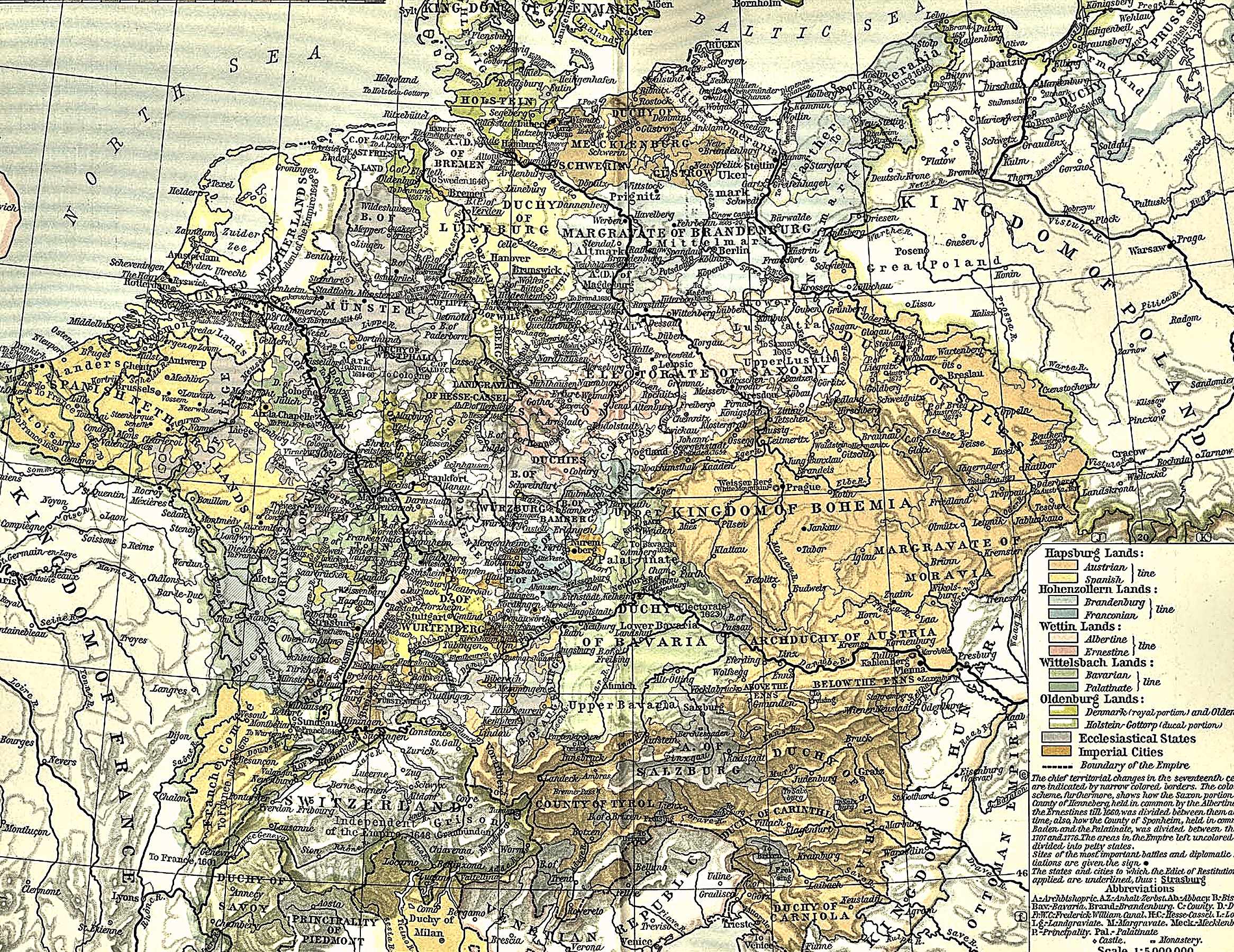
Atlas Plate · Shepherd 122–123
Click to inspect plate
The Re-mapping of Central Europe (1648) — The treaties of Münster and Osnabrück permanently reorganized the map of Europe. France obtained the bishoprics of Metz, Toul, and Verdun, and full sovereign rights over Upper and Lower Alsace, anchoring its eastern frontier on the Rhine. Sweden acquired Western Pomerania with Stettin, Wismar, and the secularized bishoprics of Bremen and Verden, making the Swedish crown an Imperial Estate and master of the mouths of the Oder, Elbe, and Weser. Brandenburg-Prussia was compensated with Eastern Pomerania, Halberstadt, Minden, and the reversion of Magdeburg. The Dutch Republic and the Swiss Confederation were officially declared independent states outside the Empire.
William R. Shepherd, Historical Atlas (New York: Henry Holt, 1911), plates 122–123. Modern house-style restoration.
By 1643, all combatants were bankrupt and exhausted. Negotiations began simultaneously in two Westphalian cities thirty miles apart: at Münster, Catholic envoys under the mediation of the Papal Nuncio Fabio Chigi and Venice; at Osnabrück, Protestant envoys under the mediation of Denmark and Sweden. It was the first modern international diplomatic congress in history, bringing together 109 delegations representing sixty-six imperial estates and sixteen European states.
Signed on 24 October 1648, the twin treaties of Münster and Osnabrück established a new constitutional framework for Europe:
1. Confessional Settlement: The Peace of Augsburg was reaffirmed and extended to include Calvinists on equal terms with Lutherans and Catholics. The contentious date for property claims was fixed at the "normal year" of 1 January 1624: whatever faith held a church, monastery, or school on that exact date remained its permanent possessor, definitively killing the Edict of Restitution.
2. Territorial Sovereignty (Landeshoheit): The German princes gained full territorial autonomy, including the crucial right to conclude foreign treaties and alliances (ius foederis), provided such alliances were not aimed against the Emperor or the Empire. The imperial Diet became a permanent congress of ambassadors at Regensburg. The Habsburg emperor could no longer make laws, levy imperial taxes, declare war, or ratify peace without the consent of the princes.
3. International Recognition: The United Provinces of the Netherlands, having fought Spain for eighty years, received formal recognition of their complete independence from Spain and the Empire. The Swiss Confederation was likewise formally recognized as entirely independent of imperial jurisdiction.
Pope Innocent X issued the papal bull Zelo Domus Dei condemning the treaties as "null, void, invalid, iniquitous, unjust, damnable, reprobate, inane, and devoid of meaning for all time." The princes and diplomats quietly ignored him. The era in which the Papacy could arbitrate international politics was over.
XWhat It Changed · The Legacy
The Birth of the Sovereign State System
The Thirty Years' War ended the medieval vision of a single Christian Commonwealth (Respublica Christiana) presided over by an Emperor and a Pope. In its place arose the Westphalian order: a system of sovereign states, theoretically equal in international law, interacting through permanent resident embassies, balance-of-power diplomacy, and treaty obligations rather than universal religious allegiance.
To survive wars of this scale, European monarchies were forced to remake their internal institutions. The private mercenary enterprise of Wallenstein was abandoned as too dangerous to crown and country; in its place grew the permanent standing army, drilled and paid directly by the state. To feed and arm these standing forces, governments created centralized treasuries, professional bureaucracies, uniform excise taxes, and state arsenals.
The geopolitical balance of Europe tilted decisively. Spain began its irreversible decline as the dominant world power; the Holy Roman Empire was hollowed out into a loose confederation, allowing the eventual rise of two rival German powers — Hohenzollern Brandenburg-Prussia in the north and the Habsburg Austrian monarchy in the southeast. And over a exhausted continent rose the undisputed sun of seventeenth-century Europe: the absolute monarchy of Louis XIV’s France.
✦ ❧ ✦
Universal empire was dead; the sovereign state had triumphed. Across the Rhine, a four-year-old child who had inherited the throne of France in 1643 prepared to turn the machinery of the modern state into the absolute mastery of Europe.
Next: Chapter XL · The Sun King and the Age of Absolute Monarchy (1648–1715)