Era IV · Atlas study

Caesar in Gaul, people by people

Eight years of war, fifty peoples, one siege: who stood with Rome, who rose against it, and how the country between the Rhine and the Ocean became Roman.

Two maps · 15 steps  ·  58–50 B.C.
Schematic territories over Natural Earth coastlines, after Caesar's Gallic War. Scroll each map, or step through it with the buttons beneath the plate; hover a people for its story.
✦   ❧   ✦
Scroll to begin ↓
58 B.C. · A country of peoples

Not one Gaul, but fifty

When Caesar took up his command in 58 B.C., Rome already held the Mediterranean coast of Gaul, the Province. Beyond it lay no single nation but some sixty peoples, each with its own council, chief town and feuds: the Aedui and the Arverni contending for leadership in the centre, the Belgae in the north, the seafaring Veneti in the west. Caesar conquered them not all at once but one by one, often with the help of their neighbours.

The first map follows that process season by season. Each people is painted as a friend of Rome, as submitted, as in arms, or as crushed, and a gold outline marks what changed. Caesar's march for the year is drawn strong over the faded marches of earlier years, with his legates' columns and the camps where the legions wintered. The second map closes in on Alesia, where the war was decided. For a simpler season-by-season view, see the campaign map in Chapter II.
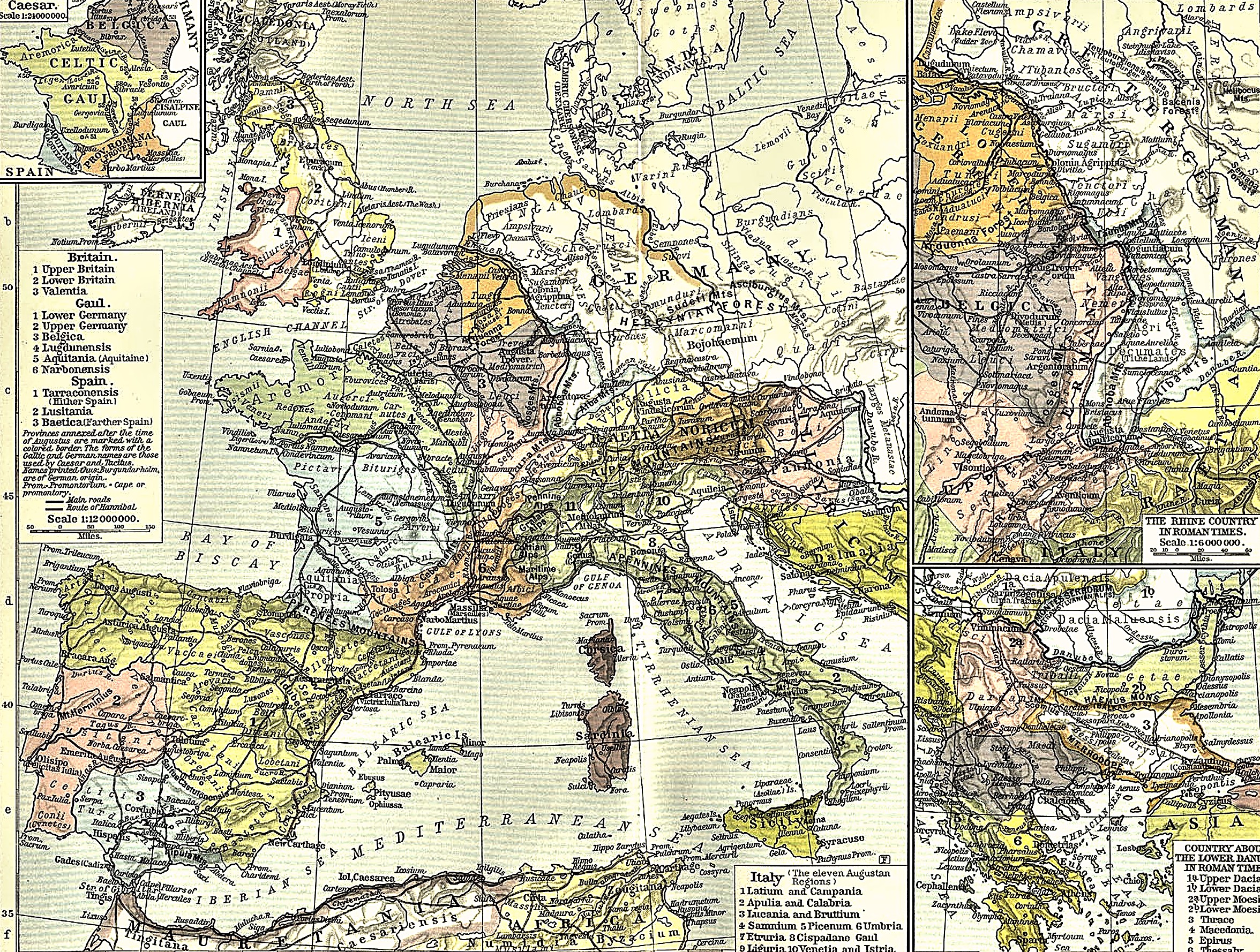
PlateGaul in the Roman world

Between the Rhine and the Ocean

Shepherd plate · the western provinces Shepherd atlas map of the European provinces of the Roman Empire, with Gaul and the Rhine frontier Tap to enlarge · zoom
The provinces that Caesar's war created. Shepherd draws Gaul as Augustus organised it: Narbonensis, the old Province, along the Mediterranean, and Aquitania, Lugdunensis and Belgica in the land Caesar conquered. The names of many peoples on the maps below survive in the towns that were their capitals. William R. Shepherd, Historical Atlas (1911), public domain; restored from the University of Texas scan.
Map I · Gaul, people by people

Eight years, fifty peoples, 58–50 B.C.

Every season of the war: who stood with Rome, who submitted, who rose — and where Caesar marched and wintered.

58 B.C.

The Helvetii and Ariovistus

Caesar reaches Genava to find a whole people, the Helvetii, setting out west. He bars the Rhône, follows them into the lands of the Aedui, cuts down one clan at the crossing of the Arar and beats the rest near Bibracte; the survivors are sent home. In late summer he marches on the Suebian king Ariovistus, drives him back over the Rhine, and winters among the Sequani.

Caesar's army: six legions
57 B.C.

The Belgae

The northern peoples combine against him. The Remi go over to Rome at once. The Belgic host breaks up on the Axona, and the Suessiones, Bellovaci and Ambiani surrender one by one. On the Sabis the Nervii fall on the legions as they pitch camp and nearly win. The Aduatuci are sold as slaves, while one legion under Publius Crassus takes the submission of the Atlantic coast.

Caesar's army: eight legions
56 B.C.

The Atlantic

The Veneti of the Breton coast seize Roman officers, and the sea-peoples rise with them. Caesar builds a fleet on the Loire; off the coast his ships cut down the rigging of the Gallic sailing ships and take them one by one. The Veneti council is executed and the people sold. Sabinus beats the Venelli, Crassus conquers Aquitania, and the Morini and Menapii hold out in their marshes.

55 B.C.

Across the Rhine and the Channel

Two German peoples, the Usipetes and Tencteri, cross the lower Rhine. Caesar detains their leaders at a parley and falls on their camp; at Rome, Plutarch says, Cato proposed handing him over to the Germans. He bridges the Rhine in ten days and spends eighteen on the far bank, then crosses to Britain late in the season. Neither crossing conquered anything; the dispatches made him famous.

54 B.C.

Britain, then the winter

Five legions cross to Britain, force the Thames and storm the stronghold of the war-leader Cassivellaunus, who submits and promises tribute. Back in Gaul a poor harvest scatters the legions into distant winter camps. Ambiorix of the Eburones lures a legion and five cohorts out of Atuatuca and destroys them; the Nervii besiege Quintus Cicero until Caesar marches to his relief.

Eight legions; one and a half lost at Atuatuca
53 B.C.

Reprisal

Caesar raises two new legions and borrows one from Pompey. He strikes the Nervii before spring, calls a council of Gaul to Lutetia, forces the Senones, Carnutes and Menapii to submit, and bridges the Rhine a second time. The Eburones are hunted down and their land thrown open to plunder. At Durocortorum the Senonian leader Acco is flogged and beheaded in the old Roman manner.

Caesar's army: ten legions
52 B.C.

Vercingetorix

News of disorder at Rome sets Gaul alight. The Carnutes massacre Roman traders at Cenabum, and the young Arvernian noble Vercingetorix is hailed as king and war-leader. Caesar crosses the Cevennes through deep snow, gathers his legions, burns Cenabum and storms Avaricum, where by his count only 800 of 40,000 escaped. At Gergovia, in Vercingetorix' own country, he is thrown back.

52 B.C.

Alesia

The Aedui, Rome's oldest friends in Gaul, join the rising. Caesar reunites his army with Labienus' column, beats the Gallic horse on the march, and shuts Vercingetorix into the hill-town of Alesia. The peoples of Gaul send a relief army of 250,000 foot and 8,000 horse, in Caesar's figures. Only the Remi, the Lingones and the Treveri stand apart. The siege itself is the next map.

51 B.C.

The last embers

Alesia did not end the war at once. Through the winter and the following year the Bituriges, Carnutes and Bellovaci rise again and are put down one by one. The last stand is at Uxellodunum, in the land of the Cadurci; when it falls, Caesar has the hands of its defenders cut off as a warning. His officer Hirtius wrote the account of this year.

50 B.C.

Gallia Comata

After eight campaigns everything between the Pyrenees, the Alps, the Rhine and the Ocean has submitted. Caesar spends his last winter in Gaul at Nemetocenna, fixes a yearly tribute (40 million sesterces, Suetonius says) and treats the defeated peoples gently. Within the year he would lead the army that conquered Gaul across the Rubicon.

58 B.C.
Gaul, people by people, 58–50 B.C. Gallia Transalpina, the Province Gallia Cisalpina Osismi Aquitani Veneti Coriosolites Venelli Redones Abrincatui Andes Namnetes Pictones Esuvii Santones Bituriges Vivisci Petrocorii Lexovii Aulerci Cenomani Aulerci Eburovices Caleti Turones Nitiobriges Morini Cadurci Carnutes Veliocasses Lemovices Bellovaci Ruteni Bituriges Ambiani Parisii Arverni Menapii Atrebates Viromandui Suessiones Senones Gabali Nervii Aedui Remi Vellavi Mandubii Helvetii Aduatuci Segusiavi Sequani Lingones Mediomatrici Eburones Leuci Treveri OSISMI AQUITANI VENETI CORIOSOLITES VENELLI REDONES ABRINCATUI ANDES NAMNETES PICTONES ESUVII SANTONES VIVISCI PETROCORII LEXOVII CENOMANI EBUROVICES CALETI TURONES NITIOBRIGES MORINI CADURCI CARNUTES VELIOCASSES LEMOVICES BELLOVACI RUTENI BITURIGES AMBIANI PARISII ARVERNI MENAPII ATREBATES VIROMANDUI SUESSIONES SENONES GABALI NERVII AEDUI REMI VELLAVI MANDUBII HELVETII ADUATUCI SEGUSIAVI SEQUANI LINGONES MEDIOMATRICI EBURONES LEUCI TREVERI PROVINCIA CISALPINA Rhenus Rhodanus Liger Sequana Garumna Mosa Arar OCEANVS OCEANVS BRITANNICVS MARE INTERNVM BRITANNIA GERMANIA HISPANIA Ubiifriends of Caesar Sugambri Suebi Winter 58–57: the legions among the Sequani, under Labienus Winter 57–56: among the Carnutes Winter 57–56: among the Andes Winter 57–56: among the Turones Winter 56–55: among the Lexovii Winter 56–55: among the Aulerci Winter 55–54: every legion in the lands of the Belgae Winter 54–53: Caesar at Samarobriva Winter 54–53: Fabius among the Morini Winter 54–53: Quintus Cicero among the Nervii, besieged Winter 54–53: Roscius among the Esuvii Winter 54–53: Labienus on the border of the Remi and Treveri Winter 54–53: Crassus among the Bellovaci Winter 54–53: Plancus among the Carnutes Winter 54–53: Sabinus and Cotta at Atuatuca — a legion and five cohorts destroyed Winter 53–52: two legions on the Treveran border Winter 53–52: two legions among the Lingones Winter 53–52: six legions at Agedincum Winter 52–51: Caesar at Bibracte Winter 52–51: Labienus among the Sequani Winter 52–51: Fabius and Basilus among the Remi Winter 52–51: Sextius among the Bituriges Winter 52–51: Rebilus among the Ruteni Winter 52–51: Quintus Cicero at Cabillonum Winter 52–51: Sulpicius at Matisco Winter 51–50: Caesar at Nemetocenna, four legions among the Belgae Winter 51–50: four legions among the Aedui Massilia Narbo Tolosa Genava the Rhône barred to the Helvetii Arar one clan cut down at the crossing Bibracte the Helvetii beaten Ariovistus driven back over the Rhine Axona the Belgic host breaks up Bratuspantium the Bellovaci surrender Sabis the Nervii nearly win Aduatuci 53,000 sold, Caesar says Sea-battle the Veneti fleet destroyed Viridovix beaten by Sabinus Sotiates Crassus takes Aquitania Usipetes & Tencteri massacred by the Rhine Rhine bridge built in ten days crossed again, 53 Britain the landing, 55 and 54 Cassivellaunus his stronghold stormed Atuatuca fifteen cohorts destroyed Lutetia a council of Gaul Labienus beats the Parisii Durocortorum Acco put to death Cenabum Romans massacred; the town burned Avaricum stormed Gergovia Caesar thrown back Cavalry battle the Gallic horse routed ALESIA the double siege Uxellodunum the last stronghold Lemonum a siege lifted Nemetocenna Caesar's last winter in Gaul 100 Roman miles
Roman provinceFriend of RomeSubmitted to CaesarIn arms against himCrushedchanged this stepCaesar, this yearearlier yearsa legate’s columnGallic movementwinter quartersa Roman reverse

Territories are schematic: no Gallic border survives, so each people is drawn round its chief town, after the Roman civitates that grew out of them, and clipped to the coast and the Rhine. Marches follow Caesar’s Gallic War (Book 8 is by his officer Hirtius) and are straightened between named places; numbers are Caesar’s own claims. Hover a people for its story. Coast and rivers: Natural Earth.

The whole war turned on a few weeks in the late summer of 52 B.C., on one hill in the land of the Mandubii. The second map closes in on it: a plain, two small rivers, and the most elaborate siege works of the ancient world.

Map II · The siege

Alesia: the double ring, 52 B.C.

One army besieging a town while besieged itself: the works, the relief army, the last attack, the surrender.

52 B.C. · I

The blockade

Vercingetorix shuts some 80,000 men, by Caesar's count, into Alesia, a town on a flat-topped hill between two rivers, and camps them on its eastern slope. Caesar rings the hill with works eleven Roman miles round, strengthened by twenty-three redoubts, and plants his camps on the hills about. Before the ring closes, the Gallic horsemen slip out by night to summon all Gaul.

52 B.C. · II

The second ring

Caesar builds a second line facing outward, fourteen miles round, against the army he knows is coming. Before the inner line lie trenches, one flooded from the rivers, a rampart with a palisade and towers, and fields of hidden pits, sharpened stakes and iron barbs. Inside, food runs short; the Mandubii are driven out of their own town and, refused by the Romans, left between the lines.

52 B.C. · III

The relief army

The relief army camps on a hill outside the lines, a mile from the Roman works. Twice it attacks across the plain while Vercingetorix sallies from the town against the inner line, and twice the double ring holds. In a cavalry battle in the plain, Caesar's German horsemen decide the day.

52 B.C. · IV

The camp to the north

The Gauls find the weak point: a camp on the lower slope of a hill to the north, too large to take inside the works. Vercassivellaunus, a kinsman of Vercingetorix, leads 60,000 picked men round by night and attacks it from above at noon, while every other sector is assaulted at once. Labienus brings six cohorts; Caesar leads fresh troops himself and sends cavalry round behind the attackers. The relief army breaks.

52 B.C. · V

The surrender

Next day Vercingetorix offers himself to the Gauls, to be killed or handed over. He is surrendered, the chiefs are brought out and the arms laid down. Caesar gives a captive to each of his soldiers, sparing the Aedui and Arverni in the hope of winning back their peoples. Vercingetorix is kept for Caesar's triumph six years later, and then put to death.

The blockade
The siege of Alesia, 52 B.C. Ose Oserain Brenne Mont Réa Montagne de Bussy Mont Pennevelle Montagne de Flavigny the plain The Gallic army, camped below the town wall ALESIA Camp on the hill of Flavigny, where Caesar watched the battle Camp on the hill of Flavigny Camp on the hill of Bussy The northern camp: two legions under Reginus and Rebilus Cavalry camp in the plain the inner line 11 miles · 23 redoubts the outer line · 14 miles the Mandubii, between the lines The camp of the relief army (its site is disputed) relief army The cavalry battle in the plain cavalry battle Vercassivellaunus Caesar’s cavalry Labienus, then Caesar Vercingetorix surrenders 1 Roman mile
Roman linesobstacle beltRoman campGallic campGallic attackRoman move

A schematic plan after Caesar’s own description (Gallic War 7.69–89) and the excavation plan made for Napoleon III in 1861–65; the lines are drawn to Caesar’s stated lengths over the real rivers and hills, not surveyed. The relief army’s camp is placed where it is usually put; its site is disputed.

50 B.C. · What the war made

A province and an army

The war gave Rome a country larger than Italy and gave Caesar what no other Roman had: a veteran army of ten legions loyal to him personally, and a fortune from the spoils of Gaul. His enemies at Rome meant to prosecute him the moment he laid down his command. In January 49 B.C. he crossed the Rubicon with the army that had taken Alesia. Augustus later divided the conquest into three provinces, and many of the peoples on these maps survive in the names of the towns that were their capitals: the Parisii in Paris, the Remi in Reims, the Senones in Sens.

Back to Chapter II: the conquest of Gaul →
Then: the Rubicon →
The Roman world, year by year, 79 B.C.–A.D. 192 →