Era IV · Atlas study

The Rise of Rome, 509–146 B.C.

From a city-state on the lower Tiber to the year Carthage and Corinth were destroyed: how Rome came to rule Italy, and then the Mediterranean.

Two maps · 18 steps  ·  Italy, then Spain to Asia Minor
Outlines after Shepherd's Historical Atlas and the Ancient World Mapping Center. Scroll each map, or step through it with the buttons beneath the plate.
✦   ❧   ✦
Scroll to begin ↓
509–146 B.C. · Two frames

From city to empire

In 509 B.C., by the Roman reckoning, the city drove out its last king. It then ruled a few miles of the lower Tiber. In 146 B.C. its armies destroyed Carthage and Corinth in the same year, and its governors sat in Sicily, Sardinia, Spain, Africa and Macedonia. These two maps follow that growth, first in Italy and then around the Mediterranean.

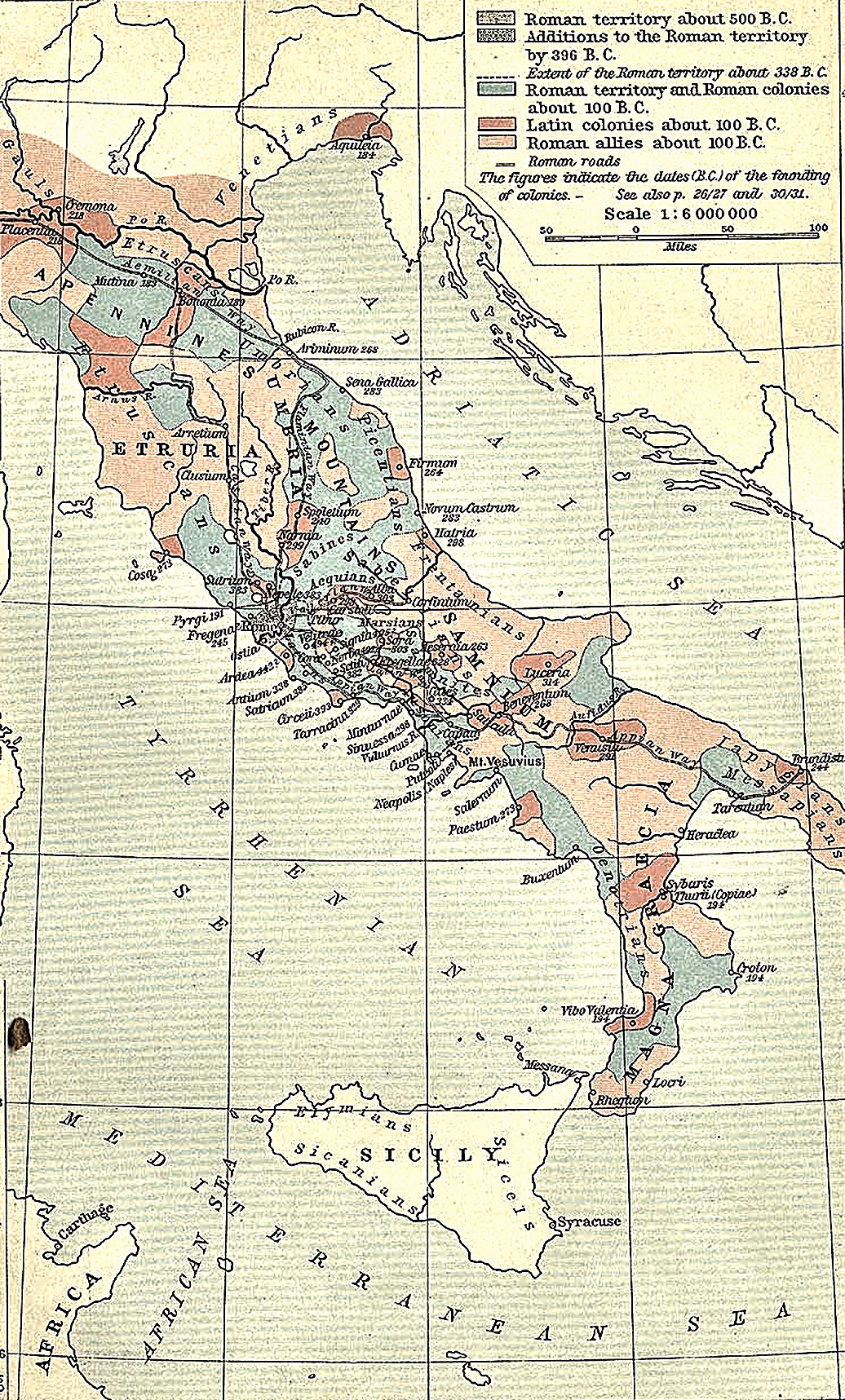
Italy was not held the way the later provinces were. Part of it became Roman land, settled by citizens and colonies; the rest was bound to Rome by treaties that asked for soldiers, not tribute. The first map marks the difference. The second follows the wars with Carthage and the Hellenistic kings that gave Rome its first provinces. A gold outline marks what changed at each step.

Plate500–100 B.C. · Roman power in Italy

The peninsula Rome bound to itself

Shepherd plate · Roman Italy Shepherd atlas map showing the growth of Roman power in Italy from about 500 to 100 B.C. Tap to enlarge · zoom
The growth of Roman power in Italy. Roman territory, colonies, treaty allies, and roads appear separately, preserving the difference between land Rome owned and communities it bound to provide soldiers. William R. Shepherd, Historical Atlas (1911), public domain; restored from the University of Texas scan.
Map I · The conquest of Italy

Rome takes Italy, 509–264 B.C.

From a city-state on the lower Tiber to the head of an Italian confederacy, south of the Arno and the Rubicon.

509 B.C.

A city on the Tiber

By the traditional date the last king, Tarquin the Proud, is driven out and two consuls are elected each year. Rome's land runs a few miles from the Tiber, perhaps 800 square kilometres. Around it lie the Latin towns, the Etruscan cities and the hill peoples, Sabines, Aequi and Volsci. A treaty with Carthage, which Polybius read on bronze, already names the Latin coast as Rome's.
493 B.C.

The Latin treaty

The Latins fight Rome at Lake Regillus, in 496 by Livy's reckoning, and lose. In 493 Spurius Cassius makes a treaty with them: peace, a joint army, and an equal share of the spoils. A like treaty with the Hernici follows in 486. For a century the allies hold off the Aequi and Volsci, who press down from the hills on Latium.

396 B.C.

Veii

Veii, the great Etruscan city a dozen miles north of Rome, falls to Marcus Furius Camillus after a siege the tradition makes last ten years, like Troy's. Its land is annexed and shared among Roman citizens, and Rome's territory nearly doubles. During the siege the soldiers are paid for the first time, a sign of campaigns that now keep men from their farms through the year.

390 B.C.

The Gauls

A Gallic war band from the Po valley routs the Roman army at the river Allia and sacks the city; only the Capitol holds, and the Gauls leave with gold. Polybius dates the sack to 387, the later Roman reckoning to 390. Rome recovers quickly: it builds a wall of stone, plants Latin colonies at Sutrium, Nepet, Satricum and Setia, and fights the Volsci for their plain.

338 B.C.

The Latin War

Called in by Capua against the Samnites in 343, Rome finds its Latin allies in arms behind it. It wins the Latin War (340–338) and dissolves their league. Some towns become Roman, while Tibur and Praeneste stay allies, each bound to Rome alone. Capua and the Campanian towns receive citizenship without the vote. The beaks of Antium's warships are set up on the speakers' platform in the Forum.

304 B.C.

The Samnite wars

The Samnites, a league of highland peoples, contest Campania and the south. In 321 they trap a consular army in the Caudine Forks and send it under the yoke. Rome answers with roads and colonies: Luceria in Apulia (314), the Via Appia to Capua (312), Alba Fucens among the Aequi (303). Peace comes in 304; the Aequi are crushed, and the Marsi, Paeligni and their neighbours make treaties.

290 B.C.

Sentinum

In 295 Samnites and Gauls, allied with Etruscans and Umbrians, meet two consular armies at Sentinum, the largest battle yet fought in Italy; the consul Decius Mus, Livy says, devoted himself to death to win it. Samnium is beaten again at Aquilonia (293) and makes peace in 290. That year Manius Curius overruns the Sabines, who receive citizenship without the vote.

280 B.C.

Pyrrhus

Rome drives the Senones from the Adriatic coast (284–283) and plants Sena Gallica on their land; the Etruscan cities, beaten again, accept treaties. Then Tarentum calls in Pyrrhus, king of Epirus, with a professional army and elephants. He beats the Romans at Heraclea (280) and Ausculum (279), at a cost Plutarch made proverbial, and Samnites, Lucanians and Bruttians rise to join him.

264 B.C.

Master of Italy

Pyrrhus campaigns in Sicily, returns, is checked at Beneventum (275) and sails home. Tarentum surrenders in 272. Picenum is conquered (269–268) and Ariminum founded on the Adriatic; Volsinii in Etruria is stormed and destroyed in 264. Italy south of the Arno and the Rubicon is Rome's, as citizen land or as allies bound to send soldiers. That year the Mamertines of Messana appeal to Rome.

509 B.C.
Rome and Italy, 509–264 B.C. The territory of Rome, c. 509 B.C. Veii Latium The Volsci and the Pomptine plain The Hernici and the Aequi The Sabines Etruria Umbria The ager Gallicus Picenum Marsi, Paeligni, Vestini, Marrucini and Frentani Samnium Campania Apulia The Messapians and Sallentini Tarentum and Heraclea Lucania The Bruttii LATIVM VOLSCI HERNICI SABINI ETRVRIA VMBRIA AGER GALLICVS PICENVM MARSI SAMNIVM CAMPANIA APVLIA MESSAPII LVCANIA BRVTTII MARE TYRRHENVM MARE HADRIATICVM MARE IONIVM GALLI AEQVI SARDINIA Carthaginian CORSICA SICILIA Greek cities and Carthage from Epirus LATINI VOLSCI HERNICI SABINI ETRVSCI VMBRI SENONES PICENTES MARSI SAMNITES CAMPANI APVLI MESSAPII LVCANI BRVTTII Roma Veii taken 396 L. Regillus c. 496 Allia Gauls win 390 Antium ships' beaks 338 Capua citizens without the vote Caudium the Forks 321 Luceria colony 314 Alba Fucens colony 303 Sentinum 295 Aquilonia 293 Sena Gallica colony 283 Heraclea 280 Ausculum 279 Tarentum calls in Pyrrhus taken 272 Beneventum 275 Volsinii destroyed 264 Ariminum colony 268 Paestum colony 273 Messana appeals to Rome
Roman territoryAllies bound by treatyAt war with RomeAllies in arms against Romechanged this step

Territories are editorial outlines after Shepherd’s Historical Atlas (1911), plate 29, cut from the Ancient World Mapping Center’s c. 60 BC outline of Italy (ODbL); the borders between the peoples of Italy are approximate, and a people is coloured whole from the date its main towns came to terms. Coastlines and rivers: Natural Earth. Sites: Pleiades.

Rome now led a confederacy that could put more soldiers in the field than any state in the western Mediterranean. The next map widens the frame to the whole sea, where that manpower met Carthage.

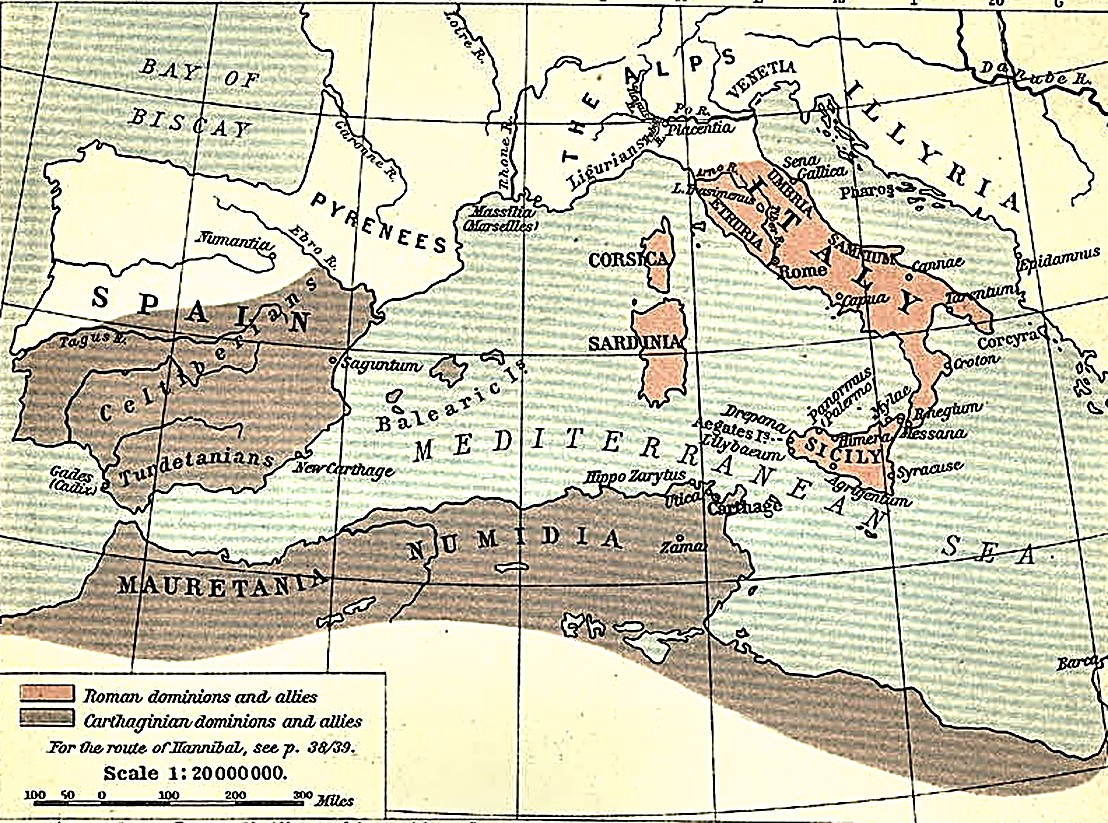
Plate218 B.C. · Two western powers

Rome and Carthage before Cannae

Shepherd plate · 218 B.C. Shepherd atlas map of Roman and Carthaginian dominions at the opening of the Second Punic War Tap to enlarge · zoom
Roman and Carthaginian dominions at the opening of the Second Punic War. The plate sets Rome's Italian confederacy against Carthage's African and Spanish power before Hannibal carried the war across the Alps. William R. Shepherd, Historical Atlas (1911), public domain; restored from the University of Texas scan.
Map II · The wars for the Mediterranean

Rome takes the Mediterranean, 264–146 B.C.

From the first crossing to Sicily to the destruction of Carthage and Corinth: the first provinces, and the kings Rome broke without annexing.

264 B.C.

Across the strait

Rome answers the appeal of the Mamertines, Campanian mercenaries holding Messana, and sends a consular army over the strait: its first war outside Italy. Carthage, the Phoenician city of Africa, holds western Sicily, Sardinia and Corsica, and trading towns on the coast of Spain; Hiero of Syracuse rules the southeast of Sicily. In 263 Hiero changes sides and becomes Rome's ally for life.

241 B.C.

The first province

A land power builds fleets. Rome wins at sea off Mylae (260), loses an army in Africa (255) and whole fleets to storms. In 241 a last fleet, paid for by private loans, destroys the Carthaginian relief convoy off the Aegates Islands. Carthage gives up Sicily and pays an indemnity. Western Sicily becomes Rome's first province, governed after 227 by a praetor sent each year.

227 B.C.

Sardinia, Illyria, Spain

While Carthage fights its own mercenaries, Rome seizes Sardinia and Corsica (238) and demands more money; Polybius counts this the truest cause of the next war. In 229 Roman fleets curb the Illyrian queen Teuta and take Corcyra, Apollonia and Epidamnus under protection. Hamilcar Barca, meanwhile, wins Carthage a new empire in Spain; Hasdrubal founds New Carthage and accepts the Ebro as a limit.

218 B.C.

Hannibal crosses the Alps

Rome turns north and beats the Gauls at Telamon (225) and Clastidium (222), and plants colonies at Placentia and Cremona. In 219 Hamilcar's son Hannibal takes Saguntum, a Spanish town in Rome's friendship. Rome declares war and sends an army to Spain, but Hannibal is already over the Pyrenees and the Alps. In December 218 he beats a consul at the Trebia, and the Po Gauls rise to join him.

216–212 B.C.

Cannae

Hannibal destroys a Roman army at Lake Trasimene (217) and a larger one at Cannae (216), the worst defeat in Roman memory. Capua goes over to him, then much of the south; Philip V of Macedon makes an alliance with him (215), Syracuse after Hiero's death (214), and Tarentum (212). The Latin colonies hold, and so does central Italy. Rome raises new legions and refuses battle.

201 B.C.

Zama

Marcellus takes Syracuse (212–211) and Capua is retaken (211). Hasdrubal marches to his brother's aid and is killed on the Metaurus (207). Publius Scipio takes New Carthage (209), drives the Carthaginians from Spain at Ilipa (206) and invades Africa. Recalled to defend his city, Hannibal is beaten at Zama (202). Carthage gives up Spain and its fleet; Masinissa's Numidia becomes Rome's ally.

188 B.C.

The Greek East

Two Spanish provinces are formed (197) and the Boii of the Po valley are crushed (191). In Greece, Flamininus beats Philip at Cynoscephalae (197) and proclaims the Greeks free. Antiochus III of Syria, crossing into Greece, is beaten at Thermopylae (191) and Magnesia (190), and at Apamea (188) gives up Asia Minor beyond the Taurus. Rome takes no land there but enlarges its friends, Pergamum and Rhodes.

168 B.C.

Pydna

Philip's son Perseus is beaten at Pydna (168) by Aemilius Paullus. The Macedonian monarchy is abolished and the kingdom split into four republics paying tribute to Rome; Genthius' Illyrian kingdom is broken up the same year. Rhodes, suspected of favouring Perseus, loses its mainland lands. Outside Alexandria a Roman envoy, Popillius Laenas, orders Antiochus IV out of Egypt, and the king obeys.

146 B.C.

Carthage and Corinth

A pretender, Andriscus, claims the Macedonian throne and is crushed (148); Macedonia becomes a province. When the Achaean League defies Rome, Mummius sacks Corinth (146). The same year Scipio Aemilianus takes Carthage after a three-year siege and razes it; its land becomes the province of Africa. In Spain the Lusitanians and Celtiberians are still at war with Rome, and will be until Numantia falls (133).

264 B.C.
Rome and the Mediterranean, 264–146 B.C. Italy Southern Italy Cisalpine Gaul and Liguria Sicily Kingdom of Syracuse Sardinia and Corsica Southern and eastern coast of Spain Coast between the Ebro and Saguntum Southern interior of Spain Celtiberia and Lusitania Carthage's territory Numidia The Illyrian coast and Corcyra Kingdom of Genthius Macedon Greece Kingdom of Pergamum ITALIA GALLIA CISALPINA SICILIA SARDINIA HISPANIA CELTIBERI AFRICA NVMIDIA MACEDONIA GRAECIA MARE INTERNVM OCEANVS GALLIA LVSITANI MAVRI BARCID SPAIN ILLYRII THRACES SELEVCIDAE Seleucid kingdom → AEGYPTVS GALLI CELTIBERI MACEDONIA GRAECI Roma Carthago razed 146 Gades Punic Messana Mamertines Syracusae Hiero taken 212–211 Mylae 260 Aegates 241 Corcyra 229 New Carthage founded c. 227 taken 209 Saguntum sacked 219 Emporiae Romans land Telamon 225 Clastidium 222 Trebia Dec. 218 L. Trasimene 217 Cannae 216 Capua defects 216 Tarentum 212 Metaurus 207 Ilipa 206 Zama 202 Cynoscephalae 197 Thermopylae 191 Magnesia 190 Pergamum Apamea peace 188 Rhodes gains Lycia, Caria loses them 167 Pydna 168 Scodra Genthius 168 Alexandria Popillius 168 Corinth sacked 146 Numantia falls 133
Italy: Rome and its alliesRoman provinceFriends and allies of RomeCarthage, or at war with RomeBeing conquered / partly heldWent over to Carthagechanged this step

Outlines: Ancient World Mapping Center, “Roman Empire c. 60 BC” and “c. AD 200 provinces” (ODbL; after the Barrington Atlas), divided editorially after Shepherd’s Historical Atlas (1911), plate 32: Italy at the Arno–Rubicon line and the Volturnus, Hiero’s kingdom in Sicily, Barcid Spain, and Macedon, Greece and the Illyrian coast. Spain, Numidia and Macedonia are drawn at their later extent, so early limits are too large. Coastlines and rivers: Natural Earth. Sites: Pleiades.

Plate264–133 B.C. · The result

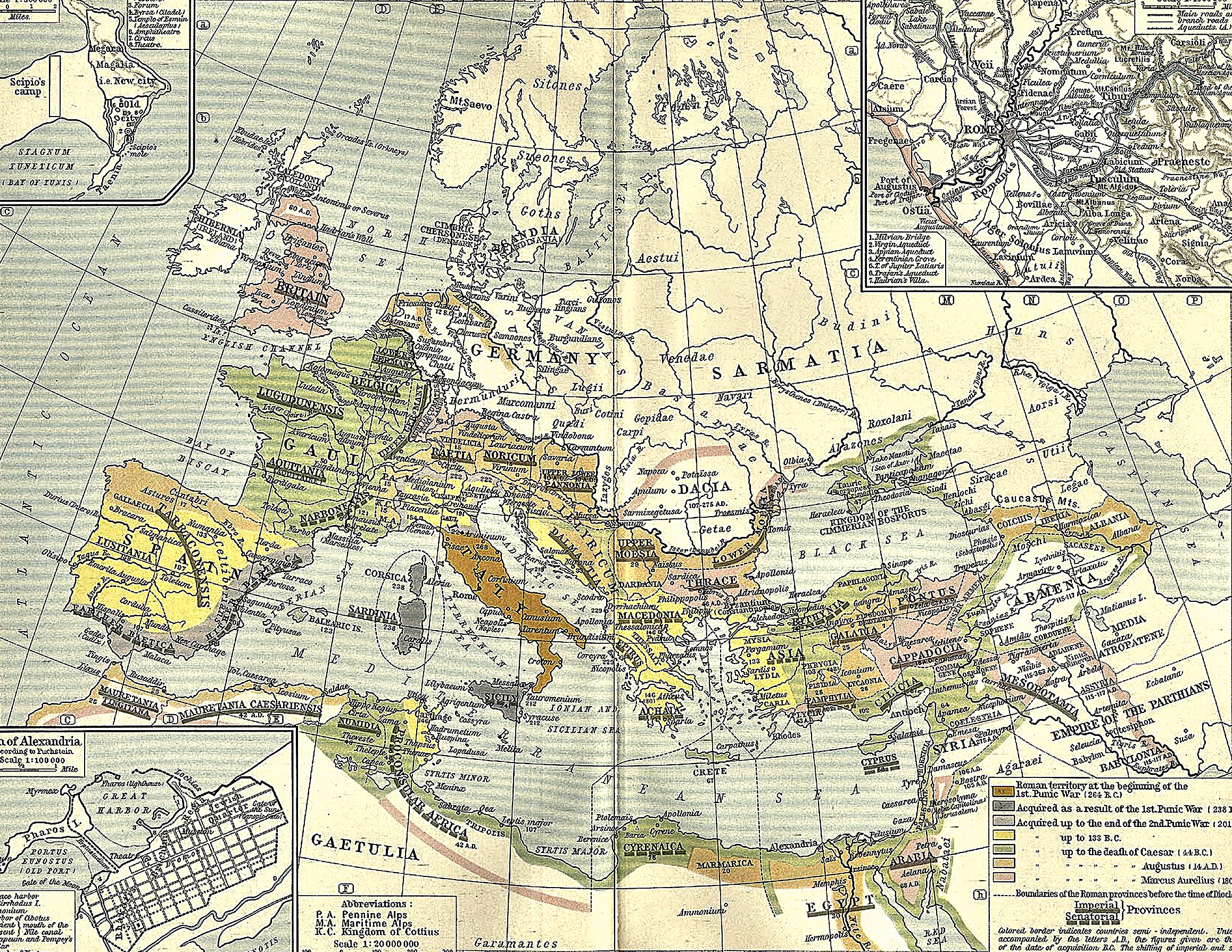
The territorial expansion of Rome

Shepherd plate · Roman expansion Shepherd atlas plate showing the territorial expansion of Rome across the Mediterranean Tap to enlarge · zoom
The territorial expansion of Rome. Successive colours distinguish the lands added after the Punic and eastern wars. The sequence ends beyond this atlas study, at 133 B.C., when Attalus III bequeathed Pergamum to Rome. William R. Shepherd, Historical Atlas (1911), public domain; restored from the University of Texas scan.
146 B.C. · The inheritance

Six provinces

In 146 Rome governed six provinces: Sicily, Sardinia with Corsica, the two Spains, Macedonia and Africa. None was planned in advance. Each came out of a war begun for other reasons, and each needed a governor with an army. How the Republic managed the men who held those commands, and the soldiers who followed them, is the story of its next century.

Continue: the dominion of Rome, 146–79 B.C. →
Then: the Roman world, 79 B.C.–A.D. 192 →