c. 550–530 B.C.Cyrus
About 550 B.C. Cyrus, king of the small Persian realm of Anshan in the hills above the Persian Gulf, overthrew his overlord Astyages, king of the Medes, and took over an empire that already reached from Iran into Anatolia. Croesus of Lydia, the richest king of the age and master of the Greek cities on the Asian coast, judged the newcomer a threat and marched against him; the traditional date is 547 or 546, and the Babylonian chronicle that might fix it is damaged at the crucial word. After an indecisive battle Croesus went home to Sardis for the winter. Cyrus followed him, which no one did in winter, defeated his cavalry with camels, Herodotus says, and took Sardis by storm. Croesus’ fate, saved from the pyre by Apollo or by Cyrus’ second thoughts, is one of Herodotus’ set pieces and is told as his.
The Ionian Greeks had refused to join Cyrus against Croesus and now found that their master had changed. Cyrus’ general Harpagus took their cities one by one, with siege-mounds; the Phocaeans and half the Teians sailed away rather than submit. In 539 Cyrus entered Babylon, where a clay cylinder in his name proclaims him the chosen of its god Marduk and a restorer of temples and peoples; the Jews, whom he allowed home from exile, remembered him in the same terms. He died in 530 fighting nomads beyond the Oxus. In twenty years he had made the largest empire yet seen, and he had ruled it by leaving each people its gods and its customs, and taking its tribute.
525–513 B.C.Cambyses and Darius
Cyrus’ son Cambyses added Egypt in 525 B.C., and Cyrene and the Greeks of Cyprus submitted. He died on the way home in 522, and in the confusion that followed a Persian nobleman of a collateral branch, Darius, killed the reigning king, whom he declared an impostor, a Magian passing himself off as Cyrus’ younger son. That is Darius’ own account, carved in three languages on the cliff of Behistun with a relief of himself trampling the usurper; Herodotus tells the same story with more colour. Those who doubt it note that the man best placed to know whether the king was an impostor was the man who profited by saying so.
Darius spent his first years putting down revolts in nearly every province and the rest of his reign organising what he had kept. He divided the empire into some twenty satrapies, each under a governor, with a fixed tribute in silver and men; he built the royal road from Sardis to Susa with post-stations and a courier service, dug a canal from the Nile to the Red Sea, struck a gold coin, the daric, that circulated from Greece to India, and began the palaces of Persepolis. About 513 he crossed the Bosporus on a bridge of boats to campaign against the Scythians beyond the Danube, and though the Scythians would not stand and fight, his general Megabazus stayed to subdue Thrace, and Amyntas of Macedon sent earth and water in submission. Persia now held Greek cities on both sides of the Aegean.
546–500 B.C.How Persia ruled the Greeks
Persian rule in Ionia was not, by the standards of empire, harsh. The cities kept their language, their temples and their walls; they paid tribute to the satrap at Sardis and furnished ships and men when the King called. What they lost was self-government. Persia found it convenient to rule each city through a single Greek, a tyrant who owed his position to Sardis and could be summoned there, and the Ionian tyrants went in the King’s train: Histiaeus of Miletus was at the Danube bridge and was rewarded with a Thracian town. To Greeks who had spent two centuries expelling tyrants, this was the grievance, and the ambitions of the tyrants themselves were the spark.
499–494 B.C.The revolt
Aristagoras, Histiaeus’ son-in-law and deputy at Miletus, persuaded the satrap Artaphernes to back an expedition against the island of Naxos; it failed, in 499 B.C., and Aristagoras, unable to pay for it and fearing the consequences, chose revolt. He laid down his own tyranny, called on the other cities to depose theirs, and sailed to Greece for help. At Sparta, Herodotus says, King Cleomenes listened until he learned that Susa was three months’ march from the sea, and then told him to be out of the city by sunset. At Athens, where the democracy was new and Hippias was at the Persian court asking for his restoration, the assembly voted twenty ships; Eretria sent five. Herodotus, looking back, called those ships the beginning of the troubles between Greeks and barbarians.
In 498 the Ionians and their allies marched inland and burned Sardis, though not its citadel; a temple of the local goddess Cybele went up with the town, and the Persians remembered it. On the way back they were beaten at Ephesus and the Athenians went home. The revolt nonetheless spread to Caria, the Hellespont and Cyprus, and it took Persia five years to put it down: Cyprus first, in 497, then the Hellespont, then Caria, where a Persian army was destroyed in an ambush. Aristagoras fled to Thrace and was killed there. In 494 the King’s fleet, some six hundred ships from Phoenicia, Egypt and Cyprus, met the Ionian fleet of three hundred and fifty off the island of Lade before Miletus. The Samian contingent, or most of it, sailed away before the fighting began, others followed, and the rest were destroyed. Miletus, the richest Greek city in Asia, was stormed, its men killed, its women and children carried to Susa and settled at the mouth of the Tigris, its temple of Apollo at Didyma burned. In Athens a playwright who staged the fall of Miletus was fined for making the audience weep.
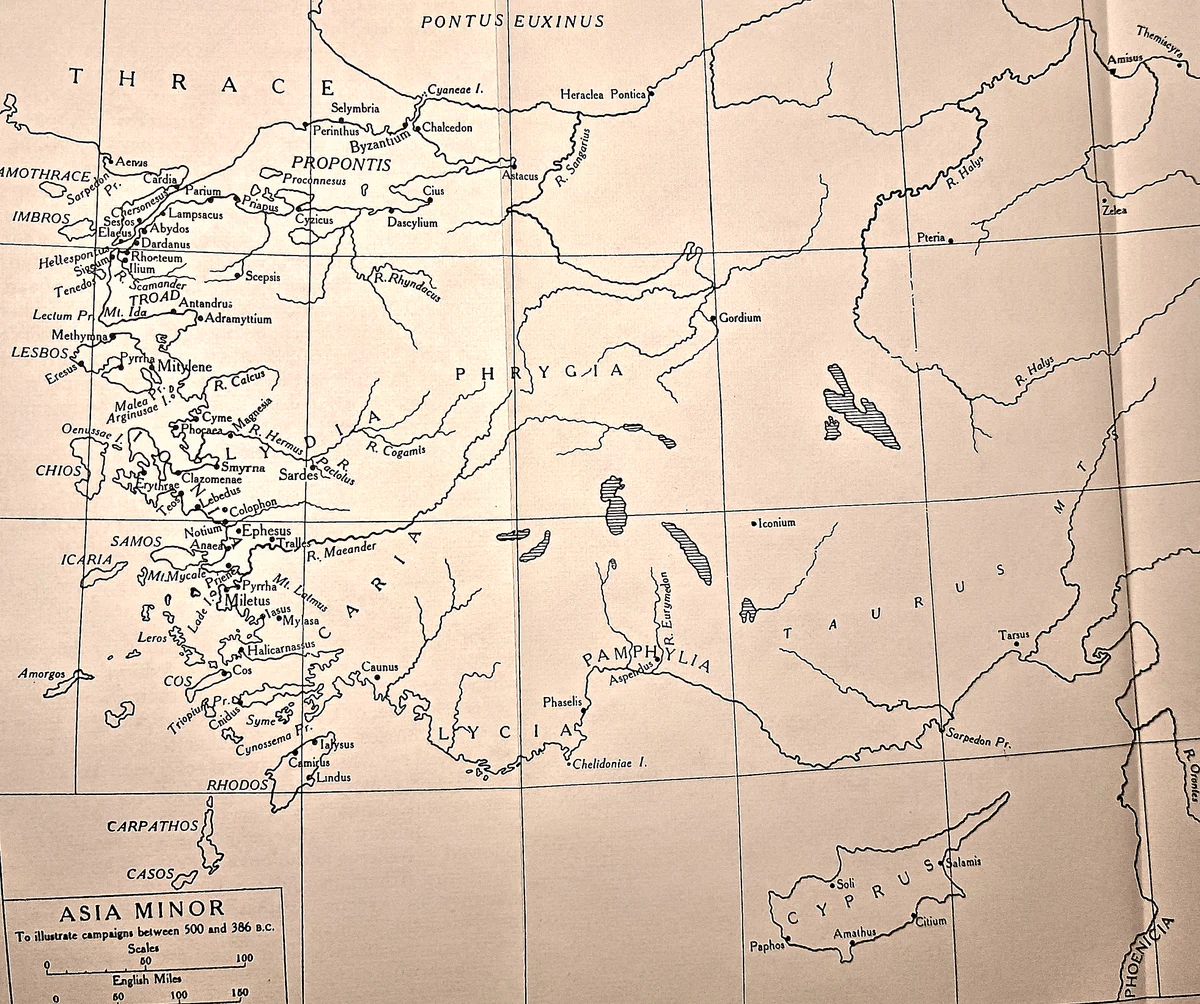 Click to enlarge
493–492 B.C.The settlement, and a grudge
Persia’s settlement was more intelligent than its vengeance. Artaphernes measured the cities’ land, fixed their tribute, and made them settle disputes by arbitration rather than raids; and in 492 Mardonius, Darius’ son-in-law, came down to the coast, put down the tyrants Persia had itself installed and set up democracies in the Ionian cities, a fact Herodotus reports as a marvel to those Greeks who did not believe it. Mardonius then crossed to Europe, brought Thrace and Macedon firmly under Persian rule, and lost half his fleet in a storm off Mount Athos on his way to punish Eretria and Athens. The punishment was postponed, not abandoned. Herodotus tells the story that Darius, learning who the Athenians were, shot an arrow into the sky and ordered a servant to remind him three times at every dinner. It is a story; but the expedition of 490 is a fact, and the next chapter begins with it.
Why it mattered
The Ionian Revolt failed, but it fixed the terms of the century. It showed that Persia’s Greek subjects would rise if they saw a chance, that Sparta would not cross the sea for them, that Athens, alone among the cities of Greece, would, and that the Great King did not forget a burned temple. Persia had learned the Aegean was not a frontier it could leave alone; Greece had learned what Persian power looked like at close range. Both sides now knew there would be a war.