490 B.C.Marathon
In the summer of 490 B.C. Darius sent a fleet straight across the Aegean under Datis and Artaphernes, with the old tyrant Hippias aboard to guide it and to be reinstalled. It took Naxos, spared Delos, burned Eretria after its gates were opened by traitors, and landed on the plain of Marathon, twenty-five miles from Athens, where Hippias’ father had once landed to seize the city. The Athenians marched out with their whole hoplite levy, perhaps nine or ten thousand men, and were joined by the entire fighting force of the small Boeotian town of Plataea. They sent a runner to Sparta; the Spartans, keeping a festival, promised to come at the full moon.
For some days the two armies watched each other. Then, on the advice of Miltiades, one of the ten generals and a man who had lived under Persian rule and knew its army, the Greeks attacked. Miltiades thinned his centre and strengthened his wings; the Persians broke the centre, the Greek wings broke the Persian wings and then turned inward, and the invaders were driven into the marsh and the sea and fled to their ships. Herodotus gives the dead as 6,400 Persians and 192 Athenians; the mound over the Athenian dead still stands on the plain. The fleet sailed round Cape Sunium hoping to find the city undefended, and found the army already back in front of it. The Spartans arrived the next day, looked at the Persian dead, and went home.
Marathon was a victory of one city and its small ally over a Persian expeditionary force, not over the empire. But it showed that the hoplite line could beat the Persian army in the open, and Athens never forgot that it had done so alone.
489–481 B.C.Silver and ships
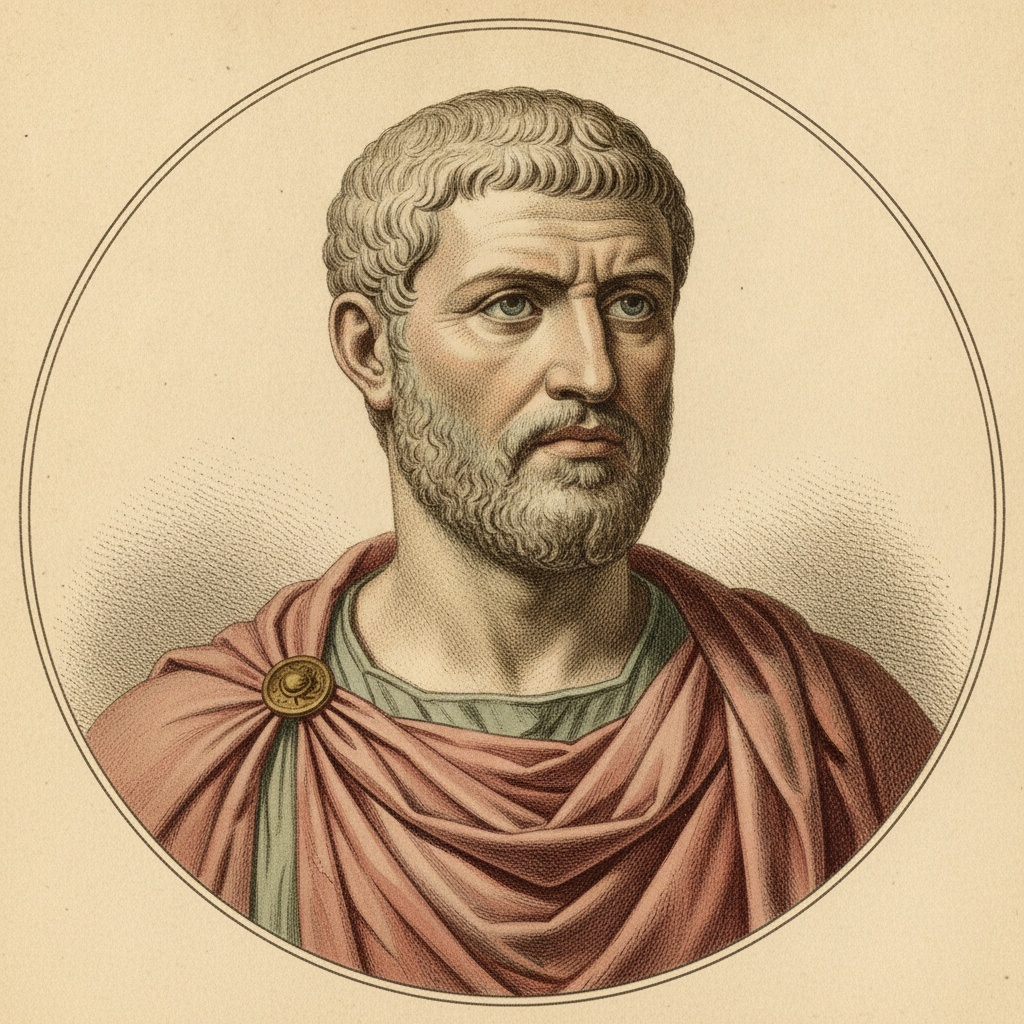
Miltiades died within the year, disgraced after a failed attack on Paros, and the politics of the next decade were dominated by Themistocles, a man of no great family and very great cunning, whom Herodotus and Thucydides alike credit with seeing that Athens’ future lay at sea. His rival Aristides was removed by ostracism in 482. In 483 a rich new vein was struck in the state silver mines at Laurium, and where the assembly would normally have divided the windfall among the citizens, Themistocles persuaded it to build ships instead: two hundred triremes, the fast three-banked warships that made Athens, overnight, the greatest naval power in Greece. The pretext was the old war with Aegina. The reason was the news from Asia.
Darius had died in 486 and his son Xerxes, after crushing a revolt in Egypt, resolved to finish what his father had begun. For four years the empire prepared: a canal was cut through the isthmus behind Mount Athos so that the fleet need not round the cape that had wrecked Mardonius, two bridges of ships were laid across the Hellespont, and supply depots were stocked along the Thracian coast. Herodotus reckoned the army at more than five million men, which is impossible; modern estimates run from a hundred thousand upward, and it was in any case far larger than anything Greece could put in the field. In 481 the Greek cities that meant to resist met at the Isthmus of Corinth and swore alliance under Spartan leadership. Thirty-one states eventually took the oath. Argos stayed neutral, Thessaly and most of Boeotia would go over to the King, and Gelon of Syracuse, asked for help, was facing an invasion from Carthage.
480 B.C.Thermopylae and Artemisium
The Greeks tried to hold Xerxes as far north as they could. A first line in the vale of Tempe was abandoned as unholdable. The second was the pass of Thermopylae, where the mountains came within a few yards of the sea, with the fleet stationed at Artemisium on the north coast of Euboea to keep the Persian ships from landing behind it. The Spartan king Leonidas held the pass with about seven thousand men, three hundred of them Spartiates. For two days the Persians could make nothing of the wall of shields in the narrows. Then a local man, Ephialtes, showed them a path over the mountain, and Leonidas, learning that he was to be surrounded, sent most of the allies away and stayed with his Spartans, the Thespians, who chose to remain, and the Thebans, whose choice Herodotus questioned. They died to a man. The fleet fought three indecisive days off Artemisium, learned of the pass, and withdrew south.
Central Greece lay open. The Athenians, told by Delphi to trust their wooden walls, took the oracle to mean their ships, and moved their women and children to Salamis, Aegina and Troezen. The few who stayed on the Acropolis were killed and the temples burned. Xerxes had his revenge for Sardis.
September 480 B.C.Salamis
The Greek fleet, some three hundred and eighty ships of which more than half were Athenian, lay in the strait between Salamis and the Attic shore under the Spartan Eurybiades, since the Peloponnesians would not serve under an Athenian. The Peloponnesian captains wished to fall back to the Isthmus. Themistocles argued that in the narrows the Greeks could fight on their own terms and that in open water the King’s numbers would tell; and when argument failed, Herodotus says, he sent his slave Sicinnus to the Persians with word that the Greeks were about to slip away. Xerxes, wanting a decision before winter, sent his fleet into the strait at night to block both exits. At dawn the Greeks rowed out to meet it. In the confined water the Persian ships fouled each other, the Greeks rammed them at will, and by evening the King, watching from a throne on the shore, had lost a third of his fleet and the sea. Aeschylus fought that day and put the battle into a play eight years later; Artemisia, queen of Halicarnassus, fought on the Persian side and was praised by Xerxes for her escape.
Salamis did not end the war; Xerxes still had the largest army in Europe. But it ended his ability to feed it by sea and to threaten the Peloponnese by water. He marched back to the Hellespont with part of the army and left the rest, under Mardonius, to winter in Thessaly and finish the business in the spring.
479 B.C.Plataea and Mycale
Mardonius first tried diplomacy, sending Alexander of Macedon to offer the Athenians their city, their freedom and more land if they would come over. The Athenians, with the Spartans anxiously listening, refused. Mardonius occupied and burned Athens a second time, then fell back into Boeotia where his cavalry could work. The Spartans, after long delay and a threat from Athens to make its own peace, marched at last with the full Peloponnesian levy, and the allied army that met Mardonius near Plataea was the largest Greek force ever assembled, perhaps forty thousand hoplites under the Spartan regent Pausanias. After days of manoeuvre in which the Persian horse cut the Greek supply lines and fouled their water, a Greek withdrawal by night went wrong, and Mardonius, seeing the Spartans apparently isolated, attacked them. The Spartan and Tegean line held the arrow-storm and then charged; Mardonius was killed, the Persian infantry broke, and the Greeks stormed the stockaded camp. Thebes, which had fought for the King, was besieged and its leaders executed.
On the same day, the Greeks afterwards said, the allied fleet under the Spartan king Leotychidas landed at Mycale on the Ionian coast, where the Persian fleet had been beached, and destroyed both the ships and the army guarding them. Samos, Chios and Lesbos were taken into the alliance, the cities of Ionia rose, and in the autumn the Athenians crossed to the Hellespont and besieged Sestos. When it fell they carried home the cables of Xerxes’ bridges. The Greeks set up at Delphi a bronze column of three intertwined serpents bearing the names of the thirty-one cities that had fought; its stone base still stands, and the column itself stands in Istanbul.
Why it mattered
A loose alliance of small states had defeated the empire of Asia twice on land and once at sea. The immediate consequences were three. Sparta stood confirmed as the first land power of Greece. Athens, which had lost its city twice and provided most of the fleet, had a navy, a grievance against those who had hesitated, and, over Spartan objections, new walls. And the Ionian Greeks were free and needed protecting, which Sparta would not do and Athens would. The alliance that had won the war did not survive its victory by three years; what replaced it is the subject of the next chapter.