VI338–336 B.C.
The settlement at Corinth
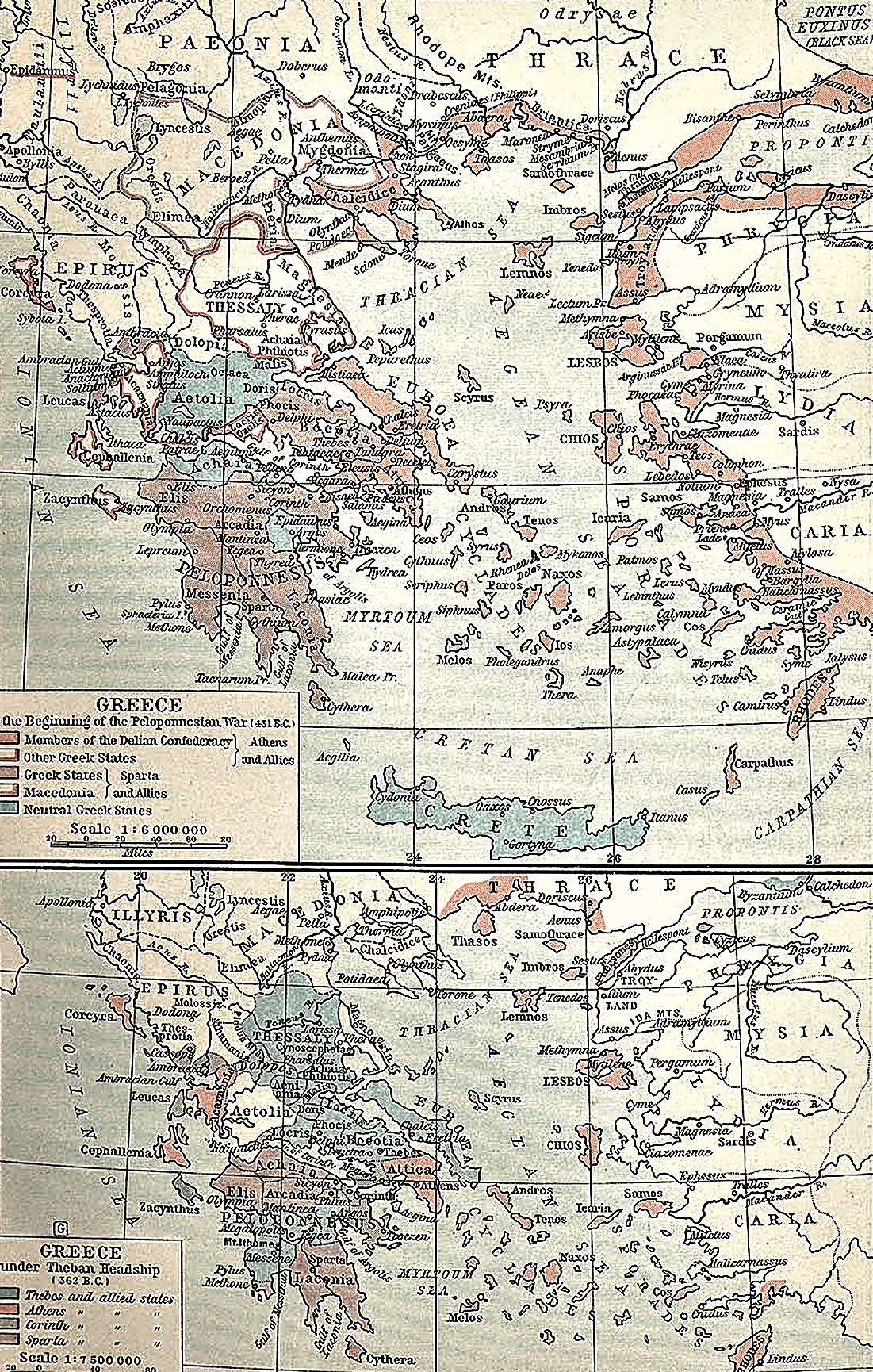
Philip’s advance was neither effortless nor inevitable. Perinthus and Byzantium resisted his sieges. Athens and Thebes eventually joined against him, overcoming a long hostility. At Chaeronea in 338 B.C. their combined army met the Macedonians and was defeated. Philip’s son Alexander, eighteen years old, commanded on one wing. The details of his part in the battle are less certain than the result: the last strong coalition able to bar Macedon from central Greece had failed.
Philip placed a garrison in Thebes but spared Athens a garrison and left its democracy intact. He needed obedience and ships, not the destruction of every defeated city. At Corinth he organised the Greek states, Sparta excepted, into a common peace and alliance. Its members retained their civic governments; a council represented them; Philip held the military command. The cities could debate their own business, but their freedom to make war had passed under the king’s supervision.
The alliance prepared a campaign against Persia. In 336 an advance force crossed into Asia, but Philip did not follow. A bodyguard murdered him at Aegae during the celebrations for his daughter’s marriage. Ancient accounts supplied wider conspiracies; they do not establish who, if anyone, stood behind the assassin. Philip left Alexander an army, a treasury, experienced officers, and a Greek settlement that depended on the strength of its king. The son’s first task was to prove that it had survived the father.
Sources & method
Xenophon, Hellenica, translated by H. G. Dakyns: II.2–4 for Athens’ defeat, the Thirty, and restoration; III.4–IV.8 for Agesilaus and the Corinthian War; V.1–4 for the King’s Peace and Thebes; VI.4–5 for Leuctra and the invasion of Laconia; VII.5 for Mantinea. His Spartan sympathies and uneven treatment of Theban achievements require caution. The retreat follows his Anabasis, I.8–II.5, III–IV, and VI–VII, also translated by Dakyns; its author was a participant defending his own conduct.
Plato, Apology, and Xenophon, Apology and Memorabilia I.1–2, preserve defences of Socrates. Diodorus, Library XV.62–66 and XVI.1–8, 35, 53–60, 84–94, supplies the Messenian settlement and the narrative of Philip; Demosthenes’ Philippics and Olynthiacs present the Athenian case against him. Chronology and institutions are checked against The Cambridge Ancient History, VI, The Fourth Century B.C., second edition, especially chapters 2, 6–7, and 14–15. The argument that military victories repeatedly failed to secure an accepted settlement is an interpretation of these events.