323–301 B.C.The generals’ war
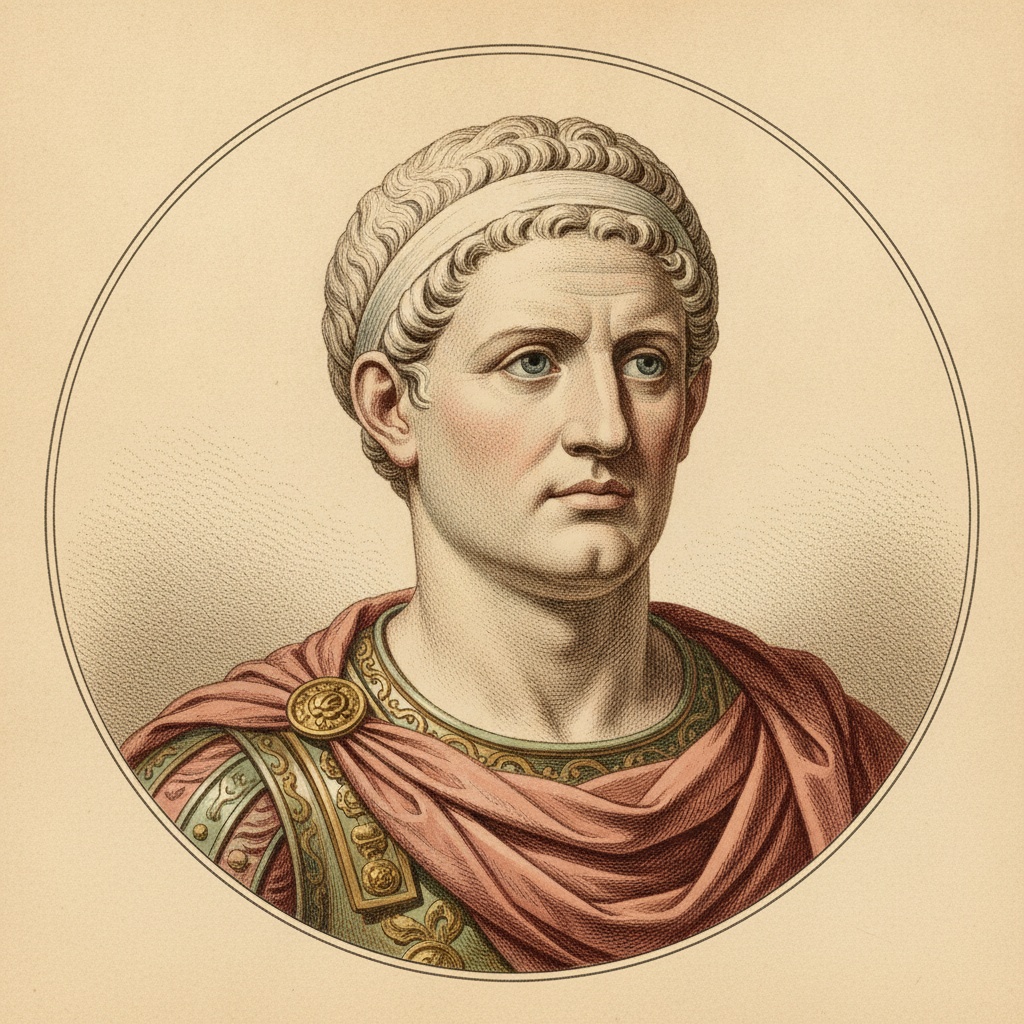
Alexander died at Babylon in June 323 B.C. leaving a half-witted half-brother, an unborn child by a Bactrian wife, and a ring he had given, the story went, to Perdiccas. The generals at Babylon compromised: the half-brother was crowned as Philip III, the child, when it proved a boy, as Alexander IV, Perdiccas was to govern for both, and the satrapies were shared out. Ptolemy took Egypt and never let it go. Within two years he had hijacked the funeral cart carrying Alexander’s body to Macedon and diverted it to Egypt, where the corpse became the founding relic of his dynasty, and when Perdiccas invaded to punish him and lost two thousand men to the Nile crocodiles his own officers, Seleucus among them, killed him in his tent. Antipater, the old regent of Macedon, took over the kings and died in 319, and after him no one governed the whole. Cassander, his son, seized Macedon, killed Alexander’s mother Olympias in 316 and, about 310, quietly murdered the boy king and his mother Roxane. Antigonus the One-Eyed, Alexander’s oldest surviving general, master of Asia Minor and Syria, hunted down and executed Eumenes of Cardia, the Greek secretary who had fought longest for the royal house, and then tried to reunite the empire under himself. Seleucus, driven out of Babylon by him, came back in 312 with a few hundred men and held it; the Seleucid kings counted their years from that return for two centuries.
In 306 Antigonus’ son Demetrius destroyed Ptolemy’s fleet off Salamis in Cyprus, and father and son took the title of king. Within the year Ptolemy, Seleucus, Lysimachus in Thrace and Cassander did the same, and the fiction of a single empire was over. Demetrius spent 305 and 304 besieging Rhodes with the largest siege engines the world had seen and failed; the Rhodians sold his abandoned machinery and paid for the bronze Colossus with it. In 301, at Ipsus in Phrygia, the other kings combined against Antigonus, and Seleucus’ five hundred Indian elephants, the price he had taken from Chandragupta for the provinces beyond the Hindu Kush, cut Demetrius’ cavalry off from his father’s line. Antigonus, aged eighty-one, died under a shower of javelins waiting for a son who did not come back.
301–276 B.C.Three kingdoms and a plague of Gauls
Ipsus made Seleucus lord of most of Asia and left Demetrius a fleet, a reputation and no country. For twenty years the Besieger wandered, took Macedon in 294 and lost it, invaded Asia with an army that melted, and surrendered in 285 to Seleucus, who kept him in comfortable captivity until he drank himself to death. Lysimachus, who had taken Macedon, was the next to fall: in 281 Seleucus crossed into Asia Minor against him and killed him at Corupedium, and Seleucus, now the last of Alexander’s generals alive and master of all but Egypt, crossed to Europe to take Macedon and was stabbed on landing by Ptolemy Ceraunus, a disinherited son of Ptolemy whom he had sheltered. Ceraunus took Macedon and within two years was dead himself, for in 279 the Gauls came. Celtic war bands that had been drifting down the Danube for a generation broke into Macedon, killed Ceraunus and carried his head on a spear, ravaged Thessaly, and in the winter attacked Delphi, where a storm and the Aetolians turned them back, the Greeks said, with the god’s help. Antigonus Gonatas, Demetrius’ son, destroyed one band near Lysimachia in 277 and on the strength of it made himself king of Macedon, which his house then held until Rome took it. The other bands crossed into Asia Minor, where they were settled after a decade of raiding in the centre of the peninsula as the Galatians, and the victory of the local dynast Attalus over them about 237 entitled him to call himself king of Pergamum.
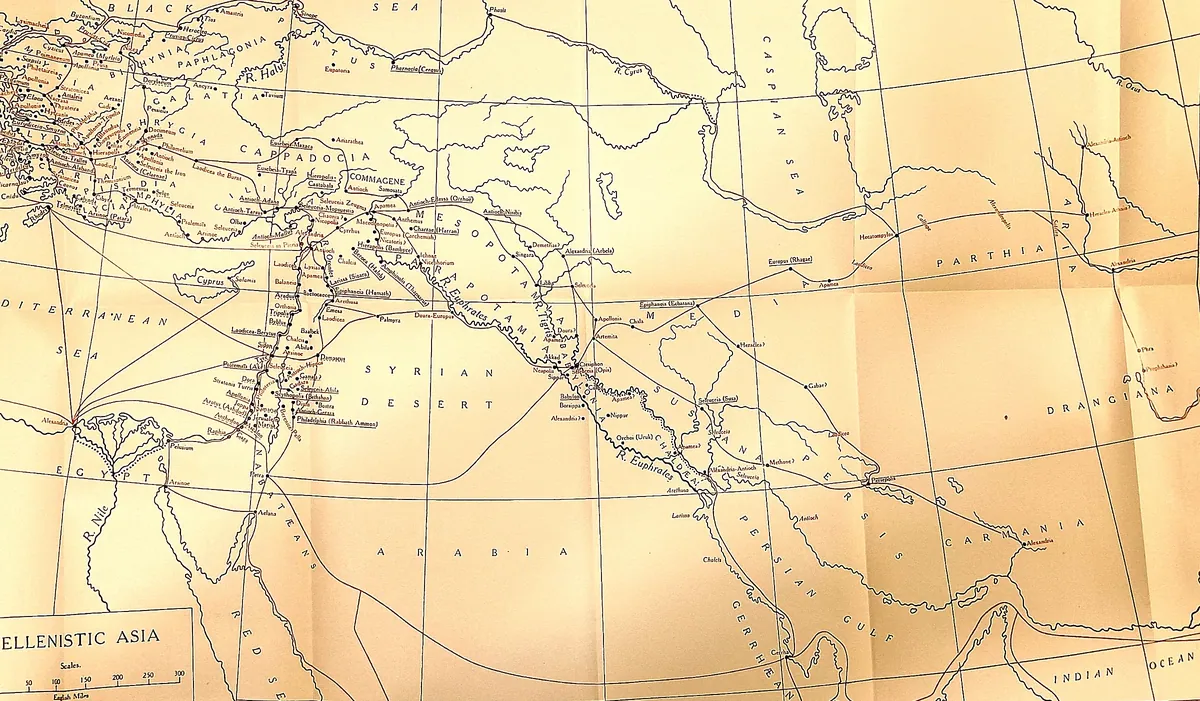
By 276 the map that would last for a century and a half was drawn. The Ptolemies held Egypt, Cyrene, Cyprus, Coele-Syria and Palestine, and a string of harbours and islands around the Aegean; their capital was Alexandria, the largest Greek city in the world. The Seleucids held Syria, Mesopotamia, and, on paper, Iran to the frontiers of India, from two capitals, Antioch on the Orontes, founded in 300, and Seleucia on the Tigris. The Antigonids held Macedon and controlled Greece through garrisons in the three fortresses Philip V would later call the fetters of Greece, Demetrias, Chalcis and Corinth. Round the edges were the smaller powers that lived by playing the three off: Pergamum, Rhodes, Bithynia, Pontus, Cappadocia, and the Greek leagues.
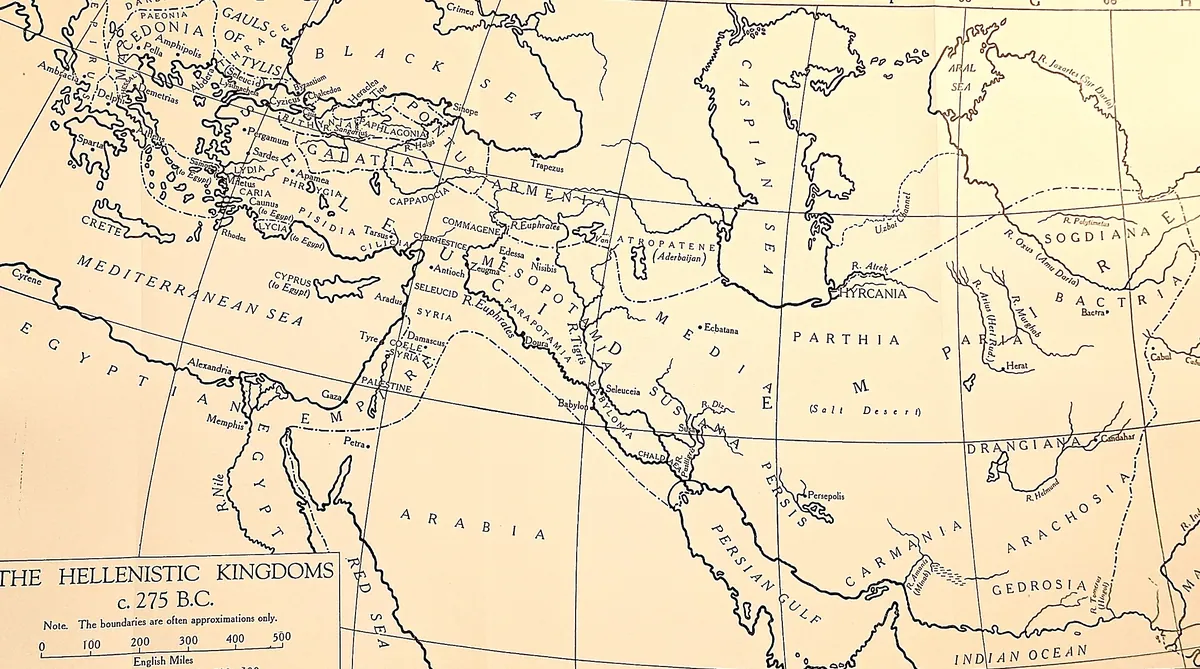 Click to enlarge
The third centuryKings and cities
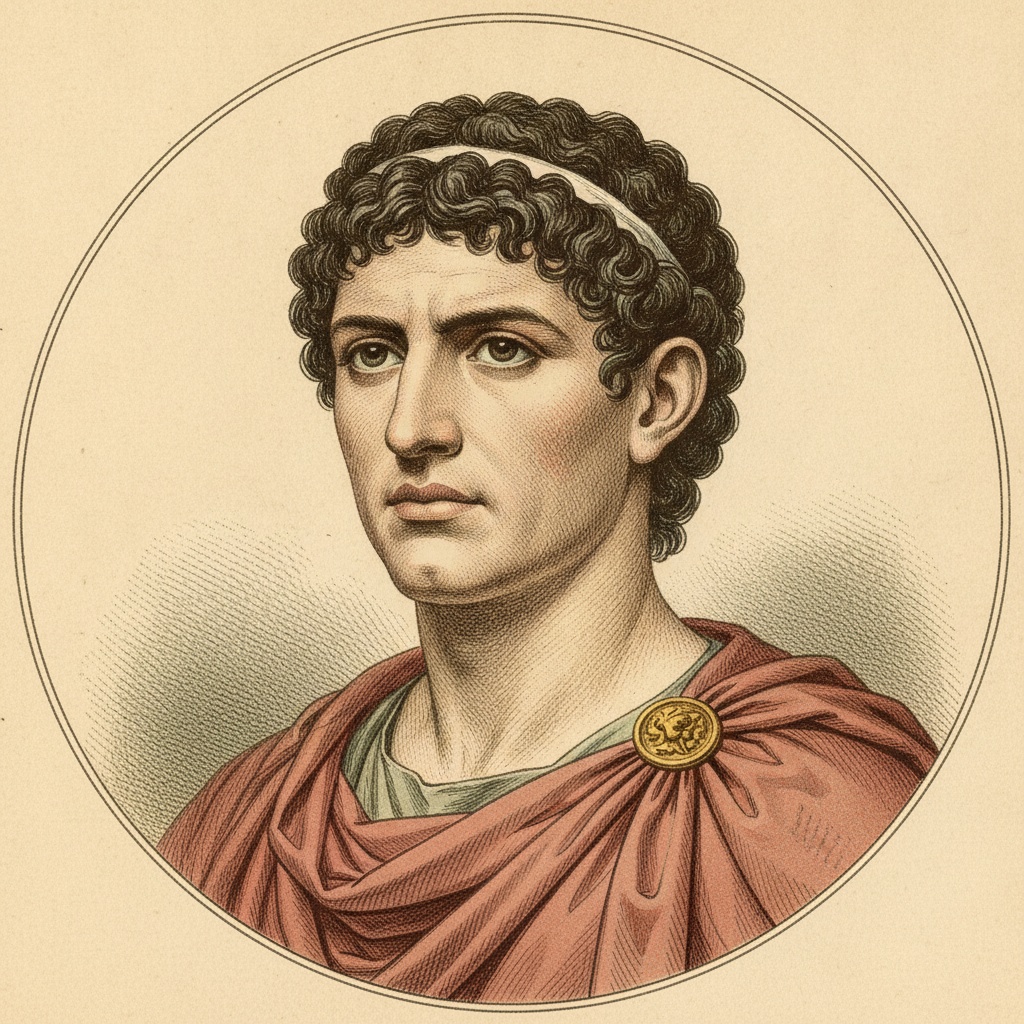
A Hellenistic king was a Macedonian who ruled by right of conquest, spear-won land, over subjects who had never chosen him. He kept a court of Friends, mostly Greeks and Macedonians, a treasury, a professional army of Macedonian phalangites, Greek mercenaries and native levies, and a fleet, and he founded cities, dozens of Antiochs, Seleucias and Ptolemaises, to settle his veterans and hold his roads. The cities were Greek islands in a native sea, with a gymnasium, a theatre, an assembly and a Greek dialect, the common speech or koine, that a man from Marseille and a man from Kandahar could both use. Kings were worshipped. The Egyptians had always deified their pharaoh, and Ptolemy II made a goddess of his sister and wife Arsinoe about 270; the Seleucids and the cities that depended on them followed, and a Greek who sacrificed to King Antiochus the Saviour was not doing anything he thought absurd, for the king could save a city and the old gods no longer did.
Egypt was governed as its kings’ private estate. The papyri that the desert preserved show a bureaucracy in Greek that registered every field, set the price of oil, let out the collection of taxes to contractors, and settled Greek and Macedonian soldiers on allotments of royal land in the Fayum. The natives kept their temples, their priests and their language, and the decree of 196 in honour of Ptolemy V that was carved in Greek, demotic and hieroglyphs on the stone found at Rosetta shows the two worlds negotiating. The Seleucid empire was too large to be run that way and was never quite run at all. The satraps of the far east fell away by 250: a Greek governor made Bactria an independent kingdom whose coins are among the finest ever struck, and a nomad chief named Arsaces took the province of Parthia and founded the dynasty that would one day face Rome across the Euphrates. Between Egypt and Syria the two great houses fought five wars in a century over Coele-Syria, the corridor between them, without result until Antiochus III, called the Great, won it at Panium in 200 after an eastern expedition, from 212 to 205, that had marched to the borders of India and made the old provinces acknowledge him, briefly, as Alexander’s heir.
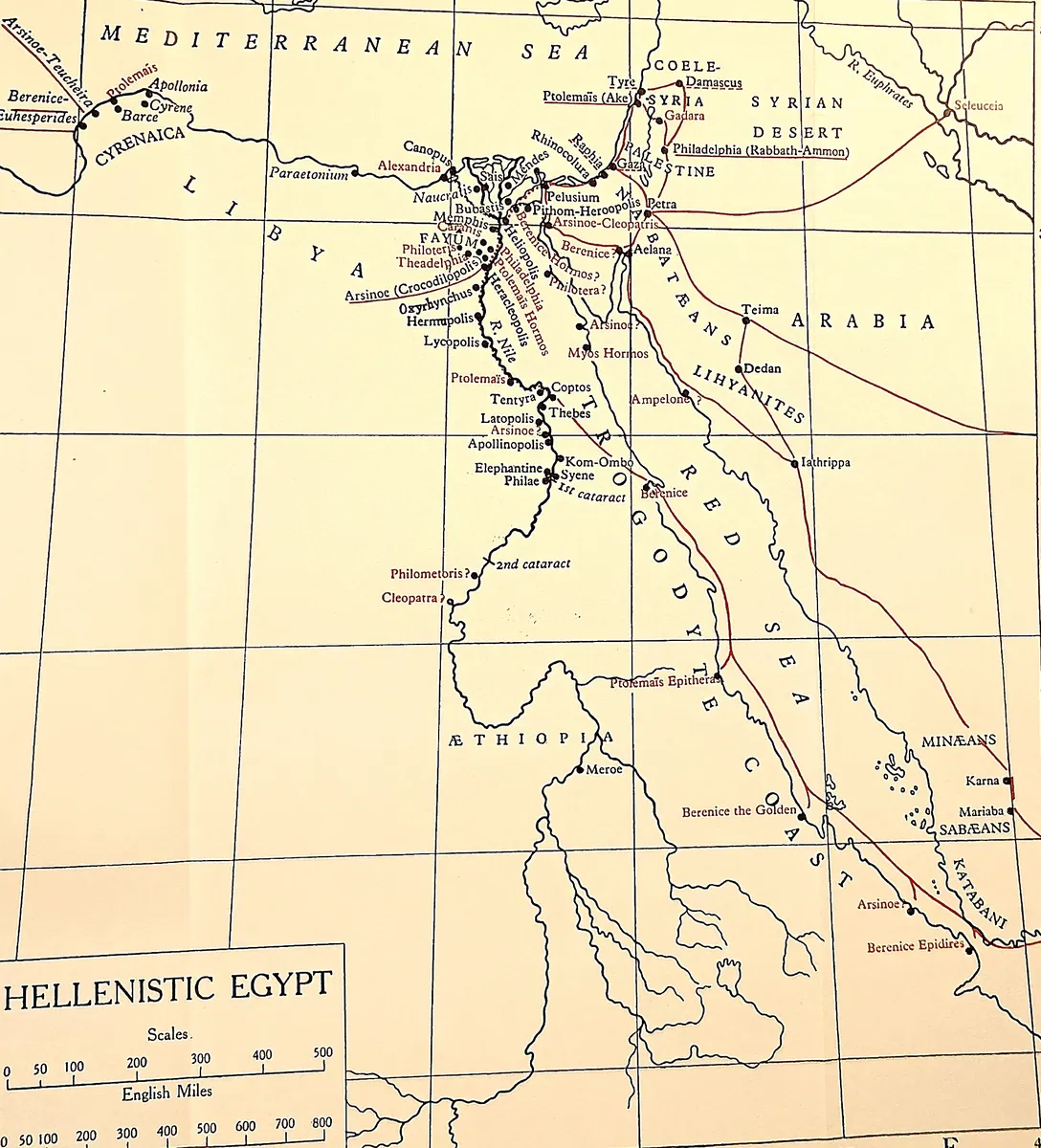 Click to enlarge
The cities of old Greece became small powers in a world of great ones. Athens, whose fleet had died at Amorgos in 322, lived on its schools and its past under a Macedonian garrison it was sometimes allowed to remove; Sparta, dwindled to a few hundred full citizens, twice attempted a revolution, under Agis IV, who was executed in 241, and Cleomenes III, who cancelled debts, redistributed land and restored the old discipline before the Macedonians and the Achaeans crushed him at Sellasia in 222. The new thing was the federal league. The Aetolians in the north-west and the Achaeans in the Peloponnese, whose general Aratus had seized the Macedonian fortress on Acrocorinth by night in 243, built confederations of cities with a common assembly, army and citizenship that could deal with kings as equals. Rhodes, a merchant republic with the best navy in the Aegean and a law of the sea that Rome would later copy, policed the trade routes against pirates and made itself indispensable to everyone.
The third centuryThe culture
Ptolemy I, on the advice of an exiled Athenian statesman, founded at Alexandria a Museum, a shrine of the Muses where scholars were housed and fed at the king’s expense, and beside it a Library that aimed to hold every Greek book and by the second century held several hundred thousand rolls. What the king got for his money was the science of the ancient world. Euclid put geometry in order there about 300; Herophilus dissected human bodies and found the nerves; Aristarchus of Samos proposed that the earth went round the sun and was not believed; Eratosthenes, the librarian, measured the circumference of the earth from the angle of the noon sun at Syene and Alexandria and was right to within a few per cent. Archimedes of Syracuse, who had studied there, worked out the mathematics of the lever, the screw and the floating body at home and was killed by a Roman soldier when the city fell in 212. The scholars of the Library edited Homer, fixed the texts of the tragedians and invented the apparatus of literary scholarship, and its poets, Callimachus, Theocritus and Apollonius, wrote learned, allusive, small-scale verse for readers rather than for a city. The Jews of Alexandria, who had lost their Hebrew, translated their scriptures into Greek, a version the Christians would inherit. Pergamum built a rival library and, about 170, the great altar whose frieze of gods and giants is in Berlin.
 Click to enlarge
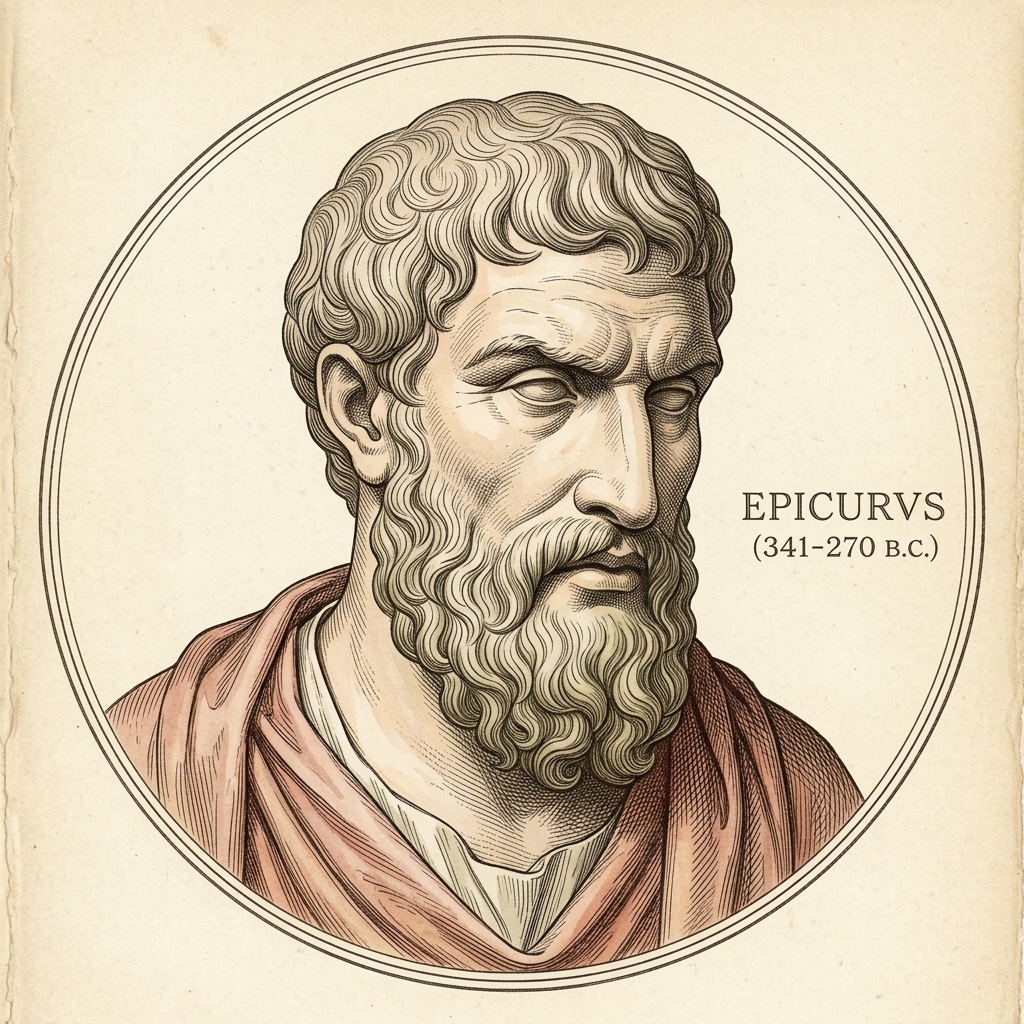
Athens kept philosophy. In the generation after Alexander two men opened schools there that between them furnished the private religion of educated Greeks and Romans for five hundred years. Zeno of Citium, a Phoenician from Cyprus, taught in the Painted Stoa from about 300 that the universe is a single rational and providential order, that virtue is the only good and the only thing in a man’s power, and that a wise man is free in chains and a fool is a slave on a throne; his Stoics gave Rome its lawyers, its emperors’ consciences and its consolation. Epicurus, an Athenian citizen, bought a garden in 306 and taught in it that the gods do not concern themselves with men, that the world is atoms and void, that death is nothing to us, and that the end of life is pleasure, by which he meant the absence of pain and fear, found in friendship and a modest life. Both were philosophies for men who no longer governed their cities and had to govern themselves. On the stage Menander’s New Comedy, with its lost sons, clever slaves and lovers reunited, replaced the political satire of Aristophanes, and it was Menander whom Plautus and Terence translated for Rome.
223–146 B.C.Rome comes
The Hellenistic balance broke because two of its kings drew Rome in. Philip V of Macedon, young, able and rash, made a treaty with Hannibal in 215 when Rome looked beaten, and Rome did not forget it. Antiochus III, back from the east and master of Coele-Syria, crossed into Europe in 196 to recover what Seleucus had held. The story of the wars that followed is told from the Roman side elsewhere in this history: Philip beaten at Cynoscephalae in 197 by a legion that could outmanoeuvre a phalanx on broken ground; Flamininus proclaiming the freedom of the Greeks at the Isthmian Games in 196 to a shout that, Plutarch says, brought down the crows; Antiochus destroyed at Magnesia in 190 and by the peace of Apamea two years later shut out of Asia Minor, fined fifteen thousand talents and stripped of his elephants and his fleet. In 168 Perseus, Philip’s son, lost Macedon at Pydna in an afternoon, and in the same summer, outside Alexandria, a Roman envoy drew a circle in the sand round Antiochus IV, who had conquered Egypt, and told him to answer before he stepped out of it; he withdrew. That was the day, Polybius understood, on which the kings became clients.
What remained was disintegration. Antiochus IV, needing money and a religion for his shrinking state, plundered the Temple at Jerusalem and tried to Hellenise the Jews by force, and the revolt of the Maccabees from 167 gave Judaea a century of independence. The Seleucid kings fought each other while the Parthians took Mesopotamia; the Ptolemies fought each other while Rome arbitrated. Macedon was made a province in 148, the Achaean League’s last defiance ended with Corinth burned and its citizens sold in 146, and in 133 the last Attalid, having no heir and a sound sense of the future, left Pergamum to the Roman people in his will.
Why it mattered
Alexander’s generals failed to keep his empire and succeeded in something they had not intended: they made Greek the language of government, learning and trade from the Adriatic to Afghanistan, and put a Greek city, a gymnasium and a theatre within reach of every considerable population in the eastern Mediterranean. Rome conquered that world in sixty years and was educated by it for four hundred more; the Romans took their philosophy, their science, their medicine, their comedy, their art and, in the end, the sacred book of their new religion from the Hellenistic Greeks, in Greek. The kings had also shown what a monarch surrounded by a professional court and army and worshipped as a god looked like. When the Roman Republic broke down, that model was waiting.