The Julio-Claudian Dynasty
The First SuccessionThe Rhine and Illyricum mutinies
On August 19, A.D. 14, Augustus died at Nola in Campania. For days his widow Livia kept the house and surrounding streets under close guard by the Praetorian cohorts, issuing optimistic bulletins on the princeps’ health until her son Tiberius could secure the palace and notify the provincial governors. The transition of power had no constitutional precedent: the Principate was not an office known to Roman public law, but an accumulation of extraordinary republican magistracies voted to one man for life. Before the princeps’ death was publicly proclaimed, an order was dispatched to the island of Planasia, where Augustus’ banished grandson Postumus Agrippa was murdered by a centurion.
The first crime of the new reign was the murder of Postumus Agrippa. Though he was surprised and unarmed, a centurion of the firmest resolution despatched him with difficulty. — Tacitus, Annals 1.6 (trans. Church & Brodribb)
When the Senate convened on September 17 to vote divine honors to Augustus, Tiberius engaged in a protracted, hesitant political dance. At fifty-five, seasoned by decades of campaigns in Pannonia and Germany, he already held the tribunicia potestas (tribunician inviolability) and proconsular imperium maius (superior military command). Yet he feigned reluctance to accept the totality of the state, suggesting that the burdens of empire were too heavy for a single mind and proposing that the Senate divide the administration among several men. The senators, terrified that agreeing would expose them to charges of treason while pressing him would reveal their helplessness, dissolved into tears, entreaties, and ambiguous prostrations. As Tacitus records, Tiberius left the Curia muttering in Greek that they were “men fit to be slaves.”
The immediate danger to the regime lay not in the docile Senate, but on the frontier. The moment news of Augustus’ death reached the summer camps, the legions erupted in mutiny. Three legions in Pannonia (VIII Augusta, IX Hispana, and XV Apollinaris) and four on the lower Rhine (I Germanica, V Alaudae, XX Valeria, and XXI Rapax) threw off the authority of their legates. Augustus had set the citizen military service at sixteen years in 13 B.C., only to raise it to twenty in A.D. 6, while keeping veterans indefinitely in the field under separate banners (*sub vexillo*). The legionaries were old men, battered by decades of campaigns, paid a nominal ten asses a day from which deductions for food, clothing, arms, and centurions’ bribes were relentlessly subtracted.
We have blundered enough by our tameness for so many years, in having to endure thirty or forty campaigns till we grow old, most of us with bodies maimed by wounds. Even dismissal is not the end of our service, but, quartered under a legion’s standard we toil through the same hardships under another title. If a soldier survives so many risks, he is still dragged into remote regions where, under the name of lands, he receives soaking swamps or mountainous wastes. Assuredly, military service itself is burdensome and unprofitable; ten ases a day is the value set on life and limb; out of this, clothing, arms, tents, as well as the mercy of centurions and exemptions from duty have to be purchased. — Speech of the mutineer Percennius · Tacitus, Annals 1.17 (trans. Church & Brodribb)
Tiberius dispatched his natural son Drusus to Pannonia with two cohorts of the Praetorian Guard, where a lunar eclipse on the night of September 26 unhinged the superstitious soldiers and enabled Drusus to execute the ringleaders. On the Rhine, the crisis fell upon Germanicus Julius Caesar—nephew and adopted son of Tiberius, grandson of Mark Antony and Octavia, and the idol of the soldiers. Germanicus restored order only after theatrical gestures of despair, producing letters forged in Tiberius’ name that promised immediate discharges at twenty years and double legacies from Augustus’ will.
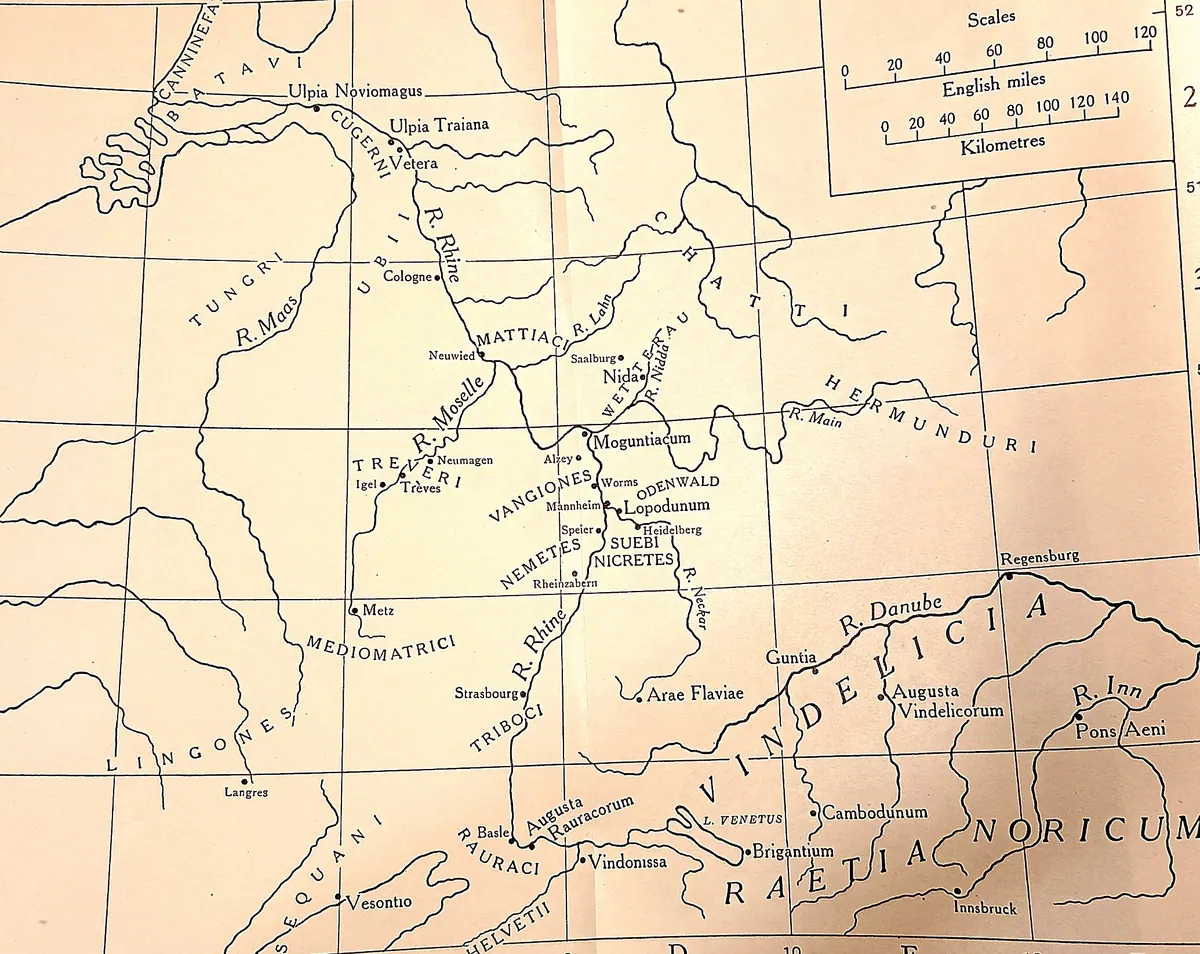
To purge the shame of mutiny, Germanicus hurled the eight Rhine legions into Germany in three massive punitive campaigns (A.D. 14–16). Marching between the Ems and the Weser, the Romans recovered two of the three legionary eagles lost by Quinctilius Varus and buried the bleached bones of the fallen in the ravines of the Teutoburg Forest. At Idistaviso in A.D. 16, Germanicus defeated Arminius in pitched battle; but winter storms shattered the returning Roman fleet in the North Sea. Tiberius called a halt. Augustus’ testamentary advice had been explicit: consilium coercendi intra terminos imperii—to preserve the empire within its natural river boundaries of the Rhine and Danube. Germanicus was granted a lavish triumph in Rome in May A.D. 17 and transferred to an extraordinary command over the eastern provinces.
 Click to enlarge
In the East, Germanicus reduced Cappadocia and Commagene to provincial status and made an unauthorized diplomatic tour of Egypt, entering Alexandria without imperial permission and opening the state granaries during a famine. In Syria he clashed violently with the conservative governor Gnaeus Calpurnius Piso. In October A.D. 19, Germanicus died suddenly at Antioch at the age of thirty-three, accusing Piso of poisoning him and practicing dark sorceries. Piso was recalled to Rome and tried before the Senate, taking his own life before judgment could be passed. With Germanicus dead, the succession was narrowed, and the atmosphere on the Palatine grew cold, suspicious, and enclosed.
The Shadow of SejanusThe Castra Praetoria, Capri, and the law of maiestas
The central constitutional development of Tiberius’ middle reign was the physical concentration of the Praetorian Guard. Under Augustus, the nine cohorts (some five thousand men) had been kept dispersed throughout Rome and neighboring towns in Latium to avoid presenting the naked aspect of military rule to civilian citizens. In A.D. 23, the sole Praetorian prefect, Lucius Aelius Sejanus—an ambitious equestrian from Volsinii—persuaded the aging emperor that the soldiers were becoming demoralized by scattered billets and loose discipline. Northeast of Rome, beyond the Servian Wall on the Viminal Hill, Sejanus constructed the massive brick-and-concrete fortress of the Castra Praetoria.
The concentration of the Guard fundamentally altered the mechanics of power. The princeps was no longer merely a magistrate protected by personal lictors and a palace detail; he had a standing garrison of disciplined elite infantry assembled within thirty minutes’ march of the Forum. Furthermore, the prefect of the Guard became the gatekeeper of the imperial person. Sejanus systematically cultivated the officers, appointed his own partisans to tribuneships, and systematically isolated the imperial family. When Tiberius’ natural son Drusus died suddenly in A.D. 23, it was accepted as illness; only eight years later was it revealed that Sejanus had seduced Drusus’ wife Livilla and poisoned the prince with the assistance of an imperial eunuch.
Exhausted by senatorial adulation and the bitter recriminations of Germanicus’ widow, Agrippina the Elder, Tiberius departed Rome in A.D. 26, never to return. After touring Campania, he settled permanently on the island of Capri in A.D. 27. There, perched atop limestone cliffs in the fortress-palace of Villa Jovis, protected by sheer drops into the Tyrrhenian Sea, Tiberius conducted the governance of an empire of fifty million souls through private letters and sealed codicils. Access to Capri was controlled entirely by Sejanus, who remained in Rome as the sole intermediary between the absent emperor, the Senate, and the legions.
As to facts, I am so guiltless, Conscript Fathers, that my words only are accused: but neither are any words of mine pointed against the Emperor, or his mother; who are the only persons comprehended in the law concerning violated majesty. It is alleged that I have praised Brutus and Cassius; men whose lives and actions have been compiled by a cloud of writers, and their memory treated by none but with honour. — Cremutius Cordus before the Senate · Tacitus, Annals 4.34 (trans. Gordon)
During the Capri years, the judicial machinery of the Roman state was poisoned by the expansion of the lex maiestatis. Under the Republic, the charge of *maiestas laesa* (diminished majesty) had covered armed treason, mutiny, or the surrender of an army. Under Tiberius, sycophantic senators and private accusers (*delatores*) extended the statute to encompass casual insults against the memory of Augustus, derogatory remarks about the living princeps, or possession of unapproved historical writings. The accuser received by law one-fourth of the condemned man’s confiscated estate; the Senate, operating as a high court of criminal justice, competed in servility to execute its own members to prove unswerving loyalty to Capri. The historian Cremutius Cordus was driven to suicide for praising Brutus and Cassius; Agrippina the Elder and her eldest son Nero Caesar were exiled to barren islands and starved to death; her second son Drusus was starved in a dungeon beneath the Palatine palace.
Sejanus’ ascent culminated in A.D. 31, when he held the joint consulship with Tiberius and prepared to demand the *tribunicia potestas* that would make him formal co-ruler. But his overreach proved fatal. Antonia Minor, sister-in-law of Tiberius and widow of his brother Drusus, smuggled a trusted freedman to Capri with a detailed dossier documenting Sejanus’ plots against the remaining Julio-Claudian children. Tiberius struck with calculated lethality. He dispatched Naevius Sutorius Macro to Rome carrying secret letters appointing him the new Praetorian prefect. At the temple of Apollo on the Palatine, before the assembled Senate, a rambling, ambiguous letter from Capri was read aloud. As the final paragraphs shifted from vague complaints into a direct accusation of treason against Sejanus, the senators who had crowded around him melted away. Macro assumed command of the guards; Sejanus was arrested, condemned that very afternoon, and strangled in the Tullianum, his corpse dragged by hooks to the Gemonian stairs and thrown into the Tiber.
To some governors, who advised him to load the provinces with taxes, he answered, “It is the part of a good shepherd to shear, not flay, his sheep.” — Suetonius, Life of Tiberius 32 (trans. Thomson)
The bloody purge of Sejanus’ faction consumed Rome for three years, cementing Tiberius’ reputation in senatorial historiography as an unfeeling tyrant. Yet the provincial record presents an astonishing contrast. Tiberius was a rigorous and frugal administrator. He launched no aggressive wars of conquest, kept competent provincial governors in office for decades to minimize corrupt extortion, and flatly refused to raise tribute. When the great earthquake of A.D. 17 leveled twelve cities in Asia Minor (including Sardis), Tiberius remitted their taxes for five years and disbursed ten million sesterces from his own purse for their reconstruction. When he died at Misenum on March 16, A.D. 37, aged seventy-seven, he left the Roman treasury with an unprecedented cash surplus of two billion seven hundred million sesterces.
 Click to enlarge
The Prince of the CampGaius Caligula and the breakdown of consensus
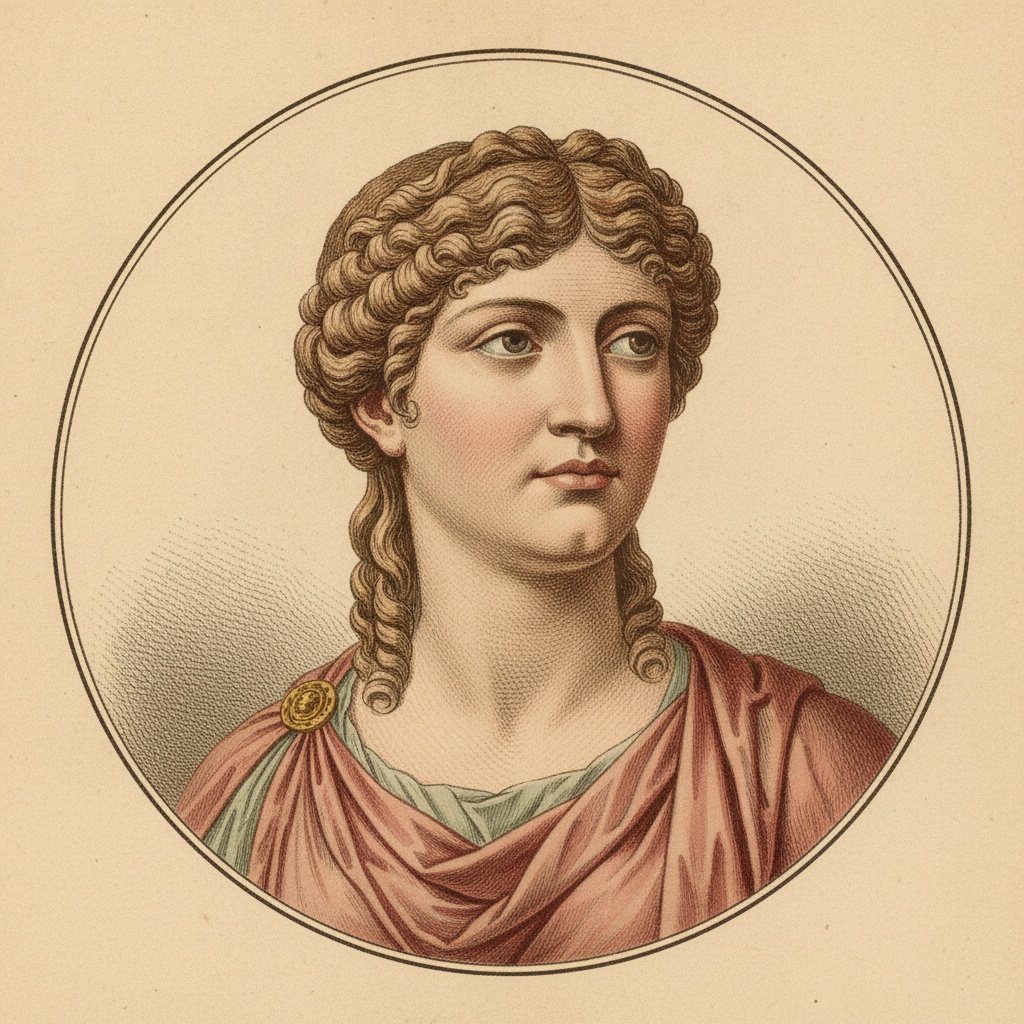
The death of Tiberius was greeted in Rome with open delirium. Shouts of “Tiberius into the Tiber!” echoed through the streets as the populace celebrated the accession of Germanicus’ sole surviving son, twenty-four-year-old Gaius Caesar Augustus Germanicus. Born at Antium and raised in the military camps on the Rhine where the soldiers nicknamed him Caligula (“Little Boot”) from the miniature military footwear he wore as a child, the young princeps was welcomed as the savior of the state. Tiberius’ will, which had named Caligula and his seventeen-year-old cousin Tiberius Gemellus as joint heirs, was promptly nullified by the Senate at the request of the Praetorian prefect Macro, and sole imperial power was conferred upon Caligula.
The opening eight months of the reign appeared to realize the dream of a restored Augustan consensus. Caligula sailed in person to the storm-swept islands of Pandateria and Pontia to recover the bones of his mother Agrippina and brother Nero, depositing their urns with filial piety in the Mausoleum of Augustus. He burned the imperial treason dossiers in the Forum, declaring under oath that he had read none of them; he recalled exiles, dismissed ongoing *maiestas* trials, paid the arrears of Tiberius’ legacies to the people, and gave an extraordinary donative of one thousand sesterces to every Praetorian guardsman. The assembly was briefly revived to elect magistrates, and the financial accounts of the empire were published openly for public inspection.
In October A.D. 37, Caligula fell gravely ill with a severe brain fever. When he recovered, the character of his reign underwent a violent rupture. Convinced that his household was conspiring against his life, he forced Tiberius Gemellus to commit suicide, compelled his father-in-law Marcus Silanus to cut his throat with a razor, and drove his benefactor Macro to suicide. The delicate Augustan fiction that the princeps was merely the first among equals (*primus inter pares*) was discarded in favor of overt Hellenistic autocracy. Caligula established a palace cult of his own divinity, requiring senators to perform eastern prostrations (*proskynesis*), replaced the heads of classical statues of Jupiter with his own likeness, and declared that he communed privately with Jupiter Capitolinus.
Under the weight of unprecedented architectural expenditures and lavish games, Tiberius’ carefully hoarded surplus of 2.7 billion sesterces vanished in less than two years. Caligula constructed a floating bridge across the Bay of Baiae from Puteoli to Bauli—a wooden span over three Roman miles in length, supported by double rows of merchant galleys lashed together and paved with earth—merely so he could ride across the sea in golden armor to refute an astrologer’s prediction that he had no more chance of becoming emperor than of riding across the gulf on horseback. When the treasury ran dry, Caligula levied ruinous taxes on civil litigation, porterage, and prostitution, auctioned off the imperial wardrobe, and systematically fabricated treason charges against wealthy aristocrats to confiscate their fortunes.
He exclaimed, “I wish the Roman people had but one neck.” — Suetonius, Life of Caligula 30 (trans. Thomson)
Caligula’s military ventures bordered on farce. In A.D. 39 he marched an army to the Rhine, executed the legate of Upper Germany Gnaeus Cornelius Lentulus Gaetulicus for conspiracy, and led brief skirmishes across the river. Moving to the Channel coast at Gesoriacum (Boulogne) for a proposed invasion of Britain, he drew up his legions and siege engines on the beach, sounded the battle charge, and commanded the soldiers to fill their helmets with seashells, calling them “the spoils of the ocean due to the Capitol and the Palatium.”
The regime became intolerable not because of madness, but because it systematically assaulted the physical security and dignity of the men who guarded the emperor. Cassius Chaerea, a scarred veteran tribune of the Praetorian Guard whom Caligula habitually mocked with obscene and effeminate passwords (*Priapus*, *Venus*), formed a conspiracy with fellow officers, imperial freedmen, and consular senators. On January 24, A.D. 41, as Caligula walked through a private subterranean corridor connecting the palace to the Palatine theater, Chaerea and his fellow tribune Cornelius Sabinus struck him down with thirty sword wounds. His wife Caesonia was stabbed through the heart, and their infant daughter Julia Drusilla had her brains dashed against a stone wall. For twenty-four hours, the Roman world stood without a princeps.
The Freedmen’s EmpireClaudius, bureaucracy, and the conquest of Britain
While the consuls and the Senate gathered on the Capitol to declare the restoration of ancestral liberty and debate the abolition of the imperial office, the Praetorian guards were plundering the Palatine. In a deserted corner of the palace known as the Hermaeum, a common soldier named Gratus noticed a pair of feet protruding from beneath heavy door curtains. Dragging the intruder into the light, he recognized Tiberius Claudius Drusus Nero Germanicus—the fifty-year-old uncle of Caligula and brother of Germanicus. Long despised by his mother Antonia as an unformed monster and excluded from public career by Augustus and Tiberius due to a limp, a stammer, and uncontrollable trembling, Claudius threw himself at the soldier’s knees, begging for his life.
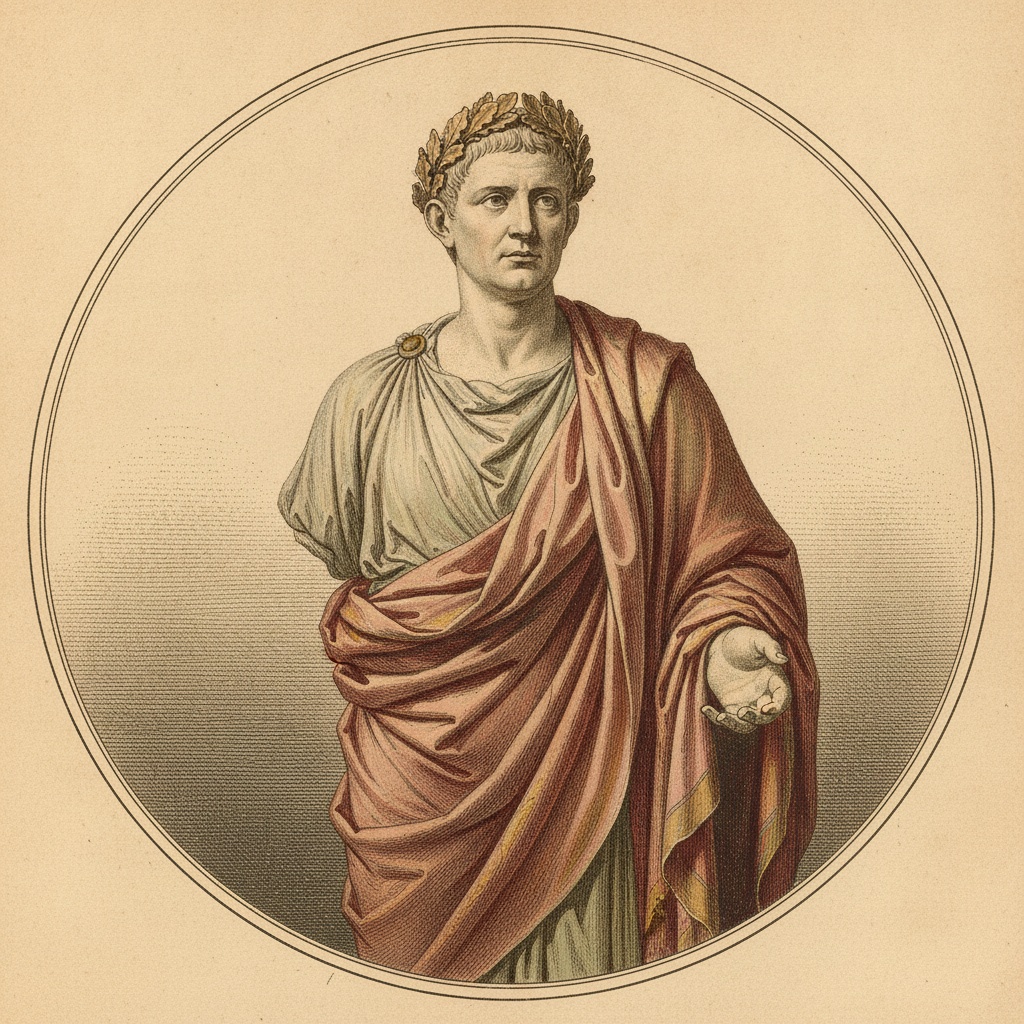
He suffered the soldiers assembled under arms to swear allegiance to him, promising them fifteen thousand sesterces a man; he being the first of the Caesars who purchased the submission of the soldiers with money. — Suetonius, Life of Claudius 10 (trans. Thomson)
The soldiers hoisted Claudius into a litter and carried him to the Castra Praetoria. When the senatorial tribunes arrived to order him to appear on the Capitol to submit to the magistrates, Claudius refused, protected by three thousand swords. By dawn, the urban mob surrounded the Senate, shouting that they demanded a single master and naming Claudius. The Senate collapsed, and on January 25, A.D. 41, voted Claudius all the imperial powers. The foundational bargain of the Principate was exposed: the monarchy rested upon the purchase of the army.
Despite his physical infirmities, Claudius possessed an acute historical intelligence. Trained as an antiquarian under Livy, he had written histories of Etruria, Carthage, and the Civil Wars. He understood that an empire spanning from the Atlantic to Syria could no longer be managed as the private estate of a city-republic’s nobility. Claudius bypassed the slow, corrupt senatorial magistrates by creating a centralized, professional imperial civil service staffed by Greek freedmen. Narcissus directed the imperial secretariat (*ab epistulis*), Pallas managed the central treasury and finances (*a rationibus*), and Callistus heard legal appeals (*a libellis*). This bureaucracy provided the Roman Mediterranean with continuous, rational administration, but it incurred the undying hatred of the senatorial elite, who saw former slaves wielding sovereign authority over consular aristocrats.
What was the ruin of Sparta and Athens, but this, that mighty as they were in war, they spurned from them as aliens those whom they had conquered? Our founder Romulus, on the other hand, was so wise that he fought as enemies and then hailed as fellow-citizens several nations on the very same day. — Speech of Claudius on the Gallic Petitions · Tacitus, Annals 11.24 (trans. Church & Brodribb)
Claudius’ greatest constitutional insight was the extension of Roman citizenship. In A.D. 47–48, holding the office of censor, he addressed the Senate on a petition from the Gallic chieftains of Gallia Comata requesting admission to the senatorial order. While conservative senators protested against polluting the Curia with the descendants of men who had besieged Julius Caesar at Alesia, Claudius reminded them that Rome had grown great by adopting its conquered foes—Sabines, Etruscans, and Latins. The Gauls were admitted, establishing the precedent that the Roman empire was not an Italian hegemony over subject races, but an integrated commonwealth of provincial elites.
To establish his military authority before the legions, Claudius accomplished what Julius Caesar and Augustus had left undone: the conquest and annexation of Britain. In A.D. 43, four legions (II Augusta, IX Hispana, XIV Gemina, and XX Valeria) under Aulus Plautius sailed from Boulogne and forced the crossing of the Medway and the Thames. Claudius joined the army in person, accompanied by war elephants, entered the British tribal capital of Camulodunum (Colchester), and accepted the surrender of eleven Celtic kings. In Rome he celebrated a magnificent triumph, received the triumphal arch in the Campus Martius, and erected monumental public works: the deep-water port of *Portus* at Ostia to secure Rome’s grain supply, the draining of the Fucine Lake, and the soaring aqueducts of the *Aqua Claudia* and *Anio Novus*.
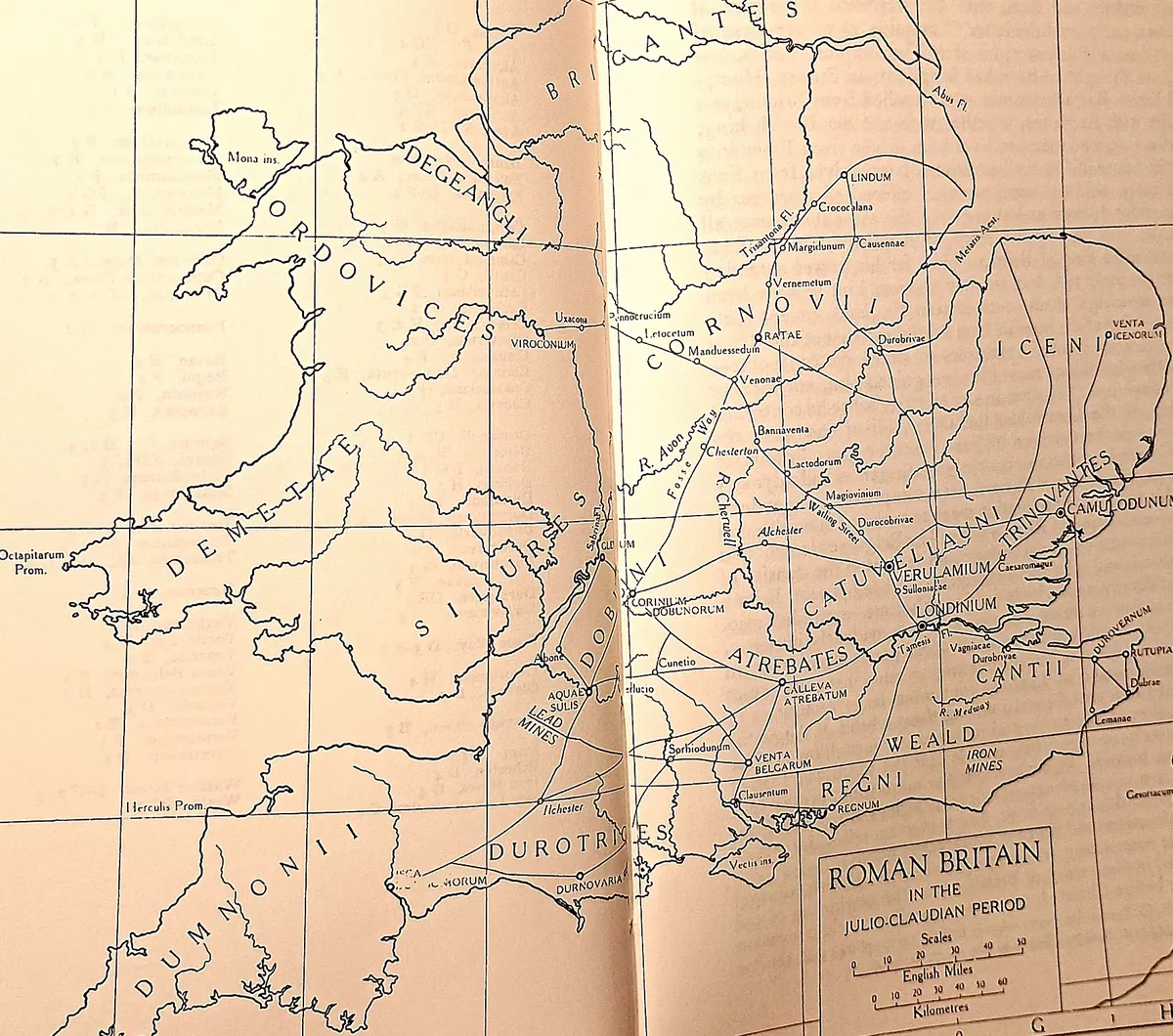 Click to enlarge
Yet Claudius was undone by the intrigues of the imperial bedchamber. In A.D. 48, his young third wife Valeria Messalina, emboldened by his perceived weakness, staged a public, legal wedding to the handsome consul-designate Gaius Silius while Claudius was inspecting harbor works at Ostia. Terrified of a military coup, the freedman Narcissus ordered their execution before the dazed emperor could issue a pardon. The freedman Pallas then persuaded Claudius to marry his own niece, Agrippina the Younger. Ambitious, ruthless, and possessing the prestige of Germanicus’ direct bloodline, Agrippina dominated the government. She secured the appointment of Seneca as tutor to her twelve-year-old son Lucius Domitius Ahenobarbus, made Sextus Afranius Burrus sole Praetorian prefect, and persuaded Claudius to adopt her son under the name Nero, demoting his natural son Britannicus. On October 13, A.D. 54, sensing that Claudius was regretting his choice, Agrippina fed the emperor a plate of poisoned mushrooms. Claudius died that morning, and Nero was proclaimed to the Praetorian Guard.
The Golden Age to the FireSeneca, Burrus, and the destruction of the capital
Nero was sixteen when he ascended the throne on October 13, A.D. 54. Brought to the *Castra Praetoria* by Burrus, he paid the customary donative of fifteen thousand sesterces per man and delivered a maiden speech to the Senate drafted by his tutor, the Stoic philosopher Lucius Annaeus Seneca. Nero promised to renounce the secret freedmen tribunals of Claudius, to honor the ancestral rights of the Senate, and to govern strictly according to the model of Augustus. The opening five years of the reign—the famous Quinquennium Neronis—were marked by legislative moderation, fiscal discipline, and efficient provincial oversight, guided by the combined statecraft of Seneca and the upright soldier Burrus.
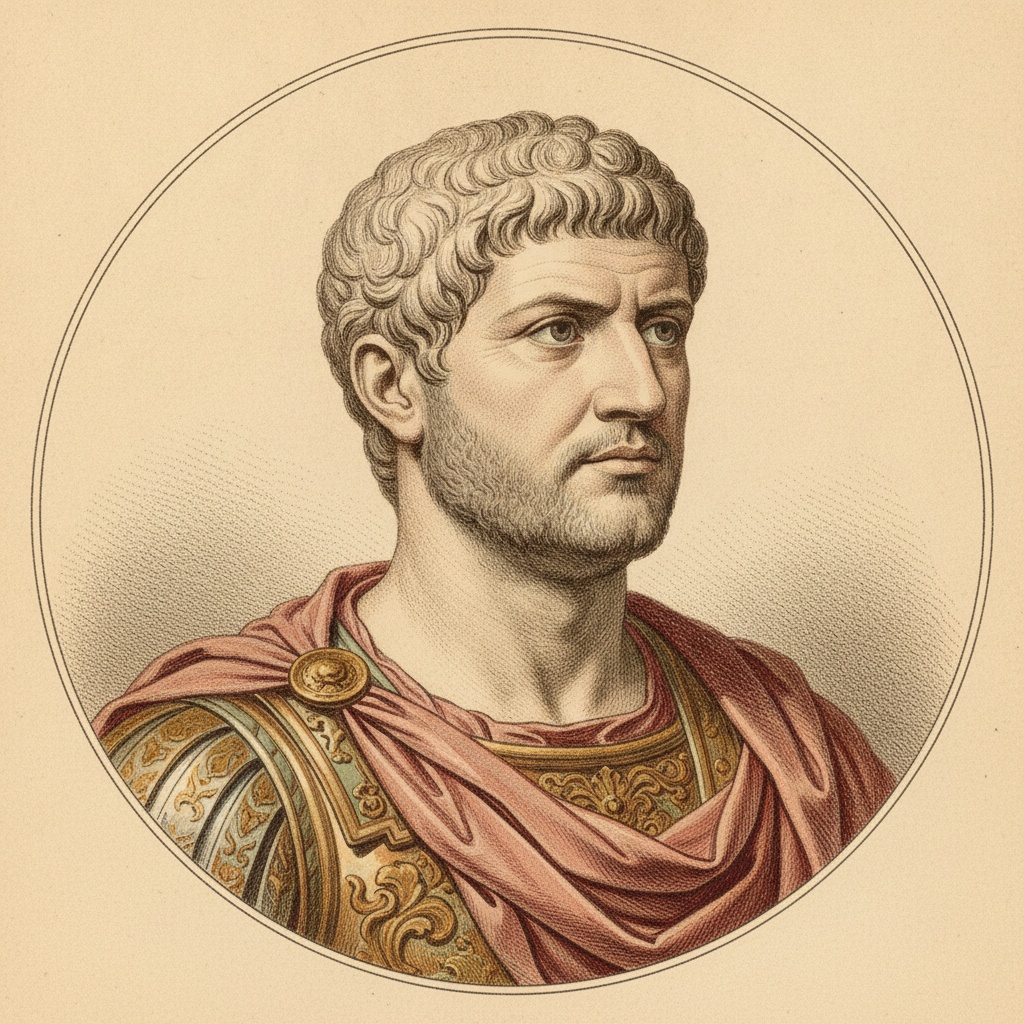
The stability of the regime was shattered by Nero’s rebellion against his mother’s suffocating tutelage. When Agrippina threatened to transfer her patronage to Claudius’ biological son Britannicus, the fourteen-year-old boy was poisoned at an imperial banquet in December A.D. 55, his wine cup cooled with poisoned water after a food-taster had cleared it. In A.D. 59, urged on by his mistress Poppaea Sabina, Nero resolved on matricide. After a collapsible yacht failed to drown Agrippina in the Bay of Naples—the empress swimming ashore in the darkness—Nero dispatched an assassination squad under the naval officer Anicetus to her villa at Baiae. As the centurions closed in with bared swords, presenting her person, she exclaimed, “Smite my womb,” and with many wounds she was slain.
With Agrippina dead, the moral constraints on the young ruler evaporated. In A.D. 62, Burrus died, and Seneca, recognizing that his influence was gone, surrendered his vast wealth to the crown and retired from court. Nero appointed the depraved and ruthless Gaius Ofonius Tigellinus to the Praetorian prefecture. Claudius’ daughter Octavia was divorced, banished on fabricated charges of adultery, and murdered, her severed head presented to Poppaea. The ancient law of *maiestas* was revived with unprecedented savagery to seize the fortunes of senators to fund Nero’s obsession with theatrical spectacles, chariot racing, and public singing.
On the night of July 18, A.D. 64, the catastrophic Great Fire of Rome erupted. Beginning in the wooden shops at the southeastern end of the Circus Maximus, fueled by summer sirocco winds, the fire raged unchecked for six days through the narrow, crooked streets of the valleys, and then reignited for three days more in the gardens of Tigellinus. Of Rome’s fourteen Augustan administrative regions, three were reduced to ash and seven others suffered near-total devastation. While ancient rumor accused Nero of having watched the conflagration from the Tower of Maecenas while singing the sack of Troy to his lyre, the emperor was actually at Antium when the fire began; he returned swiftly to Rome, organized relief camps on the Campus Martius, and subsidized emergency grain shipments from Ostia.
Consequently, to get rid of the report, Nero fastened the guilt and inflicted the most exquisite tortures on a class hated for their abominations, called Christians by the populace. Christus, from whom the name had its origin, suffered the extreme penalty during the reign of Tiberius at the hands of one of our procurators, Pontius Pilatus — Tacitus, Annals 15.44 (trans. Church & Brodribb)
Yet to dispel the persistent public belief that the blaze had been deliberately ordered to clear land for a new palace, Nero created a scapegoat. Tacitus records that he rounded up members of a small, obscure sect known as the *Christiani*, condemning them not merely for arson, but for “hatred of the human race” (*odium humani generis*). In the imperial gardens on the Vatican Hill, victims were covered in animal hides to be torn apart by dogs, nailed to crosses, or pitched with flammable resin and illuminated as human torches when night fell. Over the leveled ground between the Palatine and Esquiline Hills, Nero seized over two hundred acres of private urban property to construct the *Domus Aurea* (Golden House)—a sprawling palace complex featuring a rotating banquet hall under an ivory dome, colonnades a mile long, an artificial lake, and a colossal 120-foot bronze statue of Nero depicted as the Sun.
The Provincial CrucibleBoudica’s rising in Britain and the Parthian duel
While Rome’s center was rebuilt in gold and ivory, the frontiers shuddered under the strain of imperial exploitation. In A.D. 60, Britain erupted in the bloodiest provincial rebellion of the first century. The client king of the Iceni, Prasutagus, died, having named Nero co-heir alongside his two daughters in the expectation that the compromise would preserve his kingdom’s autonomy. Instead, Roman centurions plundered the royal estate, imperial slaves sacked the houses of the chieftains, his widow Boudica was publicly scourged with rods, and their virgin daughters were raped by Roman soldiers.
 Click to enlarge
Boudica forged an alliance between the Iceni and Trinovantes, raising an army of over one hundred thousand warriors. The revolt fell upon a province left virtually undefended: the governor Gaius Suetonius Paulinus was on the far western coast of Wales, leading the XIV Gemina and XX Valeria in an amphibious assault across the Menai Strait on Mona (Anglesey), the sacred sanctuary and political heart of the British Druids. The veteran colony of Camulodunum (Colchester)—where veterans had dispossessed native farmers and erected a despised temple to Divus Claudius—was surrounded and burned to the ground in two days, the Roman garrison slaughtered within the temple vault. The Ninth Legion (*Legio IX Hispana*), marching to its relief under Petillius Cerialis, was ambushed in dense woodland; its infantry cohorts were annihilated, and Cerialis barely escaped with his cavalry to the fortress of Lindum.
Paulinus rode south along Watling Street with his cavalry, reaching Londinium ahead of his infantry. Recognizing that he lacked the forces to hold the open commercial settlement, Paulinus made the agonizing strategic decision to abandon the city to save the province. Londinium was burned to the ground, followed immediately by the municipium of Verulamium (St Albans). Tacitus estimates that seventy thousand Roman citizens and provincial allies were massacred in the three sacked settlements, crucified, hanged, or burned alive without taking captives or offering ransom.
The crisis was resolved by tactical discipline. Paulinus concentrated approximately ten thousand men—the Fourteenth Legion, a vexillation of the Twentieth, and auxiliary infantry and cavalry from nearby stations—while the legate of the Second Legion at Exeter, Poenius Postumus, refused orders to march. Paulinus selected a defensive position in a narrow defile with a dense forest at his rear, preventing the British horde from outflanking his lines. When the mass of Celtic warriors charged across the open plain, the Roman legionaries held their ground until within range, discharged their *pila* (heavy javelins) in coordinated volleys, and surged forward in a dense, tight wedge formation (*cuneus*). Trapped against their own circle of transport wagons, the British warriors were slaughtered; Tacitus records eighty thousand Britons fallen for the loss of barely four hundred Romans. Boudica took poison, and Britain was ruthlessly pacified.
Simultaneously on the eastern frontier, Rome fought a protracted six-year duel (A.D. 58–63) with the Parthian Empire over the client kingdom of Armenia. When the Parthian king Vologases I expelled the Roman candidate and installed his brother Tiridates, Nero assigned the supreme command to Gnaeus Domitius Corbulo. Corbulo restored iron discipline to the slack Syrian legions, marched into the Armenian mountains in freezing winter campaigns, and captured the twin royal capitals of Artaxata and Tigranocerta. After the blundering consular Lucius Caesennius Paetus was surrounded and capitulated to the Parthians at Rhandeia in A.D. 62, Corbulo was given extraordinary *imperium maius* over all eastern armies. Rather than embark on an exhausting conquest of Mesopotamia, Corbulo concluded the brilliant diplomatic compromise of Rhandeia (A.D. 63): an Arsacid prince would rule Armenia, but only after journeying to Rome to receive the royal diadem from the hands of Nero. In A.D. 66, Tiridates traveled to Italy in royal pomp, kneeling before Nero in the Forum amidst glittering gold hangings: Roman prestige was secured without an unsupportable frontier expansion.
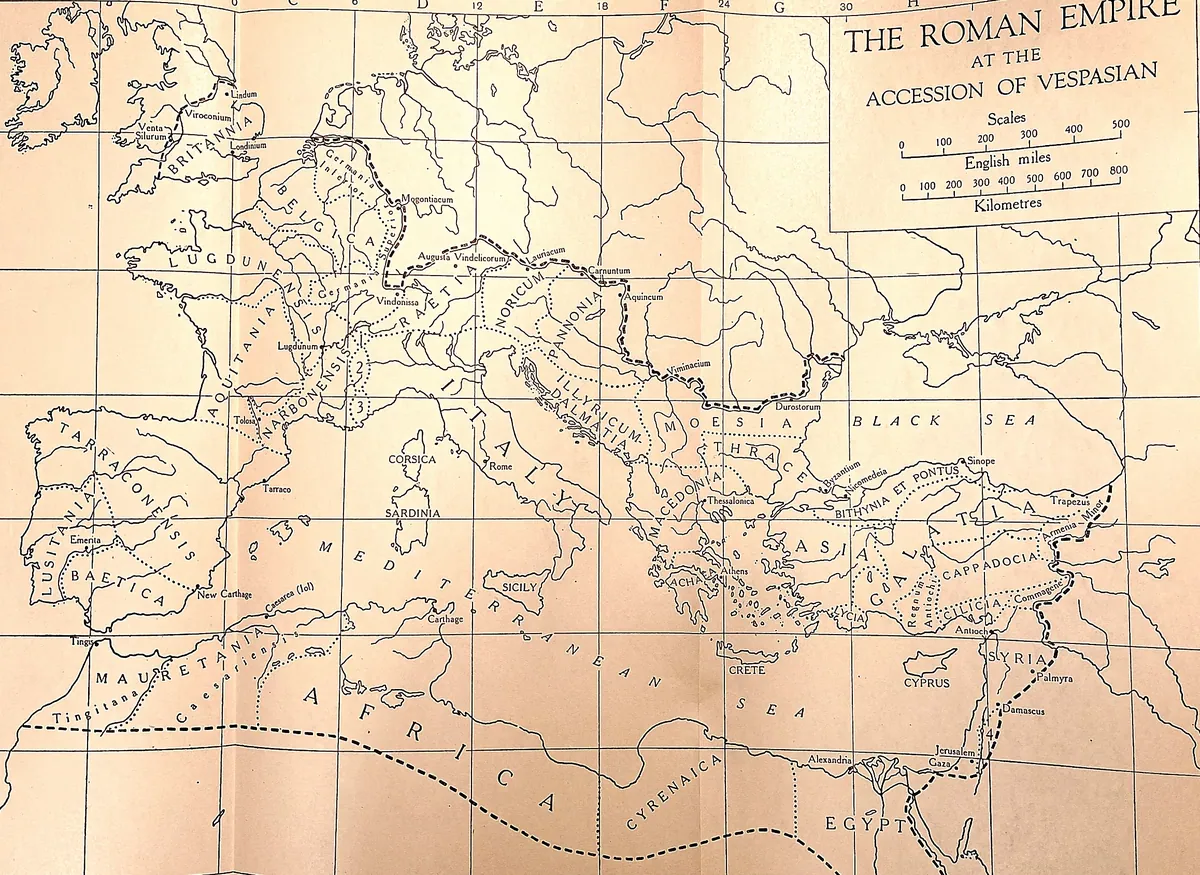
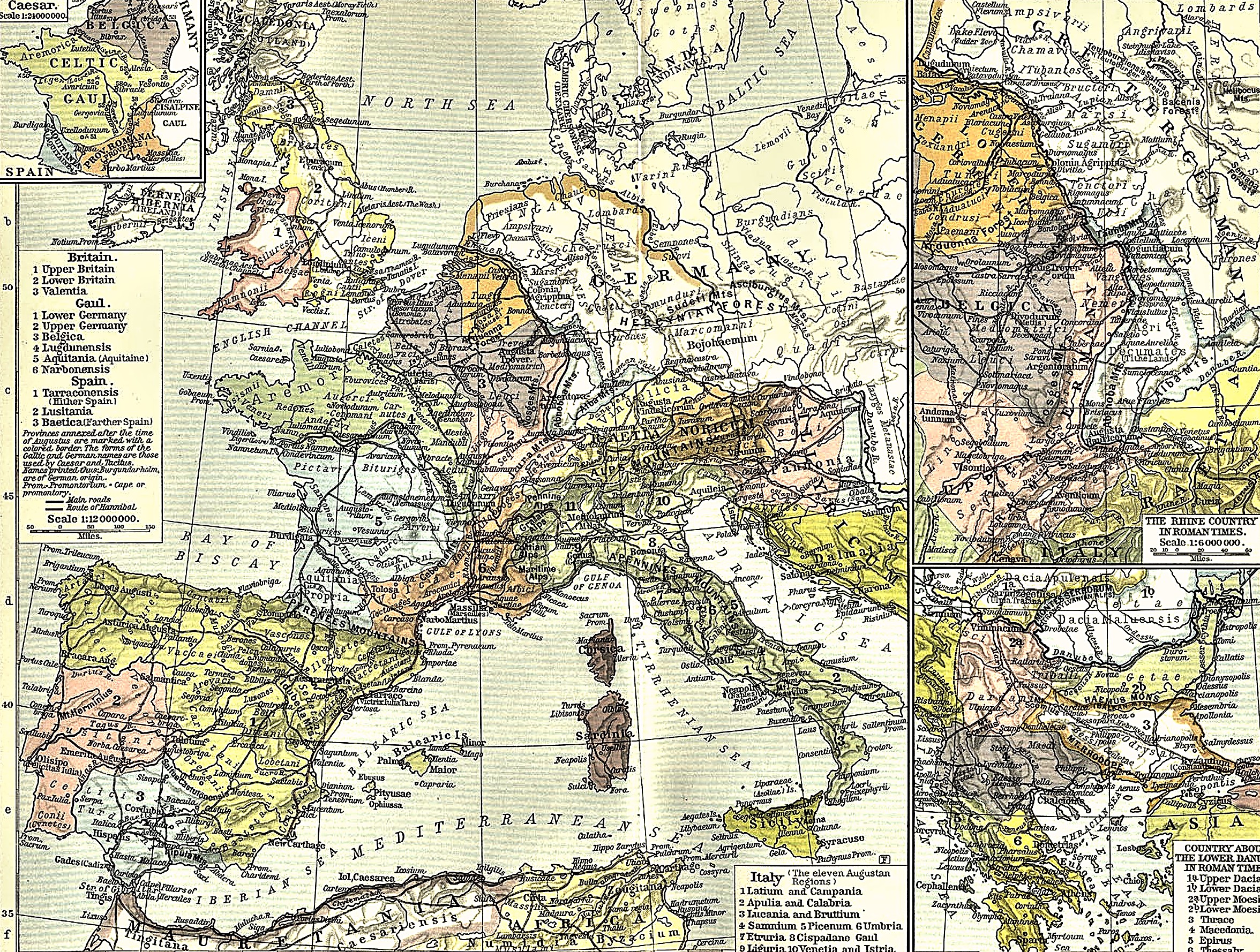
From Augustus to the Year of the Four Emperors, 27 B.C.–A.D. 69
The frontier pushed to the Danube, won and lost beyond the Rhine, and carried into Britain.
The settlement
In January 27 Octavian returns the state to the Senate and people and receives the name Augustus, with the great frontier provinces for his own command. Egypt he keeps under a prefect of his choosing. The Alps, the northwest of Spain and the Balkans below the Danube are still unconquered.
Spain completed
When King Amyntas is killed in 25, Galatia becomes a province; the same year Mauretania is given to Juba II as a client kingdom. The Cantabrian and Asturian wars, begun under Augustus himself in 26, are finished by Agrippa in 19, and all Spain is Roman after two centuries of fighting.
The Alps
Augustus' stepsons, Drusus and Tiberius, strike into the Alps from the south and from Gaul in a single summer and take Raetia and the lands up to the Danube. Noricum, a kingdom long friendly to Rome, is annexed about the same time. The trophy at La Turbie later lists forty-five Alpine peoples subdued.
To the Danube and the Elbe
Tiberius conquers Pannonia (12–9), carrying the frontier to the middle Danube. Across the Rhine, Drusus campaigns every year from Mogontiacum and reaches the Elbe in 9, then dies after a fall from his horse. Roman bases and markets begin to be built east of the Rhine.
Judaea annexed, Illyricum aflame
Herod's son Archelaus is deposed and Judaea becomes a province under a prefect. A command in Moesia is now attested on the lower Danube. Then Pannonia and Dalmatia rise; for three years Tiberius, with the largest Roman army assembled since the civil wars, fights to recover them.
The Varian disaster
The Pannonian revolt is crushed in 9. Weeks later, in the forests of northern Germany, Arminius of the Cherusci destroys Quinctilius Varus and three legions; the battlefield near Kalkriese has been identified by excavation. Rome keeps the Rhine but never again governs the land beyond it.
Cappadocia and Commagene
Augustus dies in 14; Germanicus leads punitive campaigns over the Rhine (14–16) and is recalled. Under Tiberius the kingdom of Cappadocia is annexed at the death of Archelaus, and Commagene is placed under Syria. The empire's revenue from Cappadocia allowed Tiberius to halve the sales tax, as Tacitus reports.
Claudius' provinces
Gaius has the king of Mauretania put to death (40), and after a hard war two provinces are made there. In 43 Claudius sends four legions to Britain and takes Camulodunum; Lycia is annexed the same year. In 46 the client kingdom of Thrace is ended, and the whole southern bank of the Danube is Roman.
Revolts at the edges
In Britain Boudica's rising (60–61) burns Camulodunum, Londinium and Verulamium before it is crushed. In the East Corbulo's wars end with a compromise: Tiridates, a Parthian prince, is crowned king of Armenia by Nero in Rome (66). The same year Judaea rises, and the garrison of Jerusalem is destroyed.
Four emperors
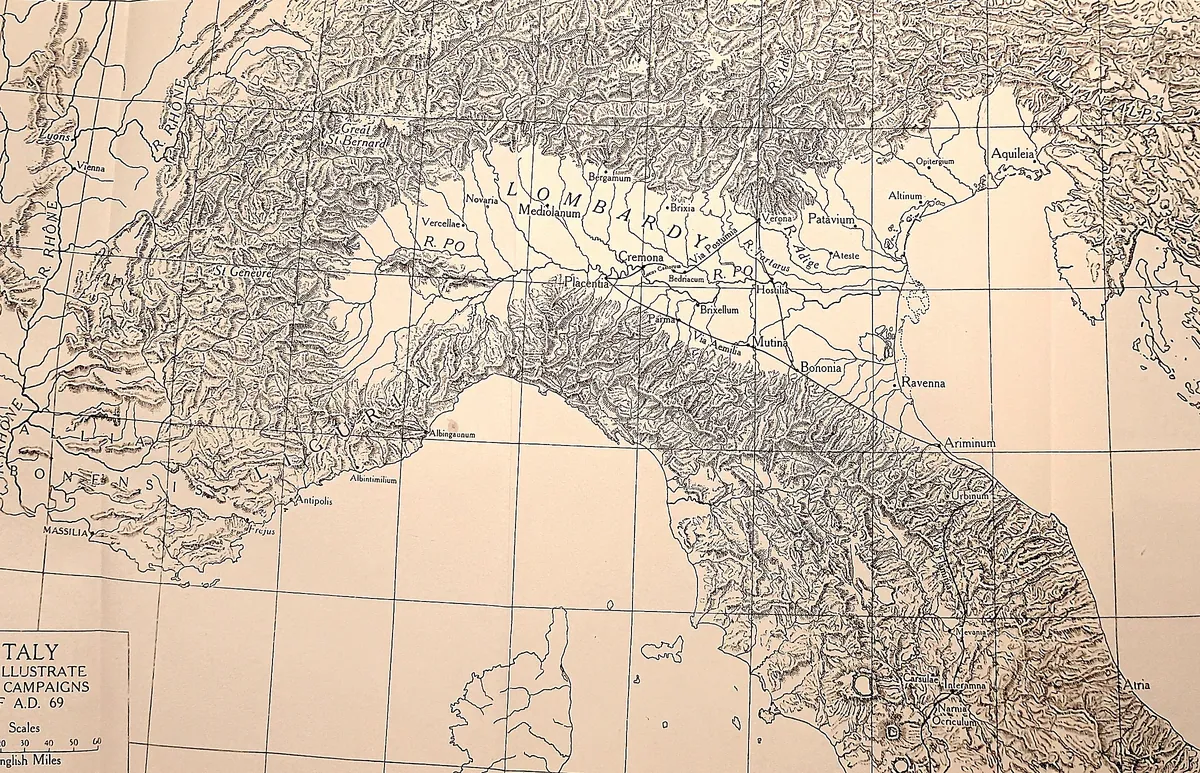
Nero's death ends the house of Augustus. Galba, Otho and Vitellius follow in a year; the armies fight two battles near Bedriacum and sack Cremona before Vespasian, commanding in Judaea, is recognised. On the lower Rhine the Batavian Julius Civilis rises and besieges the legions at Vetera.
Province outlines: Ancient World Mapping Center, “Roman Empire c. 60 BC”, “c. AD 117 extent” and “c. AD 200 extent and provinces” (ODbL; after the Barrington Atlas). Each territory is drawn at its c. 60 BC or c. AD 200 extent from the date it came under Roman rule, so earlier inland limits are drawn too large. Thrace is divided from Asia across the straits, and Galatia from Cappadocia along a meridian; the second division is an approximation. The Roman advance to the Elbe is shown by labels only, since no border was ever settled there. Coastlines and rivers: Natural Earth. Sites: Pleiades.
The Fall of the DynastyThe Pisonian conspiracy and the secret of empire
By A.D. 65, the alienation of the traditional governing class had reached the breaking point. A vast conspiracy formed around Gaius Calpurnius Piso, uniting senators, equestrian financiers, and key officers of the Praetorian Guard, including the tribune Subrius Flavus. The conspirators planned to strike Nero down during the Circus games and proclaim Piso on the steps of the palace. But on the eve of the assassination, the conspiracy was betrayed by a freedman named Milichus, whose master, the senator Flavius Scaevinus, had ordered him to sharpen a dagger and prepare bandages.
Nero and Tigellinus unleashed a reign of terror that decimated the Roman intellectual and political elite. Seneca, his brilliant nephew the epic poet Lucan, the author of the *Satyricon* Petronius Arbiter, and dozens of consulars were ordered to open their veins. In A.D. 66, the purge extended to the “Stoic Opposition”—senators like Thrasea Paetus and Borea Soranus, whose unbending republican virtue and refusal to attend sycophantic senate debates were interpreted as treason. Even the loyal Corbulo, summoned to Greece while Nero toured the games, was greeted with an execution order and fell upon his sword at Cenchreae, crying out: “Well deserved!”
Estranged from the army and terrified of Rome, Nero crossed the Adriatic in A.D. 66 to embark on an eighteen-month artistic tour of Greece. He competed in all four Panhellenic games (Olympian, Pythian, Nemean, and Isthmian), compelling the judges to award him over eighteen hundred crowns for chariot racing and musical performances. In return, at the Isthmian Games in Corinth in November A.D. 67, Nero stood before the assembled crowds and proclaimed the total freedom and tax exemption of the province of Achaea. The financial exhaustion of the empire was catastrophic: provinces were bled dry, temples were plundered of their golden offerings, and the silver content of the imperial denarius was deliberately debased from 98% to 93%—the first step in a centuries-long monetary inflation.
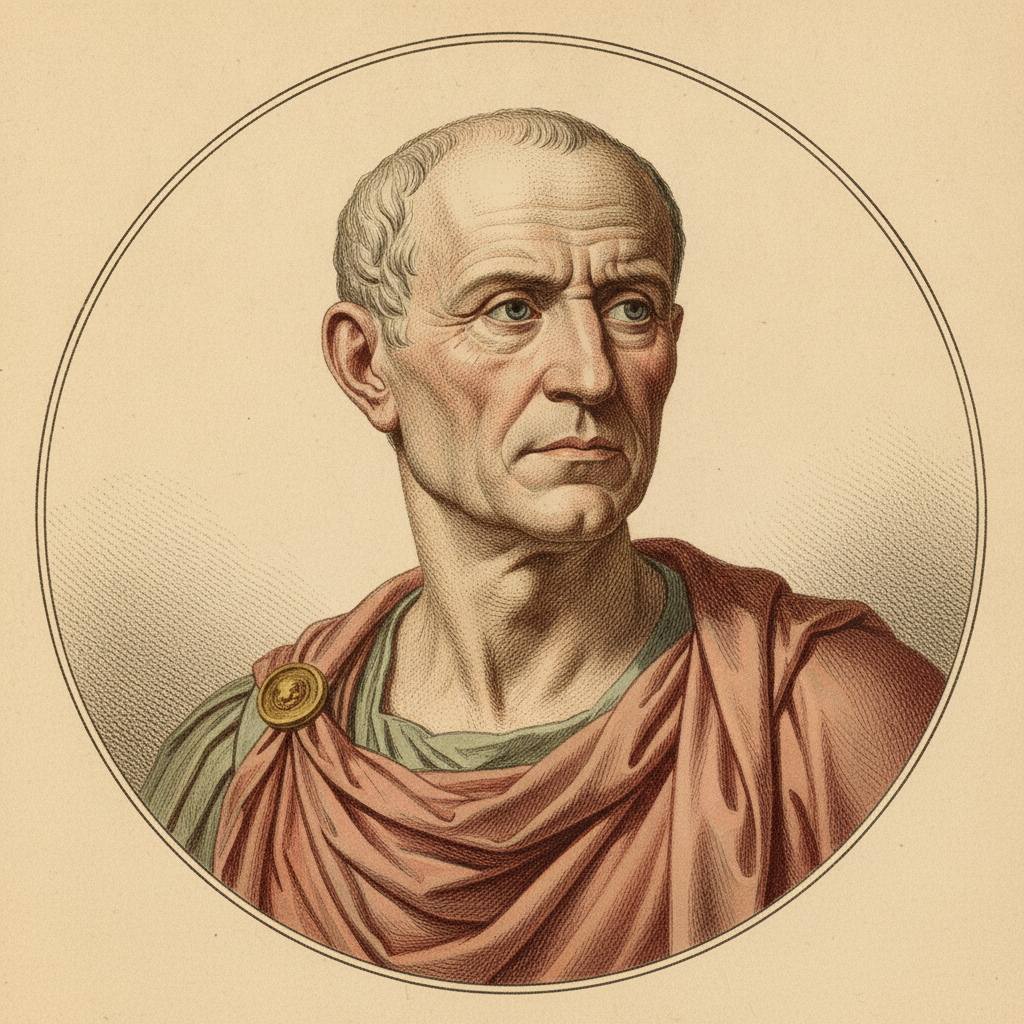
In March A.D. 68, the revolt erupted in the provinces. Gaius Julius Vindex, the Romanized Gallic governor of Gallia Lugdunensis, raised an insurrection of one hundred thousand men against Nero’s extortionate rule, offering the leadership of the movement to the venerable seventy-two-year-old governor of Hispania Tarraconensis, Servius Sulpicius Galba. Although the Rhine legions under Lucius Verginius Rufus marched south and shattered Vindex’s untrained army at Vesontio (Besançon), Galba refused to disband his troops and declared himself the legate of the Senate and Roman People.
 Click to enlarge
When news reached Rome that the Spanish legions were marching and that the Rhine armies were refusing to take the oath of loyalty to Nero, the emperor collapsed in panic. In June A.D. 68, the Praetorian prefect Nymphidius Sabinus, promised thirty thousand sesterces per man by Galba’s agents, ordered the Guard to abandon the palace. The Senate, seeing that Nero was deserted, formally proclaimed Galba emperor and declared Nero a public enemy (*hostis publicus*), to be stripped naked, secured by the neck in a wooden fork, and flogged to death with rods.
Weeping at every thing that was done, and frequently saying, “What an artist is now about to perish!” — Death of Nero · Suetonius, Life of Nero 49 (trans. Thomson)
Disguised in a faded cloak with four faithful freedmen, Nero fled by horse along the Via Nomentana to the suburban villa of his freedman Phaon, four miles outside the Salarian Gate. Hiding in a slave cubicle, hearing the hoofbeats of cavalry sent to arrest him, Nero placed a dagger to his throat and pressed it home with the assistance of his private secretary Epaphroditus. As a centurion rushed through the door to staunch the blood, pretending he had come to rescue him, Nero gasped his final words: “Too late! This is fidelity!”
For now had been divulged that secret of the empire, that emperors could be made elsewhere than at Rome. — Tacitus, Histories 1.4 (trans. Church & Brodribb)
With Nero’s suicide on June 9, A.D. 68, the House of Caesar became extinct. For ninety-nine years, the name and blood of Julius Caesar and Augustus had provided the sole accepted legitimacy for monarchical rule over the Mediterranean. Now that sacred pedigree was broken. The civil war that followed—the bloody Year of the Four Emperors (A.D. 68–69)—revealed the unvarnished reality of the Principate: that the purple belonged not to divine ancestry or senatorial decree, but to the swords of the provincial legions.
 Click to enlarge
 Click to enlarge