Part I · A city that enrolled the conquered
The settlement of 338
In 338 B.C. the Latin League, which had fought beside Rome for a century and a half and against her for two years, lay beaten, and the consul Lucius Furius Camillus put to the Senate the question that every conqueror faces and few have answered well. Livy, writing three centuries later and composing the speech himself, makes him offer the choice plainly: destroy Latium and make a desert of it, or follow the ancestors and enlarge the state by taking the beaten inside it.
“Do you wish, according to the example of your ancestors, to augment the Roman state by admitting the vanquished among your citizens? Materials for extending your power by the highest glory are at hand. That government is certainly by far the most secure, which the subjects feel a pleasure in obeying.”
Livy, History of Rome 8.13 — trans. D. Spillan (Bohn, 1853; public domain)
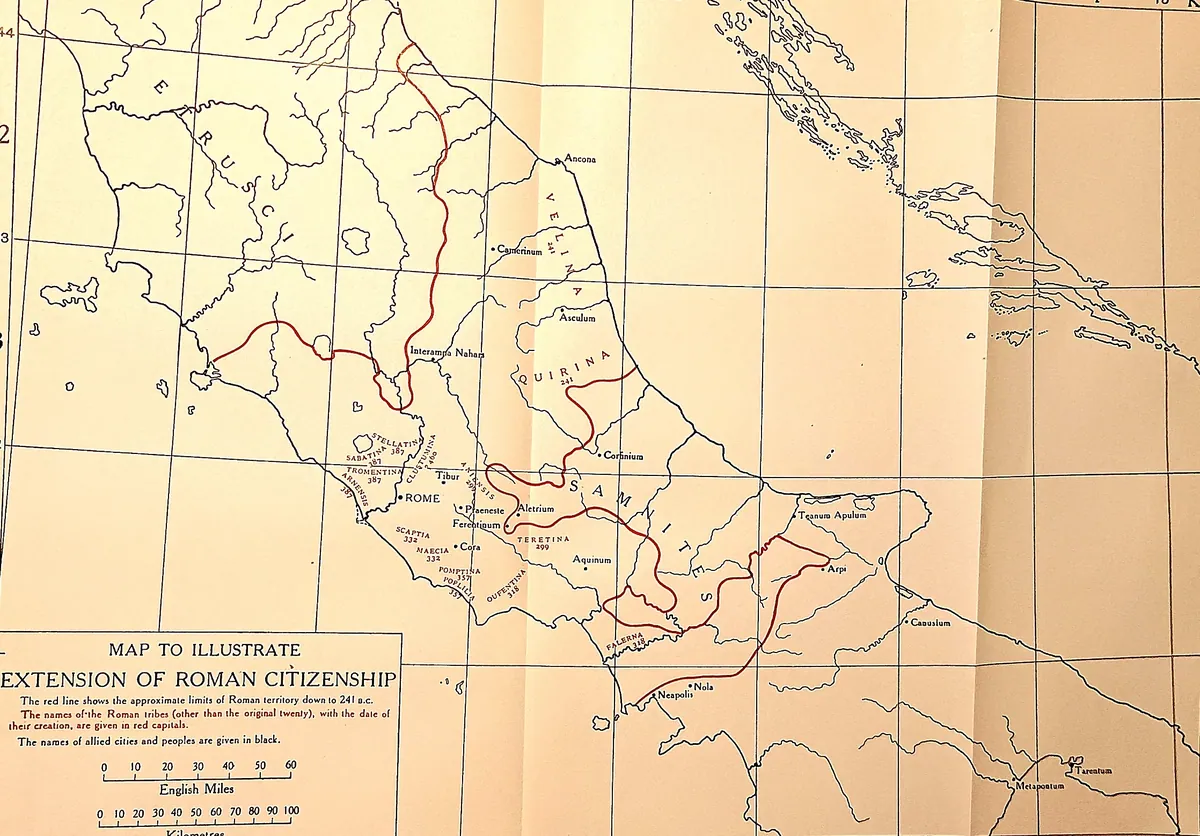
The speech is Livy's; the settlement is not, and it is the more instructive of the two. The Senate refused to treat Latium as a whole. It took each town separately and gave each a different fate. Lanuvium, Aricia, Nomentum and Pedum became Roman citizens with the vote, Lanuvium keeping its temple of Juno on condition that the goddess was now shared with Rome. Tusculum, a Roman municipality since 381, kept what it had, the blame for its revolt being laid on a few named men. Velitrae, whose people were already citizens and had rebelled repeatedly, had its walls pulled down and its senate deported across the Tiber. Antium lost its warships, whose prows went to decorate the speakers' platform in the Forum, and received a colony and the citizenship together. Tibur and Praeneste lost land and kept their treaties. The Campanians, the men of Fundi and Formiae, whose roads had stayed open, were made citizens without the vote. And for the Latin towns that remained Latin, the League was abolished as a thing with a will of its own.
“From the other Latin states they took away the privileges of intermarriage, commerce, and of holding meetings.”
Livy, History of Rome 8.14 — trans. Spillan
Each Latin town kept the right to marry, trade and litigate with Rome, and lost it with every other Latin town. The spokes remained; the rim was cut. That was the whole art of the settlement. Rome did not govern Italy; she stood at the centre of several hundred separate bargains, each made with one community and no other, each graded by what that community had done and what it could be trusted with, and each carrying, at the top, the thing the Lanuvians had just been given. A Latin who looked at Lanuvium in 337 B.C. could see what loyalty was worth.
 Click to enlarge
The ladder
Cicero, who had seen the ladder taken down and Italy enrolled wholesale, still thought the old method the ancestors' chief title to praise, and set it beside its opposite in one sentence.
“our forefathers actually admitted to full rights of citizenship the Tusculans, Aequians, Volscians, Sabines, and Hernicians, but they razed Carthage and Numantia to the ground.”
Cicero, De Officiis 1.35 — trans. Walter Miller (Loeb, 1913; public domain)
By the time the Sabines received the full vote in 268 B.C. the rungs stood as the table shows. They were not ranks of merit but ranks of trust and use, and the differences that mattered were three: whether a man voted at Rome, whether he could appeal against a Roman magistrate's rods, and how he might move up.
| Status | Who | What they had | What they owed | The step up |
|---|---|---|---|---|
| Cives | The tribes of the city and the Roman countryside; colonies of Roman citizens on the coasts; municipalities with the vote (Tusculum, Lanuvium, the Sabines from 268) | Vote, office, the right of appeal against a magistrate, marriage and contract under Roman law | The legions; the war tax until 167 B.C. | None needed |
| Cives sine suffragio | Caere; Capua and the Campanian towns until 211; Fundi, Formiae, Arpinum, the Sabines before 268 | Roman private law and the protection of appeal; their own local magistrates and laws | The legions, the war tax | The vote, by a vote of the Roman people, town by town |
| Latini | The old Latin towns (Tibur, Praeneste) and the Latin colonies, thirty of them by 209 (Cales 334, Fregellae 328, Venusia 291, Placentia 218, Aquileia 181) | Own magistrates, laws, coinage; marriage and contract with Romans; the right to move to Rome and be counted a citizen there | Contingents fixed by the formula togatorum, serving in the allied wings under Roman prefects; no tax to Rome | Migration to Rome and the census, until 187 and 177; later, a Latin magistracy |
| Socii | Everyone else bound by treaty: the Samnite peoples, the Marsi and their neighbours, the Etruscan and Umbrian cities, the Greek cities of the south (Naples, Heraclea, Tarentum) | Own laws and courts entire; their treaty; no marriage or contract at Roman law | Troops on demand, foot equal to the legions and horse three times theirs across the whole body; no tax to Rome; no appeal against a Roman magistrate | A grant by the Roman people to the whole community, or by a general to a man for valour |
Polybius, who watched the levy in the 160s B.C., gives the proportion in which the allies paid for the empire they were building.
“The whole number of the infantry of the socii generally equals that of the legions, but the cavalry is treble that of the citizens.”
Polybius, Histories 6.26 — trans. E. S. Shuckburgh (1889; public domain)
And when the Gauls came south in 225 B.C. and the Senate called for the rolls of every community in Italy, the same Polybius saw the total.
“and of the men able to bear arms, Romans and allies, over 700,000 foot and 70,000 horse; while Hannibal, when he invaded Italy, had less than twenty thousand to put against this immense force.”
Polybius, Histories 2.24 — trans. Shuckburgh
The figures are Polybius', drawn, he says, from the returns; whether every community counted honestly cannot be known. What can be known is that the Romans and Campanians together were a quarter of the total, the Latins alone eighty-five thousand, and the rest was the Italy of the treaties. Rome fought her wars with other people's sons, and the other people sent them.
Machiavelli on the second method
Machiavelli, reading Livy in exile, distinguished three ways in which a republic may grow: the league of equals, which the Etruscans, the Achaeans and the Swiss used; the direct subjection of conquered cities, which was Sparta's and Athens' method and, he thought, worthless; and Rome's.
“The second method is to provide yourself with allies or companions, taking heed, however, to retain in your own hands the chief command, the seat of government, and the titular supremacy. This was the method followed by the Romans.”
Machiavelli, Discourses on the First Decade of Titus Livius 2.4 — trans. N. H. Thomson (1883; public domain)
In the chapter before he had given the other half of the recipe: a city that means to be an empire must fill itself with men, by welcoming strangers or by transplanting the conquered, and Sparta, which kept its blood pure and its money leather, could never put more than twenty thousand into the field. Both observations are right, and the second explains why the first did not fail sooner. Rome's companions bore the cost of Rome's wars, as he says; but for a century and a half they also had before them Tusculum, Lanuvium, the Sabines, Arpinum, and the sight of their own emigrants counted as Romans at the census. A confederation whose members can join the hegemon is not a confederation at all. It is a slow enrolment, and the men in it behave accordingly.
Part II · The test: Hannibal in Italy
What Hannibal offered
Hannibal understood the system he had come to break, and struck at the joint. After the Trebia he kept his Roman prisoners on short rations and gathered the allied prisoners to hear him.
“that he had not come to fight against them, but against Rome in their behalf; and that, therefore, if they were wise, they would attach themselves to him: because he had come to restore freedom to the Italians”
Polybius, Histories 3.77 — trans. Shuckburgh
He sent them home without ransom, and repeated the gesture after Trasimene and after Cannae. It was the correct policy, and for two years it produced nothing. Not one Latin colony opened its gates; not one Etruscan city; not one of the towns of Latium; not a single community of the citizens without the vote except, at last, Capua. The allies who came over came after Cannae, when Rome had lost, on Livy's reckoning, the better part of eight legions in an afternoon, and the list Livy gives is a map of the south and of the peoples Rome had beaten last.
“The people who revolted to the Carthaginians were these: the Atellani, Calatini, the Hirpini, some of the Apulians, the Samnites, except the Pentrians, all the Bruttians, and the Lucanians.”
Livy, History of Rome 22.61 — trans. Cyrus Edmonds (Bohn; public domain)
Samnites, Lucanians, Bruttians, the Greek coast: the peoples bound to Rome by the most recent and least generous treaties, who had had two generations to feel the burden and none to see a step up. The Latins, the citizens without the vote, the old Etruscan and Umbrian allies of the centre, all of whom had watched neighbours enrolled, stayed. Capua, whose knights had held the Roman citizenship since 338 and whose nobles wanted to be the capital rather than a member, went over and was made an example of in 211. The correlation is the argument of this essay stated by Hannibal's failure. Where the ladder had been seen to work, it held; where it had not yet been climbed, it broke.
The twelve colonies
It held, but not without cost, and in 209 B.C. the cost was shown. Thirty Latin colonies had embassies in Rome that year, and twelve of them told the consuls that they had neither men nor money left to send. The consuls, Livy says, answered them not as allies but as children who had forgotten their parents.
“that they were not Campanians or Tarentines, but Romans; that from thence they derived their origin, and thence were sent out into colonies and lands captured from the enemy, for the purpose of increasing the population.”
Livy, History of Rome 27.9 — trans. Edmonds
The other eighteen, asked in turn whether their contingents were ready, answered through Marcus Sextilius of Fregellae that they were, and that more would be found if more were wanted. The Senate thanked them before the people and forbade the names of the twelve to be spoken. Livy, who names both lists, gives the verdict on which everything afterwards turned.
“By the support of these colonies the empire of the Roman people then stood”
Livy, History of Rome 27.10 — trans. Edmonds
Fregellae, which spoke for the loyal eighteen in 209, would be destroyed by a Roman praetor in 125 for asking to be made Roman. The distance between the two dates is the subject of the next part.
Part III · The door closes, 187–95 B.C.
Twelve thousand Latins sent home
The Latin's step up had always been the simplest: he moved to Rome, or to Roman land, and at the next census he was counted. In the generation after Hannibal the step was taken so often that the Latin towns, who had to find their contingents from the men who stayed, complained. In 187 B.C. the Senate heard them and acted.
“In consequence of this inquiry, twelve thousand Latins returned home; as the multitude of foreigners even then burdened the city.”
Livy, History of Rome 39.3 — trans. W. A. McDevitte (Bohn; public domain)
Ten years later the Latin envoys were back, having been turned away by two sets of consuls and censors, and this time the Samnites and Paelignians came with them to say that four thousand families had gone from their lands to Fregellae. The Latins' argument was the one the Senate could not ignore.
“their citizens, having been rated in the general survey at Rome, had most of them removed thither; and that if this practice were allowed, it would come to pass, in the course of a very few lustrums, that their deserted towns and country would be unable to furnish any soldiers.”
Livy, History of Rome 41.8 — trans. McDevitte
Livy adds the devices by which men had been getting round the one condition, that a migrant leave a son behind to keep his town's roll full.
“they made over their children as slaves to some Roman, under an agreement that they should be again set free, and thus become citizens by emancipation”
Livy, History of Rome 41.8 — trans. McDevitte
A father sold his son into a Roman's ownership so that the Roman might free him, because a freed slave was a citizen and a Latin's son was not. Nothing in the sources shows more exactly what the citizenship was worth in 177 B.C., or what Rome did about it. The Senate granted the Latin towns' petition in full: the migrants were to go home and the fictitious sales were void. The reasons were sound, since the levy depended on the towns being full, and Rome had no intention of reducing the levy. But the effect was to shut the door on the individual Latin at the very moment the number of men trying it showed how many wanted in. Rome kept the soldiers and stopped the citizens.
Half the booty, and the rods
The same decade shows the smaller signs. When the consul Gaius Claudius triumphed over the Istrians and Ligurians in 177 B.C., the donative was fifteen denarii to a citizen soldier, double to a centurion, triple to a horseman.
“The allied soldiers received less, by half, than the native troops, for which reason they followed his chariot in silence to show their disgust.”
Livy, History of Rome 41.13 — trans. McDevitte
Earlier triumphs, in Livy's own account, had paid allies and citizens alike. And in 173 the consul Lucius Postumius, sent to survey the public land in Campania, took offence at Praeneste for a slight offered him years before as a private man, and wrote ahead ordering its magistrates to meet him, lodge him at public cost and supply beasts for his baggage. Livy, who admired the old manners, is precise about what was new.
“No consul before him ever put the allies to any trouble or expense whatever.”
Livy, History of Rome 42.1 — trans. McDevitte
Magistrates had been issued mules and tents so that they need ask nothing of the towns they passed through; ambassadors had asked one horse each. Praeneste, an old Latin town with a treaty, obeyed, and its obedience, Livy says, became the precedent.
“gave to the magistrates, as if by an approved precedent, the privilege of imposing orders of this sort, which grew more burdensome daily.”
Livy, History of Rome 42.1 — trans. McDevitte
The fact behind the anecdote is that a Roman magistrate carried the rods and axes into an allied town and no ally could appeal against them. Half a century later Gaius Gracchus, arguing for a law that would have changed this, told the Roman people what the rods had lately done, and Aulus Gellius, who thought the speech too plain to be great oratory, copied it out.
“The consul lately came to Teanum Sidicinum. His wife said that she wished to bathe in the men's baths. Marcus Marius, the quaestor of Sidicinum, was instructed to send away the bathers from the baths. The wife tells her husband that the baths were not given up to her soon enough and that they were not sufficiently clean. Therefore a stake was planted in the forum and Marcus Marius, the most illustrious man of his city, was led to it. His clothing was stripped off, he was whipped with rods.”
Gaius Gracchus, On the Promulgation of Laws, in Aulus Gellius, Attic Nights 10.3 — trans. J. C. Rolfe (Loeb, 1927; public domain)
Cales, hearing of it, decreed that no one should use the public baths while a Roman magistrate was in town; at Ferentinum a praetor ordered both quaestors arrested for a like offence, and one threw himself from the wall. Gracchus went on to a young Roman, not yet a magistrate, carried in a litter through the fields of Venusia.
“A herdsman, one of the peasants of Venusia, met him, and not knowing whom they were bearing, asked in jest if they were carrying a corpse. Upon hearing this, the young man ordered that the litter be set down and that the peasant be beaten to death with the thongs by which it was fastened.”
Gaius Gracchus, in Gellius, Attic Nights 10.3 — trans. Rolfe
Teanum, Cales, Ferentinum and Venusia were all Latin or allied towns whose men had marched with Rome since the Samnite wars, and Venusia had been one of the eighteen of 209. In 108 B.C. the difference was still the law of the camp: Sallust records that Turpilius, the commandant who alone survived the massacre at Vaga, was tried by Metellus and, being a Latin and not a citizen, could be flogged before he died.
“was condemned, as a native of Latium, to be scourged and put to death.”
Sallust, Jugurthine War 69 — trans. J. S. Watson (1852; public domain)
The public land and the stone at Polla
The third grievance was land, and it is the one that turned complaint into politics. The public land of Italy, confiscated from the peoples Rome had beaten, had been occupied for a century by Roman and allied possessors alike; the Latin colonist and the Samnite noble grazed it beside the senator. Tiberius Gracchus' commission of 133 B.C. began to survey it and take back what any possessor held above the legal limit, and the allies, who had no vote in the assembly that passed the law and no standing before the commissioners who executed it, discovered that the land they had worked for generations was Roman public land after all. Appian, our only continuous account, says they went to the one Roman they trusted.
Scipio Aemilianus, who had used their contingents at Carthage and Numantia, took their case to the Senate in 129, had the commission's judicial power transferred to a consul who promptly left for Illyria, and was found dead in his bed that year; the tradition suspected murder and named no one it could prove. Two years later a roadside stone in Lucania recorded, in the first person, what a Roman magistrate of the commission's party thought he was doing. Its author is almost certainly Publius Popillius Laenas, consul of 132, the man who had presided over the prosecutions of Tiberius Gracchus' followers.
Et eidem praetor in Sicilia fugiteivos Italicorum conquaeisivei, redideique homines DCCCCXVII. Eidemque primus fecei, ut de agro poplico aratoribus cederent paastores. Forum aedisque poplicas heic fecei.
And I, the same man, as praetor in Sicily hunted down the runaway slaves of the Italians and gave back nine hundred and seventeen persons. And I was the first to make the herdsmen give way to ploughmen on the public land. I built the market-place and the public buildings here.Milestone and elogium, Polla (Forum Popilii), Lucania. CIL I² 638 = ILS 23. 132 B.C. Now in the Museo Archeologico Nazionale, Naples; a copy stands at Polla. Our rendering.
Every clause touches the allies. The runaway slaves were the Italians' slaves, returned to Italian masters; the road ran from Rhegium to Capua through Lucanian and Bruttian country; and the ploughmen who displaced the herdsmen on the public land were, in the Gracchan programme, Roman citizens settled on plots that Lucanian graziers had used. The stone is proud of all three, and the pride is not misplaced. It is also the exact grievance that Fulvius Flaccus tried to buy off.
Flaccus, Fregellae, and the law of 95
In 125 B.C. the consul Marcus Fulvius Flaccus, a member of the land commission, proposed the obvious bargain: give the allies the citizenship, and they would stop contesting the land. Appian records the proposal, the Italians' eagerness, and the Senate's answer.
“but the senators were angry at the thought of making their subjects equal citizens with themselves.”
Appian, Civil Wars 1.21 — trans. Horace White (Loeb, 1913; public domain)
The Senate sent Flaccus to fight the Ligurians beyond the Alps, and the bill died. One Latin colony did not wait. Fregellae, on the Liris, the town whose envoy had spoken for the loyal eighteen in 209, the town to which four thousand Samnite and Paelignian families had moved for the chance of a Latin's step up, rose in arms.
“Lucius Opimius, the prætor, caused the revolted Fregellans to lay down their arms, and destroyed Fregellæ.”
Livy, Periochae 60 — trans. McDevitte
Opimius, who would kill Gaius Gracchus four years later, razed it; a Roman colony, Fabrateria Nova, was planted on its land. Gaius Gracchus, as tribune in 122, tried again with a graded bill, the citizenship for the Latins and Latin rights for the rest, and the Senate answered with a rival tribune and an argument. Appian preserves the substance of the case Livius Drusus and the consul Fannius made to the Roman poor: the games, the assemblies, the grain, the land would all have to be shared. The bill failed, and its author was dead within a year. Appian, looking back from the Social War, dates the allies' awakening to this decade and names its author.
“Fulvius Flaccus in his consulship first and foremost openly excited among the Italians the desire for Roman citizenship, so as to be partners in the empire instead of subjects.”
Appian, Civil Wars 1.34 — trans. White
Rome had one more instrument, and used it. In 126 the tribune Junius Pennus carried a law expelling non-citizens from the city; in 95 the consuls Licinius Crassus and Mucius Scaevola, the two most respected lawyers of their generation, carried another, establishing a court to strip the citizenship from any ally who had assumed it without title. Cicero, who admired both men and disliked the law, drew the distinction with care.
“They, too, do wrong who would debar foreigners from enjoying the advantages of their city and would exclude them from its borders, as was done by Pennus in the time of our fathers, and in recent times by Papius.”
Cicero, De Officiis 3.47 — trans. Miller
“Still, to debar foreigners from enjoying the advantages of the city is altogether contrary to the laws of humanity.”
Cicero, De Officiis 3.47 — trans. Miller
He allows that a man who is not a citizen should not vote, and that Crassus and Scaevola were right to say so. But the law of 95 did more than say so. It set up prosecutions, and the men prosecuted were the Italian gentry who had slipped onto the rolls in the forty years since the road to the census had been closed: the very men who commanded the allied cohorts. Asconius, a century later, called that law the chief cause of the war, and Mommsen agreed with him. Within four years the men it had struck at were in arms.
Part IV · The war that made them Roman, 91–87 B.C.
Drusus and Asculum
In 91 B.C. the tribune Marcus Livius Drusus, son of the man who had outbid Gaius Gracchus, tried to carry the whole programme at once: land and colonies for the Roman poor, the courts for a Senate enlarged by three hundred knights, and the citizenship for Italy. He had, Diodorus preserves, the sworn allegiance of the Italian leaders, who had pledged themselves to him by an oath on Jupiter of the Capitol. Senate and knights hated him for different halves of the bill, and the Italians themselves feared the colonies, which would be planted on the public land they were farming. Appian says he was stabbed in the atrium of his house one evening with a shoemaker's knife. The Senate annulled his laws. The knights carried a law, the tribune Varius', to prosecute any Roman who had helped the Italians towards the citizenship.
The Italians had already exchanged hostages. At Asculum in Picenum a praetor, Servilius, who had come to threaten them, was killed at a festival with his legate and every Roman in the town. Appian gives the embassy that followed and the answer that made the war.
“They sent ambassadors to Rome to complain that although they had co-operated in all ways with the Romans in building up the empire, the latter had not been willing to admit their helpers to citizenship. The Senate answered sternly that if they repented of what they had done they could send ambassadors, otherwise not.”
Appian, Civil Wars 1.39 — trans. White
Velleius Paterculus, whose own family had commanded an Italian contingent, wrote a century and a quarter later the sentence that has stood as the verdict since.
“for they were seeking citizenship in the state whose power they were defending by their arms”
Velleius Paterculus, Roman History 2.15 — trans. F. W. Shipley (Loeb, 1924; public domain)
Italica
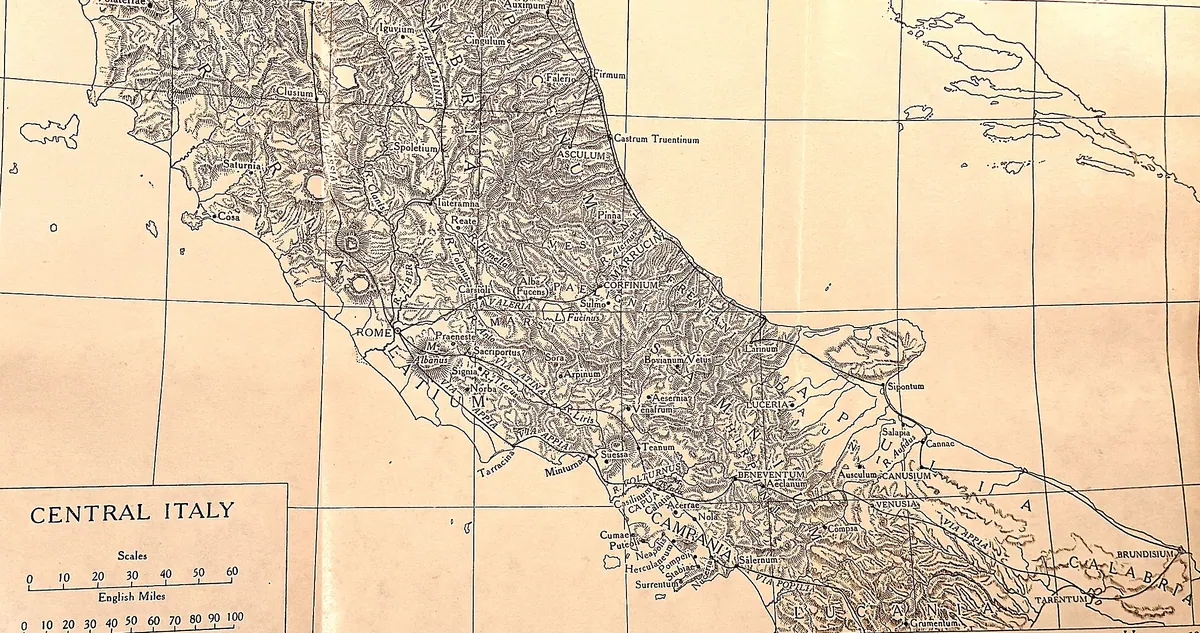
The peoples who rose were the Marsi, Paeligni, Vestini and Marrucini of the central Apennines, the Picentes, Frentani and Hirpini, the Samnites, Lucanians and Apulians: the old Italy of the treaties, and, once again, hardly a Latin colony among them. What they built is the measure of what they wanted. Strabo, who had it from the Roman annalists, describes it.
 Click to enlarge
“They decreed that Corfinium, the metropolis of the Peligni, should be the capital for all the Italians instead of Rome: made it their place d’armes, and new-named it Italica. Then, having convoked deputies from all the people friendly to their design, they created consuls and prætors, and maintained the war for two years, until they had obtained the rights for which they struggled.”
Strabo, Geography 5.4.2 — trans. H. C. Hamilton and W. Falconer (Bohn, 1854; public domain)
A senate of five hundred, two consuls, twelve praetors, and a silver coinage with the legend ITALIA and, on the Oscan issues, VITELIU: the rebels' state was Rome copied to the last magistracy. Men who wished to be free of Rome would have built something else. These men had wanted to be Romans, had been refused, and made a Rome of their own to fight for admission to the first. Appian puts their common army at a hundred thousand and the Roman at as many, and the campaigns of 90 B.C. went badly for Rome: the consul Rutilius Lupus killed on the Tolenus, his legate Caepio killed by a ruse, Pompeius Strabo driven into Firmum, the Samnites under Papius Mutilus taking Nola and the towns of Campania. Marius, old and cautious, held the Marsic front; Sulla, as legate, began the career that would end at the Colline Gate.
The Julian and Papirian laws
Rome won the war, and Appian tells how. In the autumn of 90 B.C., with Etruria and Umbria stirring behind her and freedmen being enrolled for the coast, the Senate conceded the point in arms.
The consul Lucius Julius Caesar carried a law giving the citizenship to every allied community that had not revolted or had laid down its arms. Cicero, arguing a citizenship case thirty-four years later, remembered a detail that shows what the old treaties had been worth to those who held the best of them.
“even by the Julian law itself, by which the rights of citizenship were given to the allies and to the Latins, it was decreed that those people who did not ratify the law should not have the freedom of the city, which circumstance gave rise to a great contention among the people of Heraclea, and among the people of Neapolis, as a great part of the population in those states preferred the liberty which they enjoyed by virtue of their treaty with us to the rights of citizenship.”
Cicero, Pro Balbo 21 — trans. C. D. Yonge (1856; public domain)
The two Greek cities with the most favourable treaties in Italy hesitated to trade them for the Roman franchise. Everyone else took it. In 89 a second law, the tribunes Plautius' and Papirius', extended the offer to any man enrolled in an allied city who was living in Italy and registered with a praetor within sixty days; the poet Archias, whose case Cicero later argued, came in by it as a citizen of Heraclea. The same year Pompeius Strabo, consul, gave the Latin right to the towns beyond the Po, and, on the field before Asculum, the citizenship to a troop of Spanish horsemen, an act recorded on a bronze found at Rome in 1908 that lists the thirty riders by name and the officers of his council who witnessed it. Generals had done this before. Marius, when challenged for enfranchising a thousand men of Camerinum on the field against the Cimbri, had given the answer that Plutarch preserved.
“having at one time given the freedom of the city to one thousand men of Camerinum who had behaved valiantly in this war, and this seeming to be illegally done, upon some one or other calling him to an account for it, he answered, that the law spoke too softly to be heard in such a noise of war”
Plutarch, Life of Marius 28 — trans. Dryden, rev. A. H. Clough (1859; public domain)
Cicero, defending Balbus in 56, turned the precedent into a principle, and it is the principle the Senate had refused for eighty years.
“For who could there be, O judges who would wish that the power of selecting men for distinction on account of their valour in war, in the line of battle, and in the army, should be taken from our generals; or that all hope of rewards for the energy shown in defending the republic should be taken from our allies, and from the federate states?”
Cicero, Pro Balbo 48 — trans. Yonge
Ten tribes that voted last
The concession was made, and then it was made worthless in the making. Appian is exact about the device.
“The Romans did not enroll the new citizens in the thirty-five existing tribes, lest they should outvote the old ones in the elections, but incorporated them in ten new tribes, which voted last.”
Appian, Civil Wars 1.49 — trans. White
Velleius says eight tribes; the number matters less than the arrangement, which gave several hundred thousand new citizens a vote that would be counted after the old thirty-five had already made a majority. The Samnites and Lucanians, who had not laid down their arms, got nothing. That is why the war did not end in 89. In 88 the tribune Sulpicius Rufus proposed to distribute the new citizens through all thirty-five tribes; Sulla, consul, marched his army on Rome to stop it, the first Roman general to do so; in 87 Cinna, consul, revived the bill, was driven from the city, raised the new citizens and the Samnites, and took Rome with Marius; and in 82 the Samnites under Pontius Telesinus, marching to save Marius' son at Praeneste, turned instead on Rome itself and were destroyed at the Colline Gate. Velleius reports Telesinus going down the ranks that day saying that the wolves who had ravaged Italian liberty would never be gone until the forest that sheltered them was cut down. The forest was Rome. Sulla killed the prisoners in the Villa Publica within earshot of the Senate, and treated the peoples that had fought him as Appian describes.
“Among most of them he placed colonies of his troops in order to hold Italy under garrisons, sequestrating their lands and houses and dividing them among his soldiers”
Appian, Civil Wars 1.100 — trans. White
Samnium never recovered; Strabo a century later found its towns become villages. But the distribution through the thirty-five tribes, which Sulpicius and Cinna had died for, stood. Sulla did not undo it, and the censors of 70 B.C., the first to complete a census after the war, registered the result. The Livian epitome had counted 394,336 citizens in 125 B.C. For 70 B.C. the transmitted figure is 900,000 in the modern editions and half that in the older Bohn text; on either reading Italy was now Rome. In 49 Caesar, as dictator, completed the last step.
“and to the Gauls living south of the Alps and beyond the Po he gave citizenship because he had once governed them.”
Cassius Dio, Roman History 41.36 — trans. Earnest Cary (Loeb, 1916; public domain)
The name the war has carried since, the Social War, is the Romans': bellum sociale, the war of the allies. Heitland, who wrote the best English account before 1950, declined it.
“I have not accepted the name ‘Social war,’ for which there is little authority.”
W. E. Heitland, The Roman Republic vol. 2 (1909; public domain)
He preferred the Italian war, as Velleius and Florus had, and he was right: the men who fought it were not allies asking better terms of alliance. They were Italians asking to be Romans, and they got it.
Part V · A nation under the constitution of a city
What the concession destroyed
The Republic's constitution had been made for a city whose citizens could walk to the Forum. Its assemblies voted in person; its magistrates were elected by men who could see them; its Senate was the assembled experience of families who had lived within a day's ride of the Capitol for three centuries. After 89 B.C. the citizen body was the free population of Italy from the Arno to the straits, and after 49 to the Alps. A man of Asculum or Venusia had the vote and could not use it, for the assembly still met at Rome and only at Rome. Cicero, who came from Arpinum and knew both sides, stated the legal principle that the new order kept and could no longer make sense of.
“According to our civil law, no one can be a citizen of two cities at the same time”
Cicero, Pro Balbo 29 — trans. Yonge
He solved it elsewhere with the doctrine of two fatherlands, the town of one's birth and the Rome of one's law. It was a lawyer's peace. The political fact was that a nation of citizens had been given a city's instruments of government, and the only instrument that could reach all of them was the one that had reached them first: the army. The Italian who could not vote at Rome could enlist under a Roman general, and the general who had a hundred thousand such men behind him did not need the assembly. Sulla had shown the method in 88; Pompey raised three legions from his father's Picene clients in 83; Caesar's legions were Cisalpine; the armies of 43 were Italian in a sense no army of the second century had been. The enfranchisement of Italy did not cause the civil wars. It supplied them, and it took from the Republic the one thing that had made a city's constitution work, which was that the men who voted and the men who fought were within reach of the same magistrates.
Machiavelli, who saw further into Rome's method than any writer between Polybius and Mommsen, drew from the second method a conclusion that is half the truth.
“For joining with herself many States throughout Italy as her companions, who in most respects lived with her on a footing of equality, while, as has been noted, always reserving to herself the seat of empire and the titular command, it came about that these States, without being aware of it, by their own efforts, and with their own blood, wrought out their own enslavement.”
Machiavelli, Discourses 2.4 — trans. Thomson
That is true of 338 to 91 B.C., and Velleius' sentence is the Italian version of it. But Machiavelli writes as if Rome had admitted strangers readily throughout, and the record shows eighty years in which she refused, and an enrolment extorted at last by three years of war. The other half of the truth is the one he did not draw: that in making Italy Roman by force, Rome subjected herself to the same instrument, and the seat of empire and the titular command he speaks of passed, within two generations, to whichever Roman the Italians were following.
Claudius on the Senate floor
The Empire understood what the Republic had learned too late, and once said so in the Senate. In A.D. 48 the emperor Claudius asked the Senate to admit the chiefs of Gallia Comata to its membership, and the speech he made was engraved on bronze at Lyon, where the second of its two surviving columns still reads.
Sane novo m[ore] et divus Aug[ustus av]onc[ulus m]eus et patruus Ti. Caesar omnem florem ubique coloniarum ac municipiorum, bo[norum scilicet virorum et locupletium, in hac curia esse voluit. Quid ergo? non Italicus senator provinciali potior est?
By a new custom, it is true, both the deified Augustus my great-uncle and my uncle Tiberius Caesar wished the whole flower of the colonies and municipalities everywhere, that is, the good men and the men of means, to be in this Senate-house. What then? Is not an Italian senator preferable to a provincial one?Bronze tablet, Lyon (Lugdunum). CIL XIII 1668 = ILS 212, col. II lines 1–5. A.D. 48. Musée gallo-romain de Lyon-Fourvière. Restorations Dessau's; our rendering.
He answers his own question: a provincial who can adorn the Senate should not be turned away either. Tacitus, who had the tablet or its archive before him, rewrote the speech and put the whole of this essay's argument into two sentences of it.
“What was the ruin of Sparta and Athens, but this, that mighty as they were in war, they spurned from them as aliens those whom they had conquered? Our founder Romulus, on the other hand, was so wise that he fought as enemies and then hailed as fellow-citizens several nations on the very same day.”
Tacitus, Annals 11.24 — trans. A. J. Church and W. J. Brodribb (1876; public domain)
It is Machiavelli's contrast fifteen centuries early, and Claudius, an antiquarian emperor, had read it in the same annalists. What neither the tablet nor Tacitus says is that the Senate Claudius was addressing was the instrument Augustus had built precisely because the Republic's assembly could not hold Italy, still less Gaul. The ladder had been rebuilt with the emperor at the top of it and no assembly at all. The provincial climbed it as the Latin had once climbed the census: by service, by wealth, by a patron's word. It worked for three centuries, which is longer than the Republic's version had worked, and it worked because there was no longer any voting body for the new men to outnumber.
What Nietzsche saw and did not see
Nietzsche described the aristocratic commonwealth as a breeding-place of one hard type, and he thought its hardness came from the enemies at its gates.
the species needs itself as species, as something which, precisely by virtue of its hardness, its uniformity, and simplicity of structure, can in general prevail and make itself permanent in constant struggle with its neighbours, or with rebellious or rebellion-threatening vassals.
Nietzsche, Beyond Good and Evil §262 — trans. Helen Zimmern (1907; public domain)
That is Sparta, and Nietzsche knew it was Sparta. Rome's peculiarity, which the sentence does not reach, is that for two centuries she turned the rebellion-threatening vassals into the species. The Sabine, the Tusculan, the Campanian knight, the Latin who moved to Rome and was counted, became the Roman who fought the next war, and the type held its hardness because it was constantly diluted with men who had just proved it. The Senate of 177 B.C. stopped the dilution and kept the levy, and got, within a century, the one thing Nietzsche's model does not predict: the vassals made themselves the species by force, and the aristocracy that had refused them was destroyed by the armies they filled.
Verdicts
- Rome held Italy by a ladder, not a yoke, and the ladder held because the top rung was seen to be climbed. The settlement of 338, treating each town on its own deserts and making citizens of some, was the model; Tusculum, Lanuvium, the Sabines and every Latin who moved to Rome and was counted at the census kept the model credible. Hannibal offered Italy its freedom for fifteen years and was joined only by the peoples who had had no time to climb.
- The door closed between 187 and 95 B.C., and it closed while the levy stayed open. The Latin's migration was stopped to keep the allied towns full for the contingents; the allies' donative was halved; the consul's rods reached the magistrates of Teanum and Ferentinum; the land commission took what allied possessors had held for a century; Fregellae was destroyed for asking; and the law of 95 prosecuted the gentry who had slipped in. No one measure was fatal. The refusal to trade any of the obligations for the one reward was, and the Italians built a copy of Rome at Corfinium to say so.
- The concession that won the war destroyed the constitution it enlarged. Italy was enrolled; the assembly that was supposed to receive it stayed in the Forum; and the only Roman institution that could reach a citizen at Venusia was a general's recruiting officer. Machiavelli saw that the allies had wrought their own enslavement by fighting Rome's wars. He did not add, and this essay does, that Rome, in enslaving Italy by force and then admitting it by force, put herself under the same masters, and that the Senate Claudius lectured on the wisdom of Romulus was what an assembly becomes when it has no assembly left.
Cato, who was of Tusculum, sat in the Senate of 177 B.C. that sent the Latins home, and there is no sign that he objected; the Latin towns were asking for it, and the levy came first. Cicero, who was of Arpinum, defended a Spaniard's citizenship in 56 on the ground that generals had always been free to reward valour, and won. Between the two municipal men lies the whole history of the allies: a Rome that made citizens of the Tusculans and would not make them of the Marsi, and a Rome that, having been made to, could find no way for the Marsi to be citizens except under arms. Livy's Camillus had said that the surest government is the one its subjects are glad to obey. For a century and a half Italy was glad. The Senate that forgot why did not lose Italy. It lost Rome.
Sources & method
Quotations are copied from public-domain translations held in sources/socii/raw/ (symlinks into the shared library plus three files added for this essay) and verified with tools/check_quotes.py: Livy books 1–8 (Spillan, Bohn), 9–26 (Edmonds, Bohn) and 27–45 with the Periochae (McDevitte, Bohn); Polybius (Shuckburgh, 1889); Appian (White, 1913); Velleius Paterculus (Shipley, 1924); Strabo (Hamilton and Falconer, 1854); Plutarch (Dryden–Clough, 1859); Sallust (Watson, 1852); Cicero, De Officiis (Miller, 1913) and Pro Balbo (Yonge, from the Perseus Digital Library's XML); Aulus Gellius (Rolfe, 1927, from LacusCurtius); Cassius Dio (Cary, 1916); Tacitus (Church and Brodribb, 1876); Machiavelli (Thomson, 1883); Nietzsche (Zimmern, 1907); Heitland (1909). The Latin of ILS 23 and ILS 212 is copied from Dessau's Inscriptiones Latinae Selectae vol. I (1892), Archive.org scan, with the OCR's glyph errors corrected as recorded in the corpus file; the renderings are ours.
- The settlement of 338: Livy 8.13–14; Tusculum's citizenship of 381, Livy 6.26; the Sabine vote of 268, Velleius 1.14 and the Periochae 15; Arpinum, Livy 10.1 (without the vote, 303) and 38.36 (the vote, 188). The status of Fundi and Formiae is given as civitas sine suffragio after Livy 8.14.10, which Spillan's version renders otherwise; the essay follows the Latin. The colonies and their dates, Velleius 1.14 and Livy at each foundation.
- The allied levy: Polybius 6.21 and 6.26; the formula togatorum is named in the lex agraria of 111 B.C. (Bruns no. 11) and is used here as the customary term. The census of 225: Polybius 2.24; Fabius Pictor is his source, and the essay gives the totals as his. The share of booty: Polybius 10.16 for the rule, Livy 41.13 for the exception of 177.
- Hannibal's policy: Polybius 3.77 and 3.85; Livy 22.58. The defections: Livy 22.61; Capua, Livy 23.2–7 and 26.16. The twelve colonies: Livy 27.9–10, with the punishment of 204 at 29.15.
- The migrations: Livy 39.3 (187), 41.8–9 (177), 42.10 (the census of 174); the ius migrandi and its condition of leaving a son are Livy's own account at 41.8. Postumius at Praeneste: Livy 42.1. Gracchus' speech: Gellius 10.3; the towns' statuses from their foundation notices. Drusus' proposal of 122 that no Latin soldier be beaten with rods: Plutarch, C. Gracchus 9. Turpilius: Sallust, Jug. 69, with Plutarch, Marius 8 for the other tradition.
- The land: Appian, BC 1.7–13, 18–19, 21; Scipio's death, Appian 1.20 and Plutarch, C. Gracchus 10. The Polla stone: CIL I² 638 = ILS 23; the attribution to P. Popillius Laenas, cos. 132, is Mommsen's and Dessau's, and rests on the consul's name being lost from the top of the stone; some have preferred T. Annius Rufus, cos. 128. Fregellae: Livy Per. 60; Cicero, De inv. 2.105; Greenidge, History of Rome 133–104 B.C., ch. 3. Gaius Gracchus' bill and Fannius' speech: Appian 1.23, Plutarch, C. Gracchus 5 and 9, the fragment of Fannius in Julius Victor. The laws of 126 and 95: Cicero, Off. 3.47, Brutus 109, Balb. 48, 54; Asconius on Pro Cornelio (the “chief cause”); Mommsen, bk. IV ch. 7.
- The war: Appian 1.34–53 throughout; Velleius 2.15–17; Diodorus 37.2 (the constitution of Italica) and 37.11 (the oath to Drusus); Strabo 5.4.2; the coinage, Sydenham's and Grueber's catalogues. Casualties and army sizes are Appian's. The Julian law: Cicero, Balb. 21, Appian 1.49, Gellius 4.4; the Plautian-Papirian law: Cicero, Arch. 7; the Latin right beyond the Po: Asconius on In Pisonem; the Asculum bronze, CIL I² 709 = ILS 8888 (found 1908; described, not quoted, because no clean text is in the corpus). Marius and the Camertes: Plutarch, Marius 28; Cicero, Balb. 46–48; Valerius Maximus 5.2.8.
- The tribes: Appian 1.49 (ten), Velleius 2.20 (eight); Sulpicius, Appian 1.55–56; Cinna, Appian 1.64–65; the Colline Gate and Telesinus' words, Velleius 2.27, Appian 1.93; Sulla's colonies, Appian 1.96 and 1.100. Census figures: Per. 63 (394,336) and Per. 98, where the manuscripts' DCCCC is read as 900,000 by modern editors and McDevitte's Bohn text prints 450,000; Jerome's 463,000 for 86 B.C. is not used. Caesar and the Transpadanes: Dio 41.36.
- Two fatherlands: Cicero, De legibus 2.5 (paraphrased; not in the corpus). Pompey's Picene legions, Plutarch, Pompey 6. The Lyon tablet: CIL XIII 1668 = ILS 212, col. II 1–5, with Tacitus, Ann. 11.23–25; that Tacitus worked from the speech or its record is the usual inference from the overlap and is given as such.
- Modern framing, all before 1950 per house rules: Mommsen, History of Rome bk. II ch. 7 and bk. IV ch. 7 (Dickson); Heitland, The Roman Republic vol. 2, the chapters on the Italian war; Greenidge, History of Rome 133–104 B.C. (1904) chs. 3–4 and Roman Public Life (1901) ch. 8; Ferrero, Greatness and Decline vol. 1 chs. 1–2; Tenney Frank, Roman Imperialism (1914) chs. 3 and 6.
Where this essay argues rather than reports, it says so. That the allies who joined Hannibal were those with least experience of the ladder is the essay's reading of Livy 22.61 against the settlement lists; Mommsen explained the same pattern by the greater harshness of the southern treaties, which is a different emphasis on the same evidence. That the refusal of 177 rather than the land law of 133 began the estrangement is argued from the sequence in Livy and is not the traditional starting point, which is Flaccus' bill of 125. That the enfranchisement of Italy supplied the civil-war armies rather than caused the wars follows Ferrero and Heitland against the older view that made the Italians the Republic's destroyers. The correction of Machiavelli is the essay's own; the reading of Nietzsche §262 against Rome is likewise ours, and is offered as a use of his model, not an account of his view.