The Open Door
Germania as two Romans described it — the guest who cannot be turned away, the marriage paid in oxen and a spear, the kindred that outlasts the man, and the assembly that answers with its arms.
Two Romans Looking NorthAnd what each of them could actually know
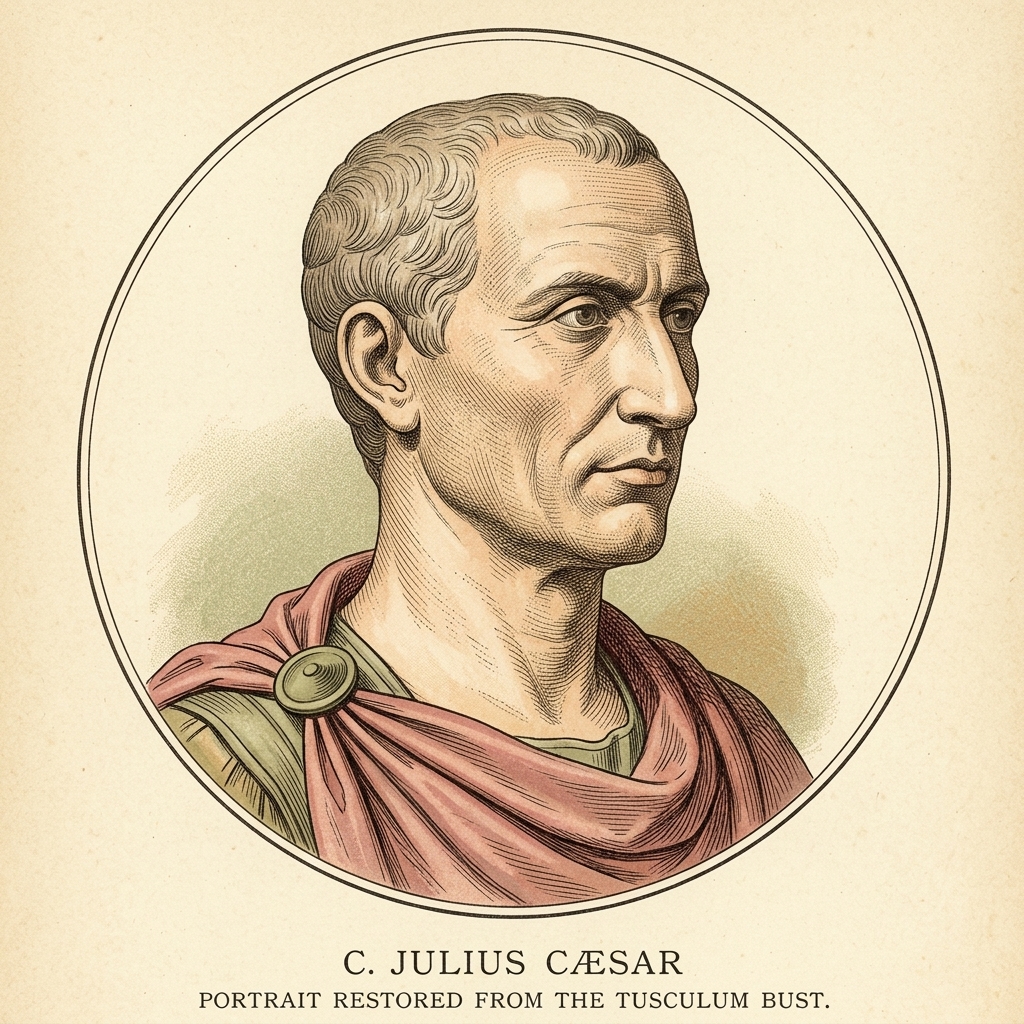
Two Latin accounts of the Germans survive from antiquity, and it matters a great deal how each was got. Caesar wrote the first. He fought Ariovistus in 58 B.C., bridged the Rhine in ten days in 55 and crossed it again in 53, and devoted a chapter of his sixth book to what he had learned. He had walked the near bank, interrogated traders and hostages, and killed a great many Germans; he had also every reason to make the river look like a natural limit of empire, since he had stopped at it.
The second is the Germania of Cornelius Tacitus, published in A.D. 98 — the first year of Trajan, who was himself on the Rhine when he was adopted. It is a short book, about thirty pages, and it is the fullest description of a non-Mediterranean European people to survive from the ancient world. Tacitus never went there. He worked from earlier writers, from the elder Pliny’s lost German Wars, from merchants, from officers, and from the reports that reached a senator in the capital. He also had a purpose. Again and again he sets a German custom against a Roman one and lets the comparison do the work: they are faithful in marriage, we are not; they lend no money at interest, we do; they have no theatre and no gladiators. Some of what follows is therefore a satire on Rome wearing German clothes, and a reader who forgets that will be misled.
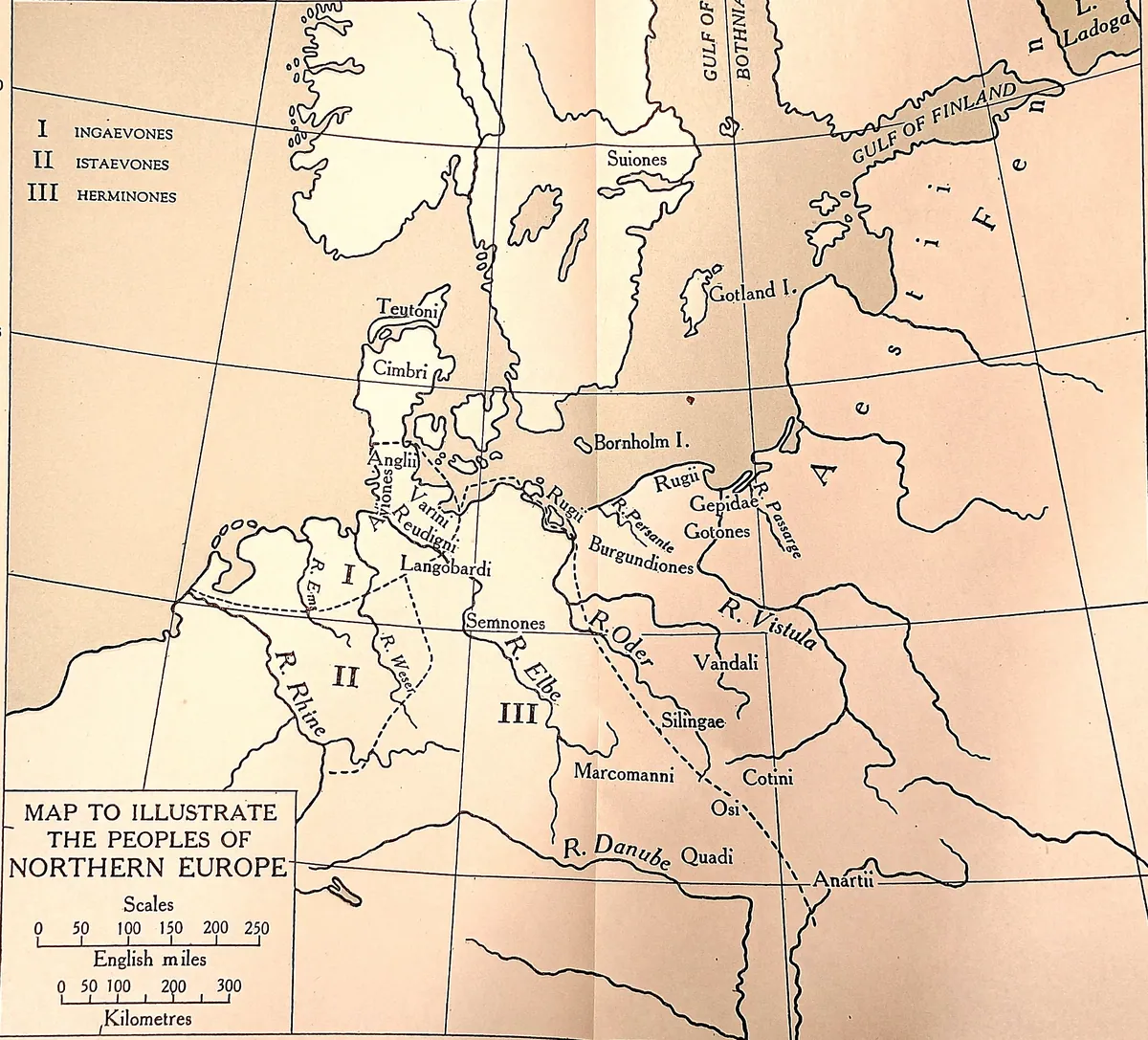
There is a third source, and Tacitus names it in his second chapter, though nothing of it survives. The Germans had ancient songs — “which are their only records or annals” — in which they traced themselves from an earth-born god, Tuisto, and his son Mannus, whose three sons gave their names to the people by the ocean, the people of the interior, and the rest. Everything Tacitus knew about them before the Roman frontier began, he knew because somebody had heard those songs sung and reported them in Latin.
But the book is not a fantasy either, and the reason to trust its detail is that the detail is so often unflattering, specific, and useless as propaganda. A people invented to shame the Romans would not be given a fondness for drinking for days without stopping, a habit of gambling away their own freedom, and a reluctance to earn by sweat what might be got with blood. Tacitus reports those too, in the same even voice. What this essay takes from him is the part that is hardest to invent: the working rules by which people without a state managed to live with one another.
 Click to enlarge
One fact frames everything else. Tacitus says the country had no silver or gold that anyone had bothered to look for, that cattle were the only wealth worth the name, and that the silver vessels given to German ambassadors were valued no more highly than earthenware. Caesar says nobody owned a fixed piece of land: the magistrates and leading men allotted ground to families by the year and moved them on the year after, and one of the stated reasons was lest the desire of wealth spring up, from which cause divisions and discords arise. Whether or not that was the real reason, the society being described has almost nothing to accumulate, nothing to inherit but kin, and therefore nothing to organise itself around except people.
The House and the KindredOxen, a horse, a shield, a spear and a sword
Roman marriage moved property from the bride’s family to the groom’s: the dowry was the point of negotiation, and the larger it was the better the match. In Germany it ran the other way, and Tacitus, who knew exactly how strange this would sound to his readers, sets out the ceremony item by item.
The wife does not bring a dowry to her husband, but receives one from him. The parents and relations assemble, and pass their approbation on the presents—presents not adapted to please a female taste, or decorate the bride; but oxen, a caparisoned steed, a shield, spear, and sword. By virtue of these, the wife is espoused; and she in her turn makes a present of some arms to her husband. Tacitus, Germania 18 — the Oxford translation, revised (Bohn, 1854; public domain)
Then he explains what the objects are for, and the explanation is the most quoted sentence in the book after the description of the war-band. The gifts are not ornaments. They are a statement of the terms of the marriage:
she is admonished by the very ceremonial of her marriage, that she comes to her husband as a partner in toils and dangers; to suffer and to dare equally with him, in peace and in war: this is indicated by the yoked oxen, the harnessed steed, the offered arms. Thus she is to live; thus to die. She receives what she is to return inviolate and honored to her children; what her daughters-in-law are to receive, and again transmit to her grandchildren. Tacitus, Germania 18 — the Oxford translation, revised (Bohn, 1854; public domain)
The arms are held in trust and passed on. A marriage is not a transfer of a woman between two families but the opening of a line, and the objects that mark it are the same objects a man is given when the assembly declares him fit to bear arms. This is a society with no documents: the shield is the record.
The children are raised in a way Tacitus reports with unconcealed approval, because it was the opposite of what wealthy Romans did. There were no wet-nurses and no separate quarters for the young master; children of the house and children of the slaves grew up together on the same ground among the same cattle, thinly dressed, until age and courage sorted them out.
In every house the children grow up, thinly and meanly clad, to that bulk of body and limb which we behold with wonder. Every mother suckles her own children, and does not deliver them into the hands of servants and nurses. No indulgence distinguishes the young master from the slave. They lie together amidst the same cattle, upon the same ground, till age separates, and valor marks out, the free-born. Tacitus, Germania 20 — the Oxford translation, revised (Bohn, 1854; public domain)
Beyond the house lay the kindred, and this is where a society without courts does its real work. A man’s own children were his heirs and no wills were made; failing children, his brothers and his uncles on both sides. Descent was reckoned on the mother’s side as well as the father’s, and the bond between a man and his sister’s son was held to be particularly strong — so much so, Tacitus says, that in taking hostages a state would ask for a man’s nephew rather than his son, as the tie that bound the widest circle of relations. Then he draws the conclusion that explains the whole system:
The more numerous are a man’s relations and kinsmen, the more comfortable is his old age; nor is it here any advantage to be childless. Tacitus, Germania 20 — the Oxford translation, revised (Bohn, 1854; public domain)
The last clause is a shaft aimed at Rome, where childlessness had become a career: a rich man with no heirs was courted by legacy-hunters all his life, and Roman literature is full of the practice. In Germany kin were the only capital there was.
They were also the only police. Feud was inherited — you took up your father’s enmities along with his friendships — but Tacitus is careful to say at once that the feuds were neither permanent nor irreconcilable, and to explain the mechanism that closed them. A killing was settled for a fixed number of cattle and sheep, paid not to an individual but to the dead man’s whole family, which then had to accept it.
and the whole family accepts the satisfaction, to the advantage of the public weal, since quarrels are most dangerous in a free state. Tacitus, Germania 21 — the Oxford translation, revised (Bohn, 1854; public domain)
That sentence contains a whole theory of government in twenty-five words. There is no magistrate to arrest a killer and no prison to put him in; the only sanction available is the injured family’s right to retaliate, and the only way to stop a retaliation running for three generations is to make acceptance of the cattle a public duty. Tacitus, who was a praetor and had prosecuted a proconsul, saw what was being done here and used the word civitas: quarrels are dangerous in a free state. The compensation-price he is describing is the institution the Germanic law codes would later write down as the wergeld, the worth of a man, tariffed by rank and by injury; it outlived the Roman empire by a thousand years.
The Open DoorThe one obligation both Romans record independently
Caesar and Tacitus agree about very little in detail. They wrote a century and a half apart, from different kinds of knowledge, with different purposes. On one point they agree completely, and it is the point this essay is named for.
No people are more addicted to social entertainments, or more liberal in the exercise of hospitality. Tacitus, Germania 21 — the Oxford translation, revised (Bohn, 1854; public domain)
To refuse anyone at all a place under your roof was reckoned a crime. And because a poor man’s stores ran out quickly, the obligation had a second stage built into it, which is the detail that shows the custom was actually practised rather than merely praised:
Every one according to his ability feasts his guest: when his provisions are exhausted, he who was late the host, is now the guide and companion to another hospitable board. They enter the next house uninvited, and are received with equal cordiality. No one makes a distinction with respect to the rights of hospitality, between a stranger and an acquaintance. The departing guest is presented with whatever he may ask for; and with the same freedom a boon is desired in return. They are pleased with presents; but think no obligation incurred either when they give or receive. Tacitus, Germania 21 — the Oxford translation, revised (Bohn, 1854; public domain)
Read the mechanism rather than the sentiment. A traveller in a country with no inns, no roads worth the name, no coinage in general use and no public authority to appeal to cannot buy shelter and cannot demand it. The only way such a country can be crossed at all is if every household is obliged to take him, and if the obligation passes from house to house until he is out the other side. The host walking his guest to the next door and going in uninvited is not politeness; it is the transport system. And the final clause — that a departing guest is given whatever he asks for, that he may be asked for something in return with the same freedom, and that neither side considers a debt to have been created — describes a circulation of goods that does the work money does elsewhere.
Caesar, writing from the other end of the period and interested in almost nothing except what would bear on a campaign, records the same rule in a single sentence at the close of his chapter on German customs:
To injure guests they regard as impious; they defend from wrong those who have come to them for any purpose whatever, and esteem them inviolable; to them the houses of all are open and maintenance is freely supplied. Caesar, Gallic War VI.23 — trans. W. A. McDevitte & W. S. Bohn (1869; public domain)
Who have come to them for any purpose whatever. Caesar means it literally, and had reason to: German states sheltered men Rome wanted, and continued to do so for four centuries. The rule takes no account of why the guest came, which is what makes it a rule rather than a courtesy.
Two sentences in the same chapter are usually left out when this passage is quoted, and they belong here. Caesar also says that robbery committed beyond a state’s own borders carried no disgrace, and was openly defended as a way of training the young and keeping them from idleness. The same society that could not turn a stranger from its door raided its neighbours as a matter of policy. Both are consistent: the obligation ran to the guest under your roof and to the kindred at your back, and it stopped there. What Germany had was not a general benevolence but an extremely strong short-range one — and no institution at all for the middle distance, which is precisely why a war-band was needed.
The Gift and the CompanionsHow a man without a treasury kept an army
A German boy was a member of a household. He became a member of the state on one particular day, in public, by receiving two objects.
Then, in the midst of the assembly, either one of the chiefs, or the father, or a relation, equips the youth with a shield and javelin. These are to them the manly gown; this is the first honor conferred on youth: before this they are considered as part of a household; afterwards, of the state. Tacitus, Germania 13 — the Oxford translation, revised (Bohn, 1854; public domain)
Tacitus translates the ceremony for his readers with the phrase toga virilis — the plain white gown a Roman boy put on at about sixteen, in the Forum, in front of his family. He is telling a Roman that this is the same institution: the moment a household surrenders a son to the community. The difference is that Rome handed over a garment and Germany handed over weapons, and the difference is the whole of what follows.
What a young man then joined was not a regiment but a following: the comitatus, the band of companions attached to a particular chief. Membership was graded by the chief’s own judgement of each man, and the competition ran in both directions — among the companions for the highest place in his favour, and among the chiefs for the largest and bravest following. A chief’s standing was measured in men, at home and abroad; he was courted by embassies and distinguished by presents, and Tacitus says a reputation of that kind could settle a war by itself.
Then comes the clause that is the centre of the book, and that every later account of Germanic society has had to start from:
In the field of battle, it is disgraceful for the chief to be surpassed in valor; it is disgraceful for the companions not to equal their chief; but it is reproach and infamy during a whole succeeding life to retreat from the field surviving him. To aid, to protect him; to place their own gallant actions to the account of his glory, is their first and most sacred engagement. The chiefs fight for victory; the companions for their chief. Tacitus, Germania 14 — the Oxford translation, revised (Bohn, 1854; public domain)
And because the bond was personal, it had to be paid for personally. There was no treasury, no tax and no coined wage. What the chief owed his companions was equipment and a table, and what he had to do to supply them was fight:
The companion requires from the liberality of his chief, the warlike steed, the bloody and conquering spear: and in place of pay, he expects to be supplied with a table, homely indeed, but plentiful. Tacitus, Germania 14 — the Oxford translation, revised (Bohn, 1854; public domain)
This is generosity as a load-bearing institution, and it should be read as economics rather than as character. A chief who stopped giving stopped having followers; a chief with no followers was nobody. The consequences run both ways, and Tacitus names both. It made the Germans formidable, because a body of men who consider it lifelong disgrace to outlive their leader will not break when a Roman line would. It also made peace intolerable: if a man’s own country was quiet too long, the young nobles simply went and attached themselves to some other state that was at war, because a large following could not be maintained without it. The war-band had to be fed, and the only thing that fed it was war.
Nor does Tacitus flatter the result. The same men who could not be broken in the line did nothing whatever between campaigns. The bravest of them handed the house, the farm and the family over to the women and the old men and lay about sleeping and eating — “so wonderful is the contrast presented by nature, that the same persons love indolence, and hate tranquillity!” Their states brought them voluntary gifts of cattle and grain, which were taken as honours and needed as supplies. And they thought it base to earn by sweat what might be bought with blood.
What They Answered WithKings by birth, generals by valour, and consent by the sound of arms
Small matters were settled by the chiefs; large ones by everybody, after the chiefs had thrashed them out first. The meeting was held at the new moon or the full, which they reckoned the lucky time to begin anything, and Tacitus adds in passing one of the most durable pieces of ethnography in the book: they counted time not in days but in nights, so that with them the night seemed to lead the day. Whoever first said fortnight was still doing it.
The assembly was slow. Since nobody was under orders to attend, two or three days were commonly lost in waiting for enough men to arrive — an inconvenience, Tacitus observes drily, produced by their liberty. When enough had come they sat down armed, the priests called silence and could enforce it, and then the king or chief spoke, along with anyone distinguished by age, birth, military reputation or eloquence. The sentence that follows is the most important in the chapter:
and gain attention rather from their ability to persuade, than their authority to command. Tacitus, Germania 11 — the Oxford translation, revised (Bohn, 1854; public domain)
And then the vote, which was not a vote:
If a proposal displease, the assembly reject it by an inarticulate murmur; if it prove agreeable, they clash their javelins; for the most honorable expression of assent among them is the sound of arms. Tacitus, Germania 11 — the Oxford translation, revised (Bohn, 1854; public domain)
It is worth pausing on what that assembly did. It heard capital charges and passed sentence. It fined lesser offenders in horses and cattle, with part of the fine going to the state and part to the injured man or his relations — the compensation principle again, now judicial. It elected the chiefs who administered justice through the districts, each with a hundred companions from the people to support him with advice and authority. It armed the young men. Rome had a senate, courts, censors and a treasury to do those things. Germany had one meeting at the full moon and a crowd with spears.
Authority was correspondingly thin at the top. Kings were chosen with regard to birth and generals with regard to valour, and the two were not the same office; and neither could give an order the way a Roman magistrate could.
Their kings have not an absolute or unlimited power; and their generals command less through the force of authority, than of example. Tacitus, Germania 7 — the Oxford translation, revised (Bohn, 1854; public domain)
Even punishment in the field was not the general’s to give: only the priests might bind or flog a man, so that a beating looked like the act of the god present with the army rather than military discipline. And the armies were not drawn up by lot or by legion but by family and clan, with the women and children of each within hearing behind the line — which Tacitus names as a principal cause of their courage, since a man fought where his mother and his wife could count his wounds afterwards.
The standing of German women is the part of the book modern readers notice most, and it should be stated exactly as Tacitus states it, because he is precise. Armies giving way had been rallied by their women, he says, and the threat of their women’s enslavement bound a German state more tightly than any other hostage. Then:
They even suppose somewhat of sanctity and prescience to be inherent in the female sex; and therefore neither despise their counsels, nor disregard their responses. We have beheld, in the reign of Vespasian, Veleda, long reverenced by many as a deity. Tacitus, Germania 8 — the Oxford translation, revised (Bohn, 1854; public domain)
Veleda was a real person and Tacitus had a file on her: a prophetess of the Bructeri who arbitrated between Germans and Romans during the revolt of Civilis in A.D. 69–70 from a tower, through intermediaries, and was eventually taken to Italy. His qualification in the next clause is equally exact — this was not servile flattery and the women were not made into goddesses. A society that conducts its politics in a crowd and its justice through families is a society in which the people who hold families together are consulted.
What Survived of ItA staff officer on the Danube, and a Frank at Aachen
The obvious objection to everything above is that Tacitus may simply have copied his predecessors and improved them for effect. There is a way to test it. If the customs were real, later observers who had no interest in the Germania’s argument should stumble across the same institutions. Two do.
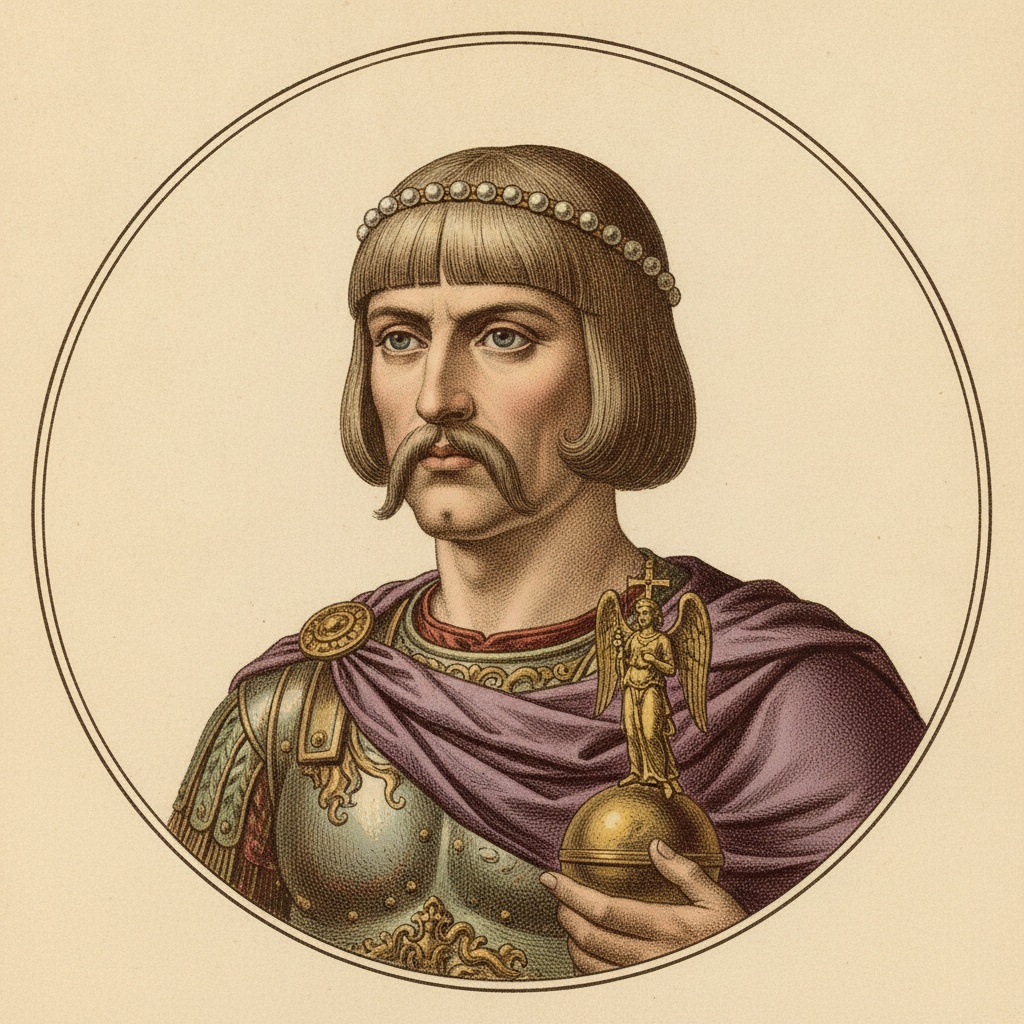
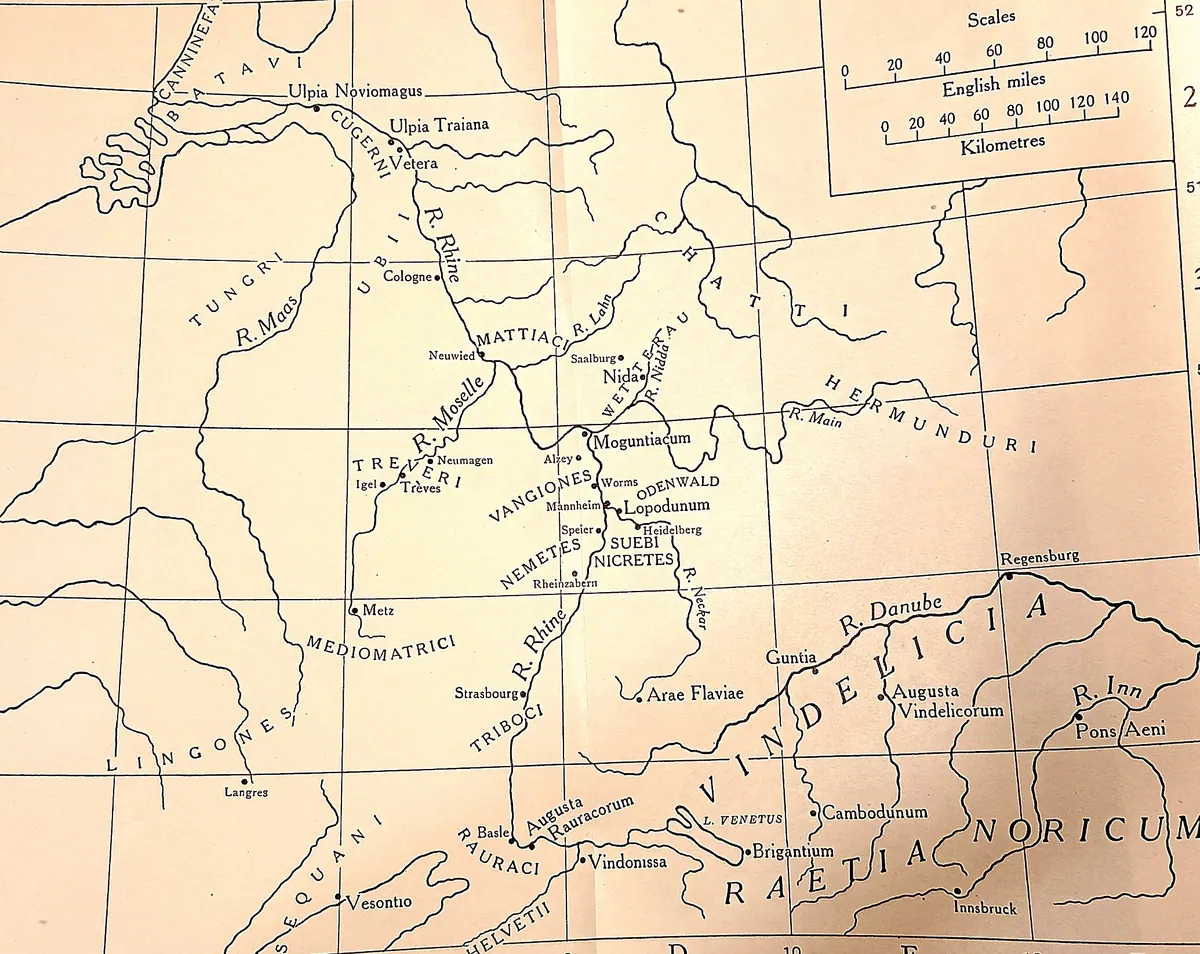
The first is Ammianus Marcellinus, a Greek-speaking staff officer who served on the Rhine and the eastern frontier and wrote his history in Rome in the 380s. Describing the Burgundians of the 370s — a people Tacitus never names in this connection — he records their constitution in two sentences, without comment:
Among them their king is called by one general name of “Hendinos,” and according to a very ancient custom of theirs, is deposed from his authority if under his government the state meets with any disaster in war; or if the earth fails to produce a good crop… The chief priest among the Burgundians is called “the Sinistus.” But he is irremovable and not exposed to any such dangers as the kings. Ammianus Marcellinus, Roman History XXVIII.5 — trans. C. D. Yonge (1862; public domain)
That is Tacitus’ two propositions, arriving independently nearly three centuries later and attached to a different people: the king’s power is not absolute and can be taken away, and the priest stands outside and above the king’s liability. Ammianus gives both offices their German names, which is the mark of a man reporting rather than composing. Whatever else the Germania is, on the structure of authority it was describing something that existed.
 Click to enlarge
The second witness is seven centuries on. Einhard was a Frank who grew up at Charlemagne’s court, served him for more than twenty years, and wrote his life in the 820s — a Latin biography, consciously modelled on Suetonius, by a man whose first language was German. What he chooses to record about his emperor keeps touching the same customs. On hospitality, Einhard is almost complaining:
He had a great love for foreigners, and took such pains to entertain them that their numbers were justly reckoned to be a burden not only to the palace but to the kingdom at large. But, with his usual loftiness of spirit, he took little note of such charges, for he found in the reputation of generosity and in the good fame that followed such actions a compensation even for grave inconveniences. Einhard, Life of Charlemagne 21 — trans. A. J. Grant (1905; public domain)
Reputation for generosity, weighed openly against cost, and found to be worth it: that is the logic of the comitatus at the head of a Christian empire. And in the chapter on Charlemagne’s learning, Einhard records three acts that belong together:
He also wrote out the barbarous and ancient songs, in which the acts of the kings and their wars were sung, and committed them to memory. He also began a grammar of his native language. Einhard, Life of Charlemagne 29 — trans. A. J. Grant (1905; public domain)
The songs are lost; his grammar is lost. The third act survives, and it answers something Tacitus had noticed. Tacitus says the Germans knew and named Winter, Spring and Summer, and were unacquainted with both the name and the bounty of Autumn. Charlemagne gave all twelve months names in his own tongue, because until then the Franks had called them partly by Latin and partly by barbarous names. Einhard lists them, and Grant renders them: Winter-month, Mud-month, Spring-month, Easter-month, Joy-month, Plough-month, Hay-month, Harvest-month, Wind-month, Vintage-month, Autumn-month, Holy-month. He named the twelve winds as well, where four, or perhaps fewer, had had names before.
Set that beside the first half of this chapter’s companion essay, in which a Roman pontifex fixed the year to the sun and had the calendar cut on walls all over Italy. Eight and a half centuries later a German king did the same work in German, and included the season his ancestors were said to have had no word for.
Why Germania MatteredAn obligation society, an honest accounting, and a warning about the book
Three Verdicts
1. What the two Romans describe is a coherent technology for living without a state, and its load-bearing member is obligation. Take away cities, coinage, written law, standing courts, a treasury and a professional army — which is what Caesar and Tacitus between them say Germany lacked — and every function those institutions perform has to be carried by a personal tie instead. The guest-right carries travel and communication. The compensation-price carries criminal justice. The kindred carries inheritance, old age and the enforcement of both. The comitatus carries the army and its pay. The assembly at the full moon carries legislation, capital trials and the appointment of judges. Read as a whole, the Germania’s famous virtues — hospitality, generosity, loyalty to the point of death, the closeness of the family — are not ornaments of character. They are the working parts.
2. The generosity was real and it was short-range, and saying so is not a qualification but the point. The obligation ran to the guest under the roof, to the kin at your back, and to the chief whose bread you ate. It did not run to the next valley. The same chapter of Caesar that records the inviolability of guests records that raiding across a border carried no disgrace and was defended as training for the young; the same chapters of Tacitus that record the marriage-gift and the nursing mothers record men drinking for days, gambling away their own liberty, and thinking it contemptible to earn by sweat what could be had by blood. A society with intense near obligations and no institutions for the middle distance will be both unusually hospitable and unusually violent, and Germany was both. This is the honest shape of the evidence, and it is more interesting than either the noble savage or the barbarian.
3. The book is an outsider’s, it had a purpose, and its later career is a warning. Tacitus never crossed the Rhine; he wrote in Latin, for senators, in a year when Rome was congratulating itself on a new emperor, and he uses German virtue as a stick to beat Roman vice with. Not a line of German survives from this period to check him against: the peoples in this essay wrote nothing down, and everything we have about them is a report by an enemy. The independent agreement of Caesar on hospitality and of Ammianus on the limits of kingship shows that the institutions were not invented, but the emphasis certainly was. That matters, because from the fifteenth century onwards, when the manuscript came out of Germany into Italy and was printed, German scholars and then German politicians read this short Roman satire as the birth certificate of a nation, and the reading eventually became something far worse than a literary mistake. The Germania is excellent evidence for how a people without a state kept faith with one another. It is not evidence for anything about their descendants.
Sources & method
Corpus. Every quotation was located with grep in sources/germania/raw/, read in context, copied verbatim and verified with tools/check_quotes.py. Texts used: Tacitus, Germania; Caesar, Gallic War VI (McDevitte & Bohn 1869); Ammianus Marcellinus (C. D. Yonge 1862); Einhard, Life of Charlemagne, in A. J. Grant’s Early Lives of Charlemagne (1905), downloaded for this essay and added to the shared library. Consulted but not quoted: Strabo VII, Tacitus’ Annals I–II and Histories IV–V (for Veleda and Civilis), Gibbon ch. 9, Mommsen.
A correction to the library. The Germania file in this project is named tacitus-germania-agricola-church-brodribb-pg7524.txt and was listed in sources/library/README.md as Church & Brodribb’s version. It is not. Gutenberg 7524 is the Oxford translation, revised, with notes (the Bohn text of 1854), with an introduction by Edward Brooks, Jr. Every quotation from the Germania on this page is attributed accordingly, and the library README has been corrected. The file name is left alone so that existing symlinks keep working — the same treatment the mis-named Livy files were given.
Passages quoted, in page order. Tacitus, Germania 18 (the marriage gifts; the partner in toils and dangers), 20 (the children; the number of a man’s kinsmen), 21 (the family accepting compensation; the liberality in hospitality; the guest passed from house to house), 13 (the shield and javelin in the assembly), 14 (the chief and his companions; the war-horse and the table), 11 (persuasion rather than command; the clashing of javelins), 7 (kings not absolute), 8 (sanctity and prescience; Veleda). Caesar, Gallic War VI.23 (guests inviolable; also, paraphrased, the raiding and the annual redistribution of land at VI.22). Ammianus XXVIII.5 (the Hendinos and the Sinistus). Einhard 21 (foreigners) and 29 (the old songs, the grammar, the months and winds).
Where this page argues rather than reports. Three things are the essay’s own. First, the functional reading of the whole set of customs as a substitute for absent institutions — ancient writers describe the customs but never say they are doing that work. Second, the use of Ammianus on the Burgundian kingship as an independent control on Tacitus: the two passages are genuinely independent, but the inference that this validates the Germania more broadly is ours. Third, the pairing of Einhard’s German month-names with Germania 26 on the missing word for autumn; Einhard does not mention Tacitus and there is no reason to think he had read him.
Deliberately not done. No attempt is made here to trace a continuous people, language or character from the first century to any later one, and no modern nation is the subject of this essay. The reception history of the Germania after 1455 is named in the third verdict in one sentence and not pursued: it belongs to the modern chapters, if anywhere, and the site’s scope ends in 1945. The Germanic law codes are mentioned once, for the wergeld, from the general fact that such tariffs were written down; none is quoted, because no text of one is in this corpus.
Length and tier. About 4,000 words of author’s prose, inside the Tier-3 range of 2,500–5,000 set by the project plan, in the five-part-plus-verdicts shape of the deep themes, and nested under Chapter XXI as an episode is.